
Should a Cash-Pay Medical Practice Use Its EMR’s Scheduling System or a Separate Booking Calendar?
The Parallel GHL + $29 Deposit Workaround
Most cash-pay medical practice owners assume the booking system that came with the EMR is the booking system patients should use. It almost never is. The clinics losing six figures in revenue every quarter to a clunky EMR scheduling flow are the same clinics that 4× their bookings the day they put a parallel GoHighLevel (GHL) calendar in front of it. Here’s the FAQ on when to keep the EMR scheduler, when to bypass it, and the exact $29-deposit parallel-calendar setup that took an IV and regenerative medicine clinic from $13K/month to $20K booked in a single day.
Why does my cash-pay medical practice keep losing booked patients between the lead and the EMR scheduling system?
Because the EMR’s scheduling flow has too many barriers for entry — and every barrier between “interested” and “booked” is a leak.
The pattern at cash-pay clinics is universal.
A patient sees an ad, lands on the website, fills out a form, gets a text, replies “yes” — and then the booking link asks them to create a profile, choose a treatment from a 40-item dropdown, fill in their insurance even though they’re a cash-pay patient, agree to a HIPAA notice, and only then pick a time.
Most patients drop somewhere in that gauntlet.
The clinic never sees them again because there’s no record of an abandoned booking — just a quiet leak.
EMR companies build their schedulers for clinic-side workflow, not for patient-side conversion.
The fields they ask for help the back office.
The fields a cash-pay patient cares about are:
- When can I come in?
- What does it cost?
- How do I lock it in?
Most EMRs have not been redesigned around modern booking expectations because they’re not in the lead-conversion business. They’re in the clinical-documentation business.
The two jobs require different products.
Should I use my EMR’s scheduling system or a separate booking calendar at a cash-pay clinic?
Use the EMR for clinical records.
Use a separate, low-friction booking calendar (GoHighLevel or equivalent) for the patient-facing booking step.
Then mirror confirmed appointments back into the EMR manually.
The mental model: the EMR is downstream.
It’s where appointments live once they’re confirmed.
It is not the place where a patient first picks a time.
A patient picks a time on a calendar with three fields — name, email, phone — and a deposit.
Then a virtual assistant or front desk staffer takes the confirmed GHL appointment and mirrors it into the EMR so the clinical workflow keeps working.
The patient gets a frictionless booking experience.
The clinic gets a clean EMR.
Both jobs get done, but neither one is forced to do the other’s work.
The clinics that resist this setup usually do so because they believe one system should do everything.
It’s an admirable goal.
It’s also why their bookings are leaking.
The clinics that grow fastest stop arguing about single-system purity and start optimizing each part of the funnel for what it actually does.
What’s the parallel GHL booking calendar setup that actually converts at a cash-pay medical practice?
Three pieces:
- A GHL calendar with weekly availability blocked
- A Stripe-integrated deposit field on the booking form
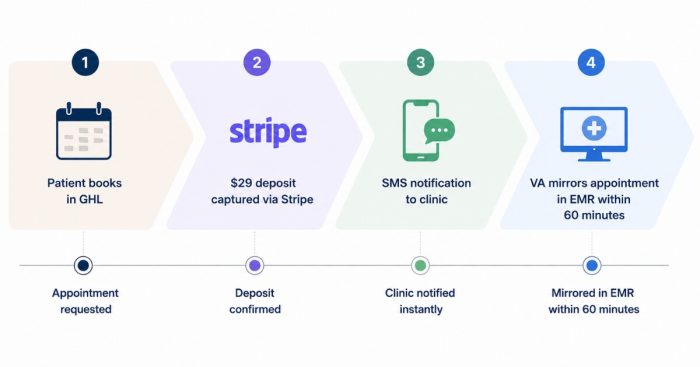
- An SMS notification that triggers a virtual assistant to mirror the appointment into the EMR within 60 minutes
The setup, step by step.
First, build a GHL calendar with the actual offer in the title — for example, “$149 IV Ozone Session” — not a generic “consultation.”
Set the meeting type to in-person, location to the clinic address, and duration to the real appointment length. Most cash-pay services need one hour.
Second, configure the available days and hours to match the clinic’s real schedule:
- Monday and Wednesday through Friday 10 to 6
- Saturday 10 to 2
- Tuesday blocked for admin work
Third, set max bookings per slot to 1 and add a one-hour buffer between appointments so a single delayed patient doesn’t cascade into the next slot.
Fourth — and this is where most clinics stop short — integrate Stripe and set a $29 deposit on the booking form.
Fifth, build the GHL workflow:
- Trigger: “customer booked appointment in calendar”
- Action: “send internal SMS notification to clinic main line”
The VA receives the SMS, opens the EMR, and mirrors the appointment.
Sixth, set up a confirmation email and a one-hour-before SMS reminder.
The whole thing takes about 90 minutes to configure and works the same day.
Why should a cash-pay medical practice charge a $29 deposit to book a first appointment?
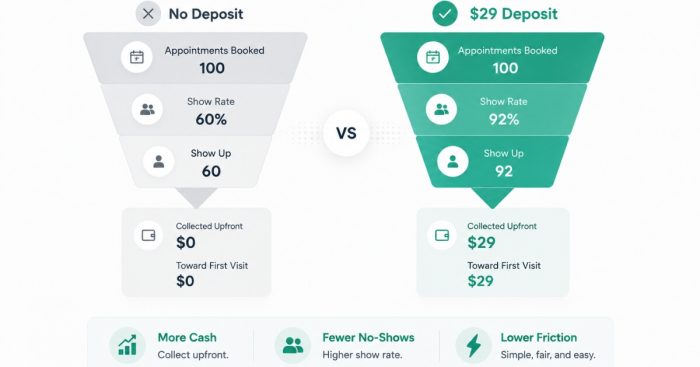
Because no-shows kill cash-pay economics, and a small refundable-toward-service deposit lifts show rates from roughly 60% to over 90% — while filtering out the patients who would never have paid for the treatment anyway.
The math is uncomfortable when you actually look at it.
A clinic with 60% show rates is paying for the chair, the staff, the lights, and the marketing for every booked patient — but only collecting revenue on six out of ten.
A $29 deposit is not a profit center.
It is a screening tool that makes patients commit a little skin.
The patients who would have ghosted now self-select out before the appointment is even on the schedule.
The patients who show pay the deposit toward their first service, so it functions as a real-money down payment, not a fee.
The deposit also accelerates the cashflow.
Most cash-pay clinics are running on tight working capital, especially during a hiring phase.
Twenty-nine dollars times a hundred booked patients a month is $2,900 in the bank before anyone walks through the door.
That cushion is small but consistent.
It pays for the GHL subscription, the Stripe fees, and the VA’s hours.
The deposit pays for the system that captures the deposit.
How do I handle the manual double-entry from GHL into the EMR without burning out my front desk?
Hire a Filipino virtual assistant on overlapping hours to mirror each GHL booking into the EMR, and run a weekly availability sync so the GHL calendar doesn’t double-book against existing EMR appointments.
The double-entry problem is real but small.
Each booking takes about 45 seconds to mirror — open the EMR, locate the patient or create a new record, schedule the appointment in the existing-patient time slot, attach the GHL note.
A VA working overlapping hours can absorb 40 to 60 bookings a week without blinking, and the cost is a fraction of what the clinic was losing on leaked appointments under the old EMR-only flow.
The bigger discipline is the weekly availability sync.
Once a week, the VA pulls the EMR’s appointment calendar and blocks those times out in GHL.
That prevents the case where a patient books a 2pm slot in GHL when the clinic already has a 2pm follow-up in the EMR.
It is not glamorous work.
It is exactly the kind of work the front desk should not be doing in real time.
An HRT clinic we helped grow from $1M to $4M in 4 years uses exactly this kind of layered VA + GHL stack to run a 250-member membership operation without the owner in the building.
What revenue lift should I expect after fixing my cash-pay clinic’s booking system?
A doubling of bookings in the first 30 days is realistic when the previous flow was an EMR scheduler with five-plus fields.
A meaningful but smaller lift when the previous flow was already low-friction.
The revenue lift is a function of how much friction the old flow had.
An IV and regenerative medicine clinic we work with went from $13,000 a month under the EMR-only booking flow to $20,500 booked in a single day after the GHL parallel calendar went live.
That kind of jump is not because GHL is magic.
It is because the EMR was eating roughly half the inbound patient demand at the booking step.
Fixing the leak revealed the demand that was already there.
The lift is smaller — but still real — at clinics whose existing scheduler is reasonable.
A 20% to 40% increase in booked appointments per inbound lead is the realistic floor when the old system already collected three or four fields without a profile-creation step.
Either way, the fix pays back in the first week.
The deposit alone covers the cost of the tooling.
The booked appointments cover everything else.
The hardest part is the conversation with the EMR vendor about why their flow is the bottleneck.
What’s the next step?
If your cash-pay medical practice is sending inbound patient demand into an EMR scheduling flow that asks them to create a profile, pick a treatment from a dropdown, and fill in insurance fields they don’t have — the booking system is leaking real revenue, and the fix takes one afternoon.
The parallel GHL calendar with a $29 Stripe deposit is the same setup that took an IV clinic from $13K a month to $20K booked in a day, and we’ve installed it at dozens of cash-pay clinics across HRT, functional medicine, regenerative pain, and longevity.
In a 60-minute strategy call we’ll audit your current booking flow, count the fields, calculate the leak, and map the exact GHL + EMR sync your team needs.