
What’s the 3 Rules of Sales Lead Nurture Script Every Cash-Pay Medical Practice Should Use to Convert Inbound Leads Into Booked Patients? (Intro → Probe → Blast → Commit → Close)
The cash-pay medical practices that book the most inbound leads are not the ones with the slickest scripts or the most aggressive closers. Instead, they are the ones whose patient coordinators understand three simple rules — and run every discovery call through the same five-step framework. Whether you’re selling a $6,500 regenerative medicine program, a $5,000 functional medicine protocol, an $899 HRT consult, or something in between, the framework remains the same. Below is the FAQ on the three rules of sales every cash-pay clinic should be running on, along with the exact Intro → Probe → Blast → Commit → Close structure that often converts 30% to 50% above industry baseline.
What Are the 3 Rules of Sales Every Cash-Pay Medical Practice Owner Should Know?
The framework starts with three rules:
- The only job you have is to help the person make the best decision for them.
- What’s best for that person is usually outside their comfort zone.
- The person on the other end will fight like hell to stay in their comfort zone.
Although these rules sound simple, they fundamentally reshape every conversation a clinic has with an inbound lead.
Rule #1: Help the Patient Make the Best Decision
First, rule one means the coordinator’s job is not to sell. Instead, it’s to uncover the patient’s problem and recommend the right solution, even if that solution is somewhere else.
Patients can feel the difference quickly.
A salesperson treats them like a transaction.
By contrast, a consultant treats them like a person.
As a result, the transactional approach books fewer patients and often burns the referral pipeline.
Rule #2: Change Requires Discomfort
Meanwhile, rule two acknowledges a reality most patients already understand.
They know staying in pain or remaining on the wrong protocol isn’t working.
However, the action required to solve the problem — showing up, paying, and committing to treatment — often feels uncomfortable.
Because of that, the coordinator’s job isn’t to make the patient comfortable.
Instead, it’s to help them move through the discomfort honestly.
Rule #3: Most Patients Need Guidance
Finally, rule three addresses the operational reality.
Most patients will not move forward on their own.
Therefore, the script becomes the mechanism that helps them cross the line.
How Should a Cash-Pay Clinic Start an Inbound Lead Nurture Call to Establish Accountability?
To begin, open with the patient’s name, identify yourself and the clinic, and then remind the patient of the exact action they took.
More specifically, reconnect them with the pain or problem they referenced when they filled out the form.
The Opening That Works
“Hello, is this [Name]?”
Pause for confirmation.
“This is [Coordinator] from [Clinic]. I understand you spent some time on our site and filled out a request for an appointment regarding your [knee pain / hormone symptoms / weight loss frustration], is that right?”
At first glance, this may seem simple.
However, both the pause and the recap matter.
After all, the patient is not a stranger.
They actively requested help.
Unfortunately, many clinic coordinators skip this step and jump directly into qualification.
As a result, the patient becomes defensive and feels cold-called, despite being the one who initiated contact.
Instead, the accountability anchor reminds the patient of their original motivation.
Consequently, the conversation becomes warmer rather than colder.
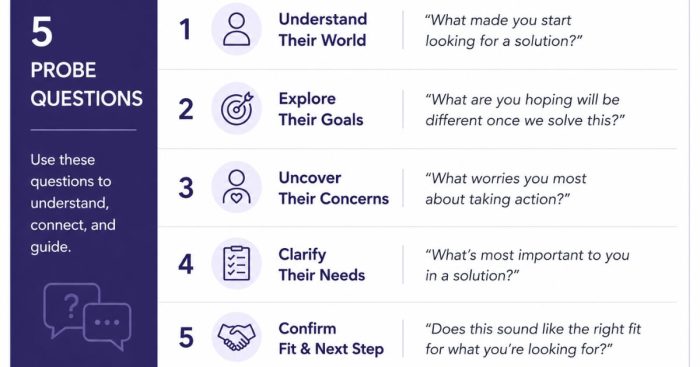
What 5 Probe Questions Should a Cash-Pay Clinic Ask Every Regenerative or Hormone Patient on the Discovery Call?
Ask the following five questions in order:
- What’s going on?
- How long has that been happening?
- What have you tried to fix it?
- Has anything worked?
- Is there a reason you’re looking to get this fixed now?
Collectively, these questions accomplish three goals.
They surface clinical context.
They build empathy.
Most importantly, they help the patient articulate why now matters.
Why the “Why Now” Question Matters
Unfortunately, this is the question most coordinators skip.
However, it’s often the most valuable one.
Specifically, it reveals the trigger that pushed the patient to seek help today.
For example, that trigger could be:
- A doctor’s appointment
- A milestone birthday
- A wedding
- A vacation
- A new diagnosis
As a result, patients who can clearly explain their “why now” tend to book at significantly higher rates.
Before moving forward, insert one empathic sentence:
“I can see why you’re frustrated.”
Bonus Questions That Improve Qualification
Additionally, ask:
- How did you hear about us?
- What can’t you do anymore?
- Has this affected your earning ability?
- Granted we were able to relieve all your pain without surgery, would investing some money out of pocket make sense for you right now?
Importantly, the final question pre-qualifies the financial discussion before pricing ever enters the conversation.
How Do You “Blast” a High-Ticket Regenerative Medicine Offer Without Scaring the Patient?
Simply put, don’t dance around the offer.
Likewise, don’t launch into a long educational presentation.
Instead, state the mechanism, differentiate it from the alternative, and stop talking.
Example Regenerative Medicine Blast Script
“We don’t need to dance around this. Instead of cutting and removing pieces like surgery does, we inject stem cells your body naturally produces, and they regrow the tissue, with very little downtime and no need for months of rehab.”
That’s it.
The mechanism is clear.
The alternative is contrasted.
Consequently, the patient now has permission to ask the financial question rather than another clinical question.
The same framework works for HRT.
Likewise, it works for functional medicine and weight loss.
Ultimately, the blast serves as the pivot point from clinical discussion to commercial discussion.
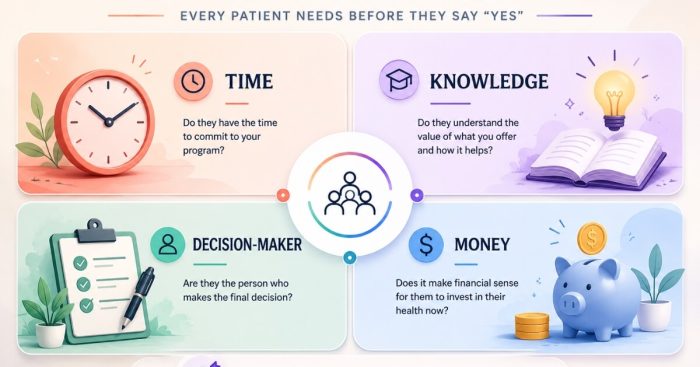
What Are the 4 Commitments a Cash-Pay Clinic Needs to Secure Before Scheduling a High-Ticket Consult?
Before scheduling, secure four commitments:
- Time commitment
- Knowledge commitment
- Decision-maker commitment
- Money commitment
Importantly, each commitment should be secured in order.
Time Commitment
“Granted we’re able to help you, you will probably need to come in two to three times over a few months — is that something you can commit to?”
If the patient says no, they are not ready.
In that case, it’s better to refer them elsewhere without damaging the relationship.
Knowledge Commitment
“Granted you knew exactly what to do to fix this, would you be doing it right now?”
The implied answer is yes.
Therefore, the clinic becomes the source of the missing knowledge.
Decision-Maker Commitment
“Do you have a partner or spouse you’d like to bring to the appointment?”
Because high-ticket purchases typically involve multiple household decision-makers, surfacing this early prevents future objections.
Money Commitment
“Most of our programs range from $1,500 to $6,500. We accept all major credit cards. Most patients use a financing option to spread the payment over six months.”
Fortunately, the number lands without surprise because the earlier qualification question already tested the patient’s comfort level.
How Should a Cash-Pay Clinic Close the Lead Nurture Call When the Patient Is on the Fence?
At this stage, reframe the alternative as the patient’s least desirable option.
Then offer the appointment as the logical next step.
Regenerative Medicine Close
“Does regrowing your joint instead of cutting it and replacing it, so you can get back to pain-free activities, sound more in alignment with what you want to do with your body than surgery?”
Naturally, very few patients answer no.
HRT Clinic Close
“Does feeling like yourself again — energy back, sleep back, libido back — sound more in alignment with how you want to live than staying on the current trajectory?”
Functional Medicine Close
“Does finally finding out what’s actually causing the symptoms — instead of treating each one individually — sound like a better path forward?”
Although each example is different, they accomplish the same objective.
They restate the patient’s desired outcome.
They contrast it with the alternative.
Finally, they move naturally into the next step.
“Great, let’s get you scheduled.”
Pause.
The patient will usually provide the time.
Why Do Cash-Pay Clinics That Follow This Exact Script Convert 30% to 50% Better Than Clinics That Wing It?
Simply put, the script removes variance.
As a result, consistency replaces guesswork.
Most cash-pay clinics rely on the natural sales ability of whoever answers the phone.
However, the clinics that outperform their competitors standardize the conversation.
Every coordinator uses:
- The same sequence
- The same probe questions
- The same blast
- The same commitments
- The same close
Consequently, conversion rates become far more predictable.
Without a script, results fluctuate dramatically.
A patient who reaches a great rep on a great day converts.
Meanwhile, a patient who reaches a tired rep on a slow day often doesn’t.
At a minimum, the script becomes the floor.
Additionally, it makes coaching possible.
Managers can review calls and quickly identify which step was missed.
A regenerative and hormone clinic we helped grow from $1M to $4M over four years runs exactly this Intro-Probe-Blast-Commit-Close script across every coordinator on the team; the consistency of the script is one of the structural reasons the clinic’s inbound lead conversion sits meaningfully above the industry baseline.
What’s the Next Step?
If your cash-pay medical practice is currently running discovery calls without a written script, there’s a strong chance your conversion rate is lower than it should be.
Likewise, a script that lacks the Intro-Probe-Blast-Commit-Close structure often leaves revenue on the table.
The script we install at clinics is the same one above, adapted to the clinic’s specific service mix, including regenerative medicine, HRT, functional medicine, longevity, and weight loss.
During a 60-minute strategy call, we’ll audit your current discovery process, identify which of the five steps your coordinators are skipping, and build the version of the script that best fits your offer.