
How Should a Cash-Pay Longevity / Functional Medicine Clinic Structure Its Discovery Call to Close a $600 Consult + Monthly Membership?
A cash-pay longevity or functional medicine clinic that runs discovery calls has a harder job than a single-treatment cash clinic. The discovery call has to do three things in 30 minutes: qualify the patient, sell a $500–$700 entry consult that includes labs, and pre-frame a $199–$499 monthly membership that starts after the consult. Get any one of those three wrong and the patient politely says “let me think about it” and never calls back. Here’s the FAQ on the discovery call structure that actually closes both the entry payment and the downstream membership.
What is a discovery call in a cash-pay longevity / functional medicine clinic and why does it work?
A discovery call is a 15–30 minute phone call between the provider (or a trained new patient coordinator) and a prospective patient, used to:
- Qualify fit
- Explain the model
- Collect payment for the entry consult
…before any clinical work is scheduled.
The reason the discovery call format works in cash-pay longevity and functional medicine is that the entry consult is itself a meaningful commitment:
- $500–$700
- Includes labs
- Takes 60–90 minutes
- Has no insurance reimbursement to soften the cost
A patient who has just submitted a website form or clicked a “request consultation” CTA isn’t ready to swipe a card for that without a human conversation first.
The discovery call fills the gap.
It also lets the provider check that the patient is a fit for the clinical model — concierge longevity care isn’t the right answer for everyone, and the discovery call gives both sides an honest chance to walk away.
We’re working with a longevity-functional medicine clinic right now (Optimize Tampa Bay) where the discovery call process has gone from:
- “Uncomfortable, low conversion”
…to:
- “Duplicatable, two booked in one afternoon”
…inside a month, just by tightening the script and the payment-collection step.
The provider listened back to one of the calls last week, recognized it sounded much more like a real consultative conversation than a sales pitch, and decided to run all discovery calls that way going forward.
A longevity / functional medicine clinic we increased website leads by 900% for in 4 months
…runs a near-identical discovery call structure — the funnel is the same regardless of clinic specialty.
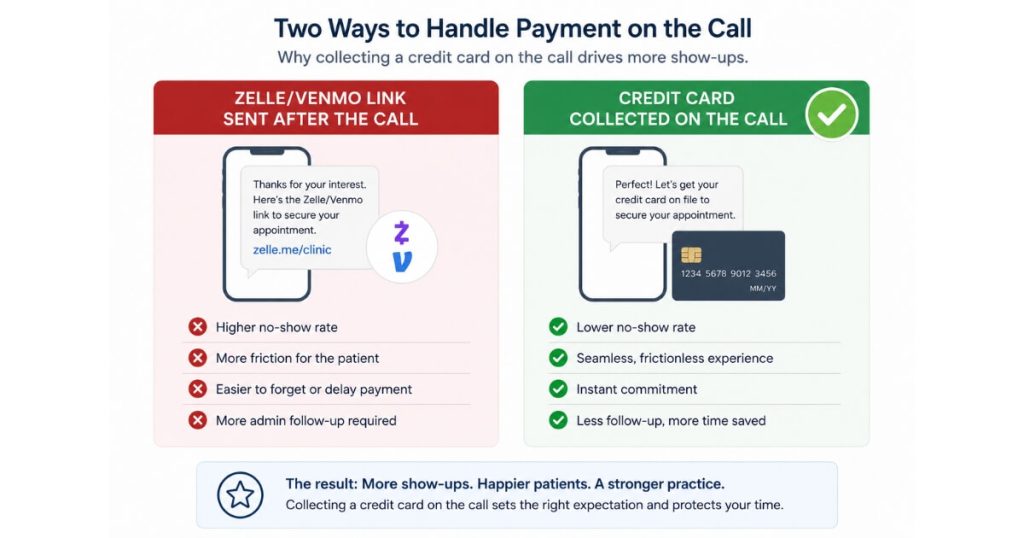
Should a cash-pay longevity clinic take payment on the discovery call, or send a Zelle / Venmo link after?
Take the credit card on the call.
Every time.
Sending a payment link after the call is the single biggest reason discovery calls don’t convert.
The pattern shows up like this:
- The call goes well
- The patient says “yes, I’d like to move forward”
- The provider books the labs appointment
Then says:
“I’ll send you a Zelle or Venmo link to avoid the 3% card fee.”
The link goes out.
The link doesn’t get paid.
The provider follows up the next day.
Still no payment.
The patient has now had 24 hours to talk themselves out of it, and the discovery call’s emotional momentum is gone.
The fix is mechanical.
At the end of the discovery call — after the patient has said yes — the provider says:
“Great, I’ll get you set up. We accept Zelle or Venmo with no fee, or we can run a card today for a 3% fee. What would you prefer?”
Most patients pick the card on the phone just to get it done.
The ones who insist on Zelle still get the card on the call as a fallback:
“If the Zelle doesn’t come through by end of day, I’ll just run the card on file — does that work?”
Either way, the payment is committed before the call ends.
A booked-labs appointment without payment is a no-show waiting to happen.
We had one this week where:
- The patient said yes
- Booked labs for the 29th
- The Zelle never arrived
The provider’s text follow-up went unanswered.
The patient was technically scheduled, but the clinic knew the appointment was at risk before it was even on the calendar.
Taking the card on the call removes that ambiguity entirely.
How should a longevity clinic frame the $600 initial consult so patients don’t feel double-charged for labs?
Frame it as:
“$600 to join the practice — that covers your comprehensive lab panel and your initial consult.”
One unified entry fee, not two stacked $300 charges.
We tested both framings on the same longevity clinic.
Saying:
- “$300 for labs”
- “$300 for the initial consult”
…sounds like two separate charges to the patient and, weirdly, often produces patients who arrive thinking they’ve already paid for labs and now have to pay again for the consult.
Their brain bundles the $300 they remember paying as:
“The cost of getting in”
…and then sees the second $300 as a surprise.
The conversion math gets worse on both ends:
- Patients are slower to commit to the upfront $600
- They push back harder downstream when they think the consult was supposed to be free
The single-line framing:
“$600 to join the practice, which includes your comprehensive lab panel and your initial consultation with the physician”
…closes both gaps.
The patient hears one decision.
They commit to the bundle.
They show up understanding what they paid for.
For clinics using the consult-credit-toward-membership play
The framing becomes:
“$600 to join the practice — that’s your labs and your initial consult — and if you commit to one of our programs after the consult, we credit the consult cost back toward your first month with us.”
That version works exceptionally well when the clinic actually has a 6- or 12-month program to commit to.
For clinics still building out their membership tiers, the simpler one-line framing is the right starting point.
How should a cash-pay longevity clinic position monthly membership pricing on the discovery call?
Don’t quote the full tier range cold.
Instead, tell the patient that after their consult the clinic will put together:
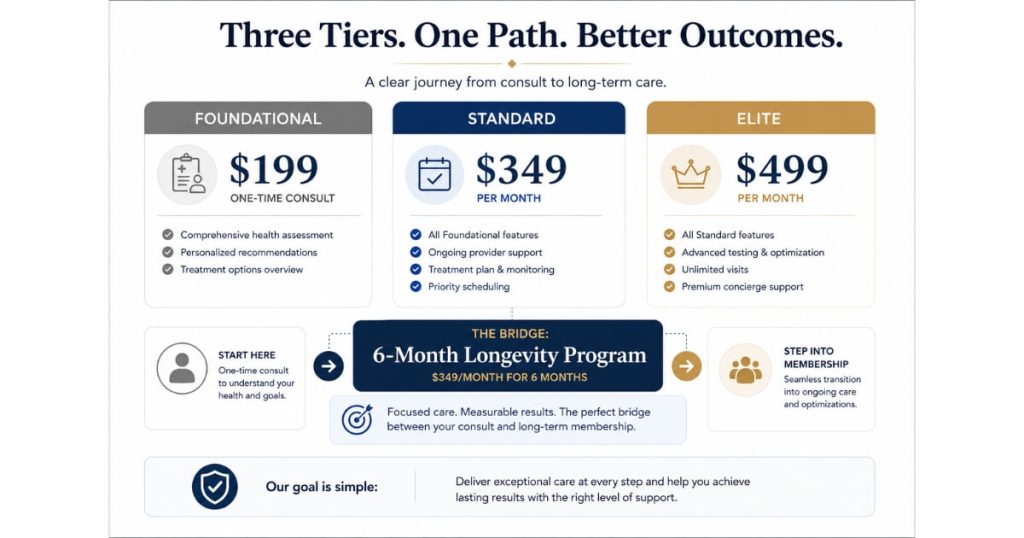
“A personalized, affordable membership program”
…tailored to them, with two options to choose from.
Patients calling a longevity or functional medicine clinic for the first time are not ready to evaluate:
- “$199”
- “$349”
- “$499 per month”
…against each other on a 30-minute phone call.
They don’t yet know:
- Which tier maps to their goals
- What’s included where
- Whether the higher tier is “worth it”
Forcing the comparison on the discovery call shifts the conversation into logical-evaluation mode at exactly the wrong moment.
The wording that works
“After your consultation, we’ll put together a personalized, affordable membership program that makes sense for you. We typically present two options, and you choose the one that fits best.”
Two specific levers in that sentence do real work.
1. “Personalized and affordable”
This reframes the membership from:
“Package I’m being upsold into”
…to:
“Plan built around me”
2. “Two options to choose from”
This lets the patient feel like the decision is theirs, not the clinic’s.
It also gives the provider room to present:
- A base tier
- A stretch tier
…where the stretch tier closes more often than people expect because the patient has now compared two options and picked one.
The monthly range itself ($199–$499 for the longevity clinic we worked on, but the principle holds across the cash-pay vertical) doesn’t need to come up on the discovery call at all unless the patient asks directly.
If they ask, the honest answer is:
“Monthly memberships typically range from $199 to $499, and we’ll show you exactly which option fits in your follow-up appointment.”
Most patients don’t push past that.
The ones who do are:
- High-intent
- Mid-funnel buyers
…who would have asked anyway — and they tend to respect the clinic for not pricing them off the phone.
Should a cash-pay clinic credit the initial consult fee toward the first month’s membership?
Yes — if the membership tier pricing supports it — and only for patients committing to a 6- or 12-month program.
Skip the credit play if the membership pricing is still being stabilized.
The credit-toward-membership move is one of the highest-converting offer structures we’ve ever tested in cash-pay longevity and functional medicine.
Discovery call framing
“$600 to join the practice — labs and initial consult — and if you commit to one of our 6- or 12-month programs after the consult, we credit the consult cost back toward your first month with us.”
The patient hears two things at once:
- The entry fee feels lower
- The program commitment feels like a logical next step
The reason to skip the credit play when membership pricing isn’t yet stabilized is that the math has to work.
Example:
If memberships are running at $199 base, crediting a $300 consult cost into a $199 first month produces a negative first-month invoice.
That sounds great until the clinic realizes it’s lost the cushion that was supposed to cover lab cost recovery.
The credit play needs membership tiers high enough that:
- The credit is meaningful
- The unit economics still work
Rule of thumb
The credit shouldn’t exceed about 60% of the base tier’s monthly price.
Examples:
- $300 credit against a $499 elite tier = clean ($199 effective first month)
- $300 credit against a $199 base tier = breaks the model
If the clinic isn’t ready to run the credit play yet, the alternative is:
“100% of the consult cost was earned because of the value of the lab review and the protocol design.”
Quiet.
No upfront discount.
Full margin retained.
That’s where most clinics should start while the membership program is being built out.
How should a longevity clinic word “follow-up care” on its website to convert discovery call no-shows?
Replace:
“Follow-up care”
…with:
“Begin your personalized protocol”
Then add 3–5 bullet points underneath that show what the patient actually gets in the months after the consult.
“Follow-up care” is one of those phrases that looks fine in isolation and dies on a website.
It’s the medical-industry default:
- Insurance clinics
- Primary care offices
- Urgent cares
…all use “follow-up care.”
It does nothing to position a cash-pay longevity clinic as different.
Worse, it implies the clinic’s main offer is the initial appointment and everything after is an afterthought.
That’s the opposite of how longevity and functional medicine deliver value.
Why “Begin your personalized protocol” works
It signals:
“The consult is the entry point, and what happens AFTER is the substance of the relationship.”
Pair the section header with 3–5 bullet points describing the next 3–6 months in concrete terms:
- Monthly clinical messaging
- Quarterly lab panel review
- Peptide or hormone protocol refinement
- IV therapy access
- Biological-age retesting at month six
Each bullet should describe a deliverable, not a category.
The HRT clinic we grew from $1M to $4M in 4 years
…rebuilt the “what comes after the first visit” section of its website around exactly this principle:
- Replace vague care language with specific protocol deliverables
- Membership conversion rate climbs noticeably
The website section also doubles as a discovery-call recovery tool.
Patients who said:
“Let me think about it”
…on the call often re-visit the site within 48 hours.
If the post-consult section is concrete and compelling, a meaningful share of those patients book labs without a second call.
What’s the next step?
If your cash-pay longevity or functional medicine clinic is running discovery calls and watching them not convert:
- Patients say yes, then ghost
- Payment links go unpaid
- Membership pricing comes up at the wrong moment
…book a strategy call.
In 60 minutes we’ll review:
- The current discovery call script
- The payment-collection step
- The membership framing
- The website’s post-consult section
…and map exactly what to change in the next 30 days.