
How Should a Cash-Pay HRT or Functional Medicine Clinic Pick Its Q4 Growth Priorities?
Brand Distribution, Patient Journey Mapping, and Provider-Led Content Come Before More Lead Gen
The clinic has steady demand, two newer providers ramping up, and capacity to grow — and the owner’s instinct is to “drive more leads.” Almost every time, that’s the wrong Q4 move. Brand distribution, patient journey mapping, and provider-led content come first. Here’s the sequencing that lifts close rate and lowers CPL at the same time.
When a cash-pay HRT, functional medicine, regenerative, or longevity clinic reaches a steady $80K–$300K/month with new providers ramping, the owner’s natural instinct is usually to ask:
“What else can we do to drive more leads?”
Almost universally, that’s the wrong Q4 priority.
Instead, the smarter move is sequencing growth correctly.
Below is the decision framework we use on quarterly strategy calls with cash-pay practices in exactly this situation — along with the order of operations that consistently produces the next leg of growth without burning ad budget into a leaky funnel.
Why should a cash-pay HRT or functional medicine clinic build the brand before pushing more lead gen?
Because brand is the multiplier on every other channel.
For example, a patient who lands on a clinic’s Instagram and sees nothing but paid-ad creatives — with zero educational content from the actual providers — books a consult with a much higher level of skepticism than a patient who has already watched two provider reels and feels like they know who they’re going to meet.
As a result:
- The first patient closes at roughly 12%
- The second closes at 30%+
The CPL math may be identical.
However, the back-end economics are completely different.
Why Brand Also Improves Ad Performance
A no-brand clinic that increases ad spend usually ends up paying premium CPLs for low-quality leads because the targeting algorithms have nothing meaningful to optimize against.
Meanwhile, a branded clinic generates:
- Cheaper leads
- Higher-intent leads
- Better retargeting pools
- Stronger engagement audiences
on the exact same platforms.
Therefore, if your provider hasn’t filmed a single piece of content this quarter, increasing ad spend is probably the wrong investment.
How much does brand strength actually move cost-per-lead — and what’s the real-world example?
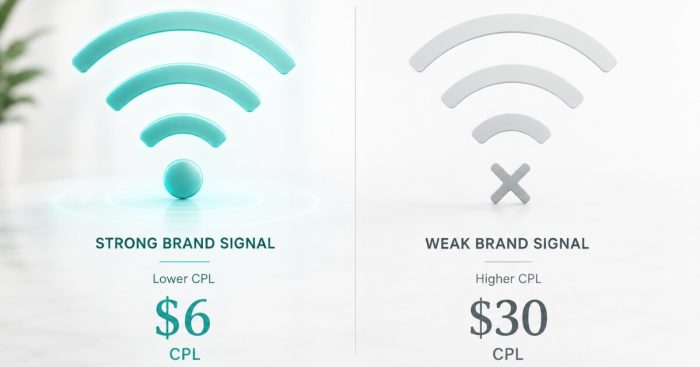
Inside our portfolio, two medspas running TikTok ads with similar offers and similar metro areas saw a dramatic spread:
- The branded clinic generated leads at roughly $6–$8 each
- The non-branded clinic generated leads at roughly $30 each
on the same platform.
That creates a 4–5× spread on raw CPL before even factoring in close rate.
Once you multiply through acquisition economics, the branded clinic’s:
cost per acquired patient
was dramatically lower.
The Same Pattern Happens in HRT and Functional Medicine
This exact pattern also appears at HRT and functional medicine clinics.
The HRT membership clinic we scaled from $1M to $4M/year gets a meaningful percentage of membership revenue from:
- Organic search
- SEO
- Existing brand equity
because the brand had already been built over time.
In that situation, paid ads simply amplify what’s already converting.
By contrast, clinics that try to skip the brand-building step and lead with paid ads usually plateau somewhere between:
$80K and $150K/month.
What does “provider-led educational content” look like for a cash-pay HRT or functional clinic?
It looks like the provider answering the exact questions patients already ask during consults.
Importantly, this does not require TV-quality production.
In fact, phone-quality content often performs better because it feels more authentic.
The fastest content engine for a cash-pay clinic is simple:
- Providers keep a running list of the top questions patients asked this week
- The provider films a 60–90 second answer daily
- A VA or junior editor captions and distributes the clips
Those clips then get posted across:
- TikTok
- YouTube Shorts
The Topics Already Exist
The content topics write themselves.
Examples include:
- “Should I do tirzepatide or semaglutide?”
- “What does optimized testosterone actually feel like at 45?”
- “Why did my last clinic miss this lab marker?”
- “What’s the difference between cypionate and enanthate?”
Patients ask these questions every single day.
Therefore, filming the answer once allows the next thousand patients to hear it before they ever book.
As a result, those patients walk into the consult already half-closed because they trust the provider’s clinical thinking.
Should the owner be on camera, or should it be a non-owner provider?
For most cash-pay clinics, a non-owner provider is the better long-term content solution.
Why?
Because the owner is usually the bottleneck for everything else in the business.
At scale, content production and business operations become difficult to balance simultaneously.
When the Owner Should Be the Face
There is one major exception:
Owner-operator clinics where the owner is intentionally becoming the brand.
This is common in:
- Concierge HRT
- Longevity clinics
- Regenerative practices
In those cases, the provider is the positioning.
Pattern Observations Across Clinics
Across dozens of clinics in our portfolio, we’ve observed:
- Female providers often outperform male providers on social platforms
- Blonde or visually distinctive providers tend to outperform less-distinctive providers
These are pattern observations — not absolute rules.
Pay Providers for Content Work
Most importantly, providers should be compensated specifically for content production.
Otherwise, burnout usually appears by month three.
To prevent that:
- Build filming hours into the provider schedule
- Reserve 3–4 hours weekly for content
- Add content bonuses if needed
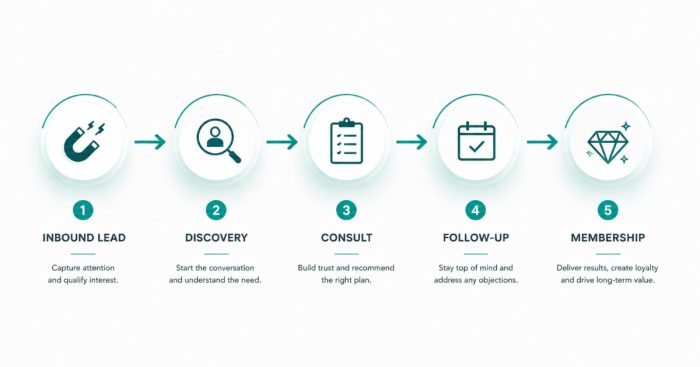
How do I map the patient journey for a cash-pay HRT or functional medicine clinic so new patients aren’t overwhelmed?
Map every touchpoint from:
The first ad click → through the third month of membership.
Then, at each touchpoint, identify:
- What the patient is feeling
- What they’re confused about
- What asset would remove the confusion
Most cash-pay clinics have a weak post-consult experience.
Typically, the patient leaves with:
- A complicated treatment plan
- No communication instructions
- No clarity around visit structure
- No understanding of supply ordering
Then the patient disappears.
The clinic blames:
“The leads.”
The Fix: Create a Structured Welcome System
Instead, every patient should leave with a printed welcome folder containing:
- Their personalized treatment plan
- A communication cheat sheet
- Visit-type explanations
- Supply-ordering instructions
- The provider’s photo and bio
For telehealth patients, deliver the same assets digitally through:
- PDF onboarding
- Loom walkthrough videos
- Follow-up email sequences
This matters especially for:
- Functional medicine
- Naturopathic-style practices
because the modality itself feels overwhelming to first-time patients.
Without support, those patients churn.
What kind of physical brand investment (swag, gifts, materials) actually moves retention at a cash-pay clinic?
The swag that improves retention is the swag patients genuinely use in public.
For example:
- High-quality water bottles
- Comfortable gym shirts
- Winter beanies
- Laser-engraved tumblers
Cheap pens and stress balls usually disappear into drawers.
What Actually Creates Word-of-Mouth
A premium water bottle used at CrossFit becomes a walking billboard for the clinic.
Similarly, a retention gift box that includes:
- A tumbler
- A collagen sample
- A printed micronutrient guide
creates a memorable patient experience.
Match the Swag to the Avatar
Different patient avatars value different things.
For example:
- Older HRT patients often prefer practical daily-use items
- Aesthetic patients care more about presentation and unboxing
- Functional medicine patients respond strongly to educational materials
Therefore, spend money on items your specific avatar will actually use.
Skip the rest.
How should I sequence Q4 priorities at a cash-pay practice with two new providers, a steady base, and capacity to grow?
A workable Q4 sequence looks like this:
Weeks 1–2
Focus on foundational systems:
- Map the patient journey
- Build the welcome folder
- Create the telehealth onboarding sequence
- Pin the quarterly strategy one-pager in the breakroom
Weeks 3–4
Next, focus on content infrastructure:
- Hire or assign a content producer
- Begin filming the non-owner provider
- Build the first batch of 16 posts
Distribute content across:
- TikTok
- YouTube Shorts
Weeks 5–8
Then expand visibility channels:
- Double GMB posting frequency
- Double SEO blog cadence for 90 days
- Launch a simple referral/affiliate program
For example:
$100 per referred patient who starts treatment.
Weeks 9–13
Only now should the clinic aggressively evaluate:
- Which channels produced bookings
- Which campaigns generated consults
- Which content created demand
Then concentrate ad spend behind the winner.
Why This Sequence Works
Importantly, this sequence pushes aggressive lead generation into the final third of the quarter.
The clinics in our portfolio that follow this structure usually see:
- Close rate improve first
- CPL drop second
- Volume scale third
because:
- Brand trust improves
- Patient journey friction decreases
- Platforms finally receive strong optimization signals
The pain management practice we added $2.095M in revenue to in 10 months followed this exact sequencing:
Brand and conversion first. Volume second.
That compounding effect showed up heavily in the back half of the engagement.