
How Should a Cash-Pay HRT Membership Clinic Design Its Cancellation Form to Surface Churn Drivers and Save Memberships?
The $20/Month Freeze Option Playbook
Most cash-pay HRT and functional medicine clinics lose 5% to 8% of their membership base every month and never learn why. The patient calls or emails, says “please cancel my membership,” gets a confirmation, and disappears into the void. No exit interview. No retention save. No data.
However, the clinics that turn that pattern around install three structural pieces: a cancellation form requirement embedded in the membership agreement, a $20-per-month freeze tier that catches the patients who would otherwise leave permanently, and a billing-stays-on-until-the-form-is-filled enforcement mechanism.
Here’s the FAQ on how to build that retention layer at a 200-to-300-member HRT clinic.
Why is my cash-pay HRT clinic losing 17 members a month even though new enrollments are healthy?
Because every cancellation that leaves without an exit interview is a structural problem you can’t see. In most cases, the membership agreement also doesn’t require that exit interview to happen.
The pattern is universal.
A 250-member cash-pay HRT clinic adds 32 new enrollments in October. Then, it loses 17 to cancellation and ends the month net +15.
On the surface, the math looks fine. The clinic is growing.
However, those 17 cancellations contain four to six patients who would have stayed if the clinic knew what was bothering them.
Instead, the clinic loses them because the cancellation flow is a one-line email:
“please cancel my membership”
No one asks the question that would have surfaced the fix.
At one HRT clinic we work with, five recent cancellation-form submissions each had “a little thing in there” — an onboarding hiccup, a records-transfer frustration, or a specific protocol question that had never been resolved.
Importantly, none of those patients were unhappy with the core service.
They left because the small things weren’t surfaced in time to fix.
What should a cash-pay HRT membership cancellation form actually ask (and what should it skip)?
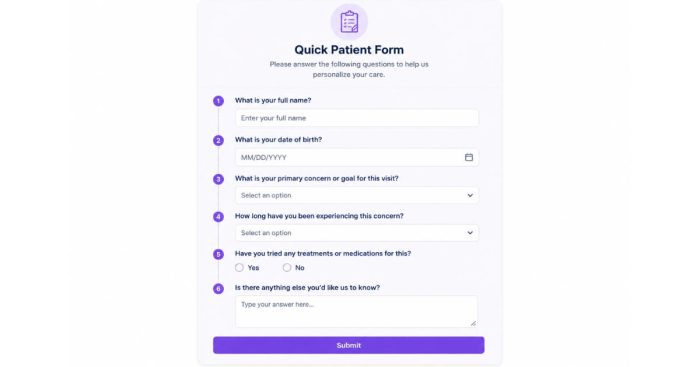
Six questions, no more.
Ask:
- What made the patient join
- What made them stay
- What made them leave
- What the clinic could have done differently
- Whether they would consider a paused-membership freeze tier
- Whether they’d be open to a follow-up call from the owner or clinical lead
Skip the demographic questions.
Also, skip the rating scales.
In addition, skip the “would you recommend us” Net Promoter Score because the patient is leaving. At that point, the answer doesn’t help you anymore.
The six questions that matter are the ones that turn a cancellation into either a save or a structural improvement to the practice.
The “what made you stay” question matters as much as the “what made you leave” question. It tells you which protocol elements are working and shouldn’t be touched when you’re tempted to redesign the offer.
Meanwhile, the “would you consider a freeze tier” question is the highest-converting retention question in the form.
Why?
Because most patients who are cancelling are not done with the clinic. They’re done with the current monthly cost or current life circumstance.
So, give them a way to stay attached at a lower price point.
How do I make patients actually fill out the cancellation form before they cancel?
Bake the form requirement into the membership agreement. Then, don’t stop billing until the form comes back.
The mechanics are simple.
First, update the membership agreement so the cancellation clause reads:
“Membership cancellation requires completion of the Membership Exit Form, which will be sent to your email upon notification of intent to cancel. Billing will continue until the form is returned.”
Patients sign this on their initial intake.
As a result, the form requirement becomes part of the original commitment, not a new ask.
Second, when a cancellation request comes in by email, phone, or GHL message, the front desk responds with a single sentence and the form link.
At that point, the patient knows what to do because they agreed to it.
Third, enforce the rule.
If the patient pushes back, the answer is:
“your billing will continue until the form is completed — this is what you signed for.”
Now the patients who would have ghosted have a reason to take three minutes and answer the questions.
As a result, the clinic gets the data.
Even better, patients who fill the form thoughtfully are far more likely to accept the freeze offer or the retention save inside the form itself.
Should a cash-pay HRT clinic offer a $20/month membership freeze instead of a full cancellation?
Yes.
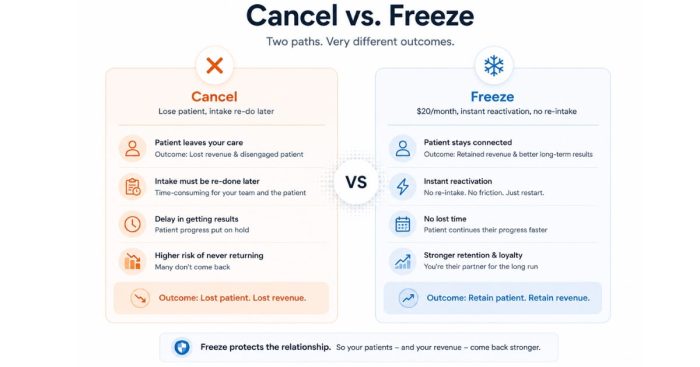
A $20-per-month freeze tier is the highest-leverage retention tool a cash-pay HRT clinic can add. The build cost is essentially zero.
The math is asymmetric.
A patient who fully cancels takes $300 to $400 a month of recurring revenue off the books. They also require a full re-intake if they ever come back.
On top of that, they disappear from the clinic’s communication universe within a quarter.
By contrast, a patient on a $20-per-month freeze stays in the system.
They still receive the same monthly newsletter. They keep their chart open and labs accessible. Also, they can reactivate in 60 seconds when life circumstances change.
That means no new consult, no $899 intake, and no records transfer.
At a 250-member clinic, even five freezes a month creates $100 in retained recurring revenue. It also creates $0 in operational cost and roughly two to three patients per quarter who reactivate into the full membership instead of leaving permanently.
The clinics that have rolled this out are seeing freeze acceptance rates of 40% to 60% on patients who would otherwise have cancelled.
At the most recent clinic we surveyed, three out of five cancellation patients accepted the freeze.
What net-new-member ratio is healthy for a cash-pay HRT membership clinic?
A 2:1 ratio of new enrollments to cancellations is the rough benchmark.
In other words, net 20 after losing 10 puts you in a healthy growth posture.
The math is built around what happens to revenue over twelve months at different ratios.
For example, a clinic adding 30 new members and losing 15 is operating at 2:1. That clinic nets 180 members a year and grows roughly 70% off a 250-member base.
That is enough velocity to support hiring a second provider and a second front-desk staffer within the year.
However, a clinic at 1.5:1 is netting closer to 60 to 80 members a year. It will hit a capacity wall before it can afford the team to break through it.
Meanwhile, a clinic at 1:1 is treading water.
The cancellation form and freeze tier are how a 30-and-17 clinic becomes a 30-and-10 clinic.
These two retention moves don’t change the marketing or the offer. Instead, they convert the patients who would have leaked silently into freezes, saves, or actionable feedback.
A cash-pay HRT membership clinic we helped scale from $1M to $4M over four years runs this exact retention layer as part of its core operating system.
In that clinic, the cancellation-driven feedback loop catches protocol issues before they become quiet exits.
When should a concierge HRT clinic hire a second front-desk person to recover unscheduled leads?
Hire when the inbound-call calendar shows more than 50 unscheduled leads from the previous month and the existing front-desk person is at or near capacity.
Usually, the hiring trigger shows up in the data before it shows up in the day-to-day.
For example, a 250-member HRT clinic in active growth had 64 leads from the previous month who had inquired and never scheduled.
They were not uninterested.
Instead, no one had time to follow up.
Adding a second front-desk staffer dedicated specifically to calling and converting that unscheduled list typically books another 10 to 15 patients a month at clinics this size.
The math is straightforward.
Ten new patients at a $400 monthly average equals $4,000 of new recurring revenue per month. That offsets a $4,000-to-$5,000-a-month hire, especially because patient lifetime values compound over years.
As a result, the hire pays for itself in the first 90 days.
The trigger isn’t:
“the front desk feels busy.”
The trigger is:
“we left more than fifty inquiries on the table last month.”
How does the cancellation-form-plus-freeze playbook compound retention at a cash-pay HRT clinic?
It compounds in three ways:
- Direct saves, where patients choose the freeze instead of cancelling
- Structural saves, where the clinic fixes protocol or operational problems from form feedback
- Reactivations, where freeze patients return to the full membership lane
The direct save shows up in the first month.
For example, five patients request cancellation. Three accept the $20 freeze offer, while two cancel anyway.
In that scenario, the clinic keeps three patients in the system instead of zero.
Structural saves take about 90 days to materialize.
For example, the form feedback may surface a records-transfer process that frustrates new patients. It may also reveal a check-in cadence that doesn’t match what engaged members expect. In some cases, it may expose a medication price point that drives departures.
Once the clinic fixes those issues, new cancellations slow because the underlying causes are gone.
Finally, reactivations create the long-tail compounding effect.
Patients who freeze for three to six months when life gets busy often come back to full membership when it doesn’t.
Each reactivation costs zero acquisition dollars and starts at full LTV.
After two years of running this system, a 250-member HRT clinic can have a reactivation pipeline of roughly 30 to 50 freezes a month.
That is a free, owned acquisition channel that didn’t exist before the cancellation form went live.
What’s the next step?
If your cash-pay HRT or functional medicine membership clinic is netting fewer than two new members for every one cancellation, the retention layer is missing.
That is especially true if you can’t tell anyone exactly why patients are leaving when they leave.
In that case, the issue is not the marketing.
The cancellation form requirement, the $20-per-month freeze tier, and the billing-stays-on-until-the-form-is-completed enforcement are the same three pieces we install at every concierge HRT and functional medicine clinic over 100 members.
In a 60-minute strategy call we’ll audit your current cancellation flow, draft the six-question form for your specific service mix, and map the membership-agreement language your team needs to make it enforceable.