
How Should a Cash-Pay Functional Medicine Clinic Structure Its 6-Month Patient Journey from Enrollment to Maintenance?
The 4-Consult + Weekly Check-In Cadence
Most cash-pay functional medicine clinics know they should have a patient journey. However, few have one that is written down, automated, and consistent across every new enrollment.
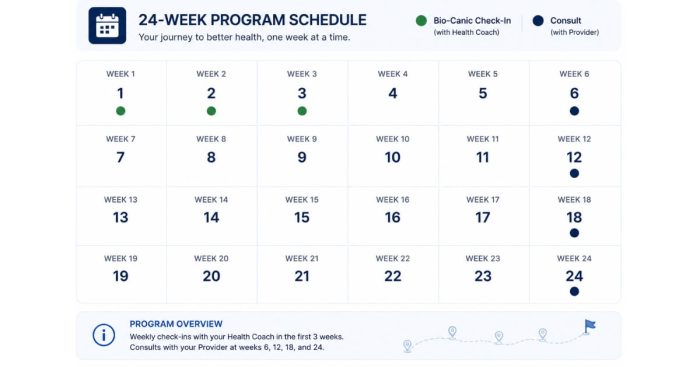
The clinics that retain functional medicine members into long-term maintenance memberships — and grow LTV from one program cycle into multiple years — follow a specific cadence. That cadence includes enrollment plus a welcome kit, three weekly check-in calls, four provider consults spaced six weeks apart across the 24-week program, lab retesting at month six, and a clean transition into a recurring maintenance tier.
Here’s the FAQ on how to build that exact patient journey.
What does the first 24 weeks of a cash-pay functional medicine patient journey actually look like?
The journey consists of six structural touchpoints.
Week 0: Enrollment
The patient:
- Pays the upfront program fee
- Receives a welcome kit
- Starts a three-month supplement protocol
- Gets access to the Bio-Canic or equivalent patient app
Weeks 1–3: Coordinator Check-Ins
The patient coordinator conducts check-in calls during:
- Week 1
- Week 2
- Week 3
Weeks 6–24: Provider Consults
The provider conducts 30-minute consults during:
- Week 6
- Week 12
- Week 18
- Week 24
Week 24 also includes the lab retest and the maintenance-transition decision.
The structure matters more than the individual moves.
Patients who know what happens next — and when it happens — stay engaged in the program. By contrast, patients who must figure everything out themselves often drop at the first friction point.
The cash-pay functional medicine clinics that retain 70% or more of patients into maintenance are not necessarily the clinics with the best protocols. Instead, they are the clinics with the clearest cadence.
Most clinics already have these touchpoints somewhere on the calendar. They simply have not connected them into a journey the patient can predict, the staff can automate, and the founder can audit.
Why do most cash-pay functional medicine programs run consults every 6 weeks instead of every 4 weeks?
Because 24 weeks divides cleanly into four six-week intervals.
More importantly, six weeks gives patients enough time to apply the previous protocol before the next conversation.
Many people miss the math.
Six months equals roughly 24 to 25 weeks.
If consults occur every four weeks, the patient needs six provider visits during that period. That sounds reasonable until you calculate the provider time involved. At that point, the program either becomes shorter or more expensive.
Most clinics solve this by scheduling four consults:
- Week 6
- Week 12
- Week 18
- Week 24
The clinical argument for six-week spacing is even stronger than the operational argument.
Functional medicine protocols such as:
- Gut repair
- Hormone balancing
- Detoxification
- Supplement adjustments
often require three to four weeks before symptoms or labs show meaningful change.
A four-week consult catches the patient mid-adjustment.
A six-week consult captures a stronger signal.
As a result:
- The patient gets a more meaningful conversation.
- The provider makes better decisions.
- The program absorbs supplement costs that might otherwise be billed separately.
What automations should run between enrollment and the first provider consult at a cash-pay functional medicine clinic?
Run three pre-consult automations and three weekly automations.
Pre-Consult Automations
Immediately after enrollment, send:
- A confirmation email with the program overview
- The Bio-Canic login information
Then, two to three weeks before the consult, send:
- A “what to watch before your first consult” video
Finally, send:
- An SMS reminder 24 hours before the consult
- An SMS reminder one hour before the consult
Weekly Automations
At the end of Week 1:
- Assign a check-in task to the patient coordinator
- Send a supplement-compliance SMS
Repeat the same process at the end of Week 2.
At the end of Week 3:
- Assign another coordinator check-in task
- Send another compliance SMS
- Deliver the consult-prep calendar invite and email
The goal is simple.
Assign the task automatically so nobody has to remember it.
The system should notify Sienna, or whoever owns coordination.
Meanwhile, the patient receives human contact every week during the early ramp-up period.
That timing matters because most functional medicine programs lose patients during the “I’m not feeling anything yet” phase.
For best results, schedule the prep video three weeks before the first consult rather than immediately after enrollment.
That timing ensures the patient remains engaged and is close enough to the appointment to actually watch the video.
How should a cash-pay functional medicine clinic structure its weekly check-in calls with new members?
Keep the calls to five minutes.
Structure each call around three questions and finish with a clear next step.
Ask:
- Are you taking the supplements on schedule?
- What has changed — good or bad — since we last talked?
- What do you need from us before your next consult?
The purpose of the call is not clinical.
Instead, the purpose is operational.
The patient coordinator is not adjusting protocols. That remains the provider’s responsibility.
Instead, the coordinator:
- Verifies compliance
- Surfaces issues before Consult 1
- Reinforces the relationship
As a result, the patient feels supported during Week 2 instead of waiting for the next paid touchpoint.
Most functional medicine dropouts happen between Week 1 and Week 4.
Typically, those patients leave because they feel that nothing happened.
The weekly check-in solves that problem.
Five minutes from a coordinator each week can strengthen patient commitment in a way that no automated email ever will.
When should we retest labs during the 6-month functional medicine program?
The default schedule is one retest at Week 24.
That retest applies to the saliva panel or comprehensive panel that originally guided the protocol.
In some cases, a second retest may happen at Week 6.
However, reserve that for patients whose baseline markers were severely abnormal.
The end-of-program retest serves three purposes:
- It quantifies progress.
- It validates the program for the patient.
- It supports the maintenance-tier conversation.
Patients can see what improved and what still requires attention.
As a result, ongoing care becomes easier to justify.
Mid-program retesting should remain the exception.
When clinics make it universal, they increase costs without creating meaningful clinical value for most patients.
Additionally, excessive testing can push patients to focus on numbers instead of outcomes.
How should a cash-pay functional medicine clinic transition patients from the 6-month program to maintenance?
Introduce maintenance during Consult 3 at Week 18.
Do not wait until Consult 4.
Position maintenance as the natural continuation of the progress the patient already paid to achieve.
At Consult 3, the provider should:
- Review symptom improvements
- Review lab improvements
- Explain what happens if the protocol stops
- Introduce the maintenance tier
This gives the patient six weeks to think about the decision.
It also gives the staff time to send enrollment paperwork.
By the time Consult 4 arrives, the conversation becomes a confirmation rather than a sales pitch.
The difference is significant.
Clinics that wait until Consult 4 typically convert at roughly half the rate of clinics that introduce maintenance at Consult 3.
The same principle applies to returning patients.
One Aven Wellness patient completed the six-month program, stepped away for three to four months, and later re-enrolled in maintenance.
That return happened because the clinic clearly defined what maintenance meant rather than presenting it as an open-ended option.
What pricing tier structure works best at the end of a cash-pay functional medicine program?
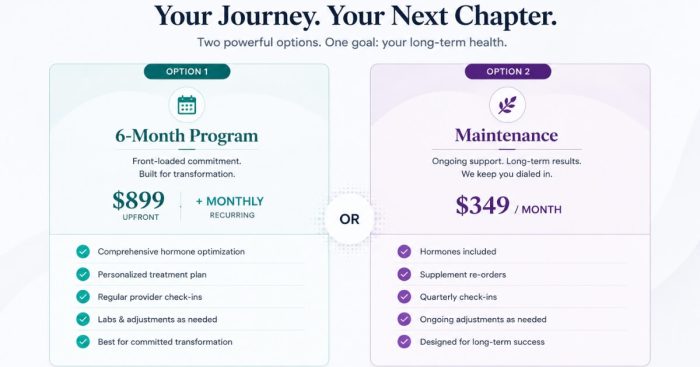
One maintenance tier.
$349 per month.
That tier should include:
- Hormones
- Supplement re-orders
The structure is simple, which eliminates decision fatigue.
When anchored against:
- $899 upfront fees
- $599–$1,599 program tiers
the $349 maintenance fee feels like a relief.
This pricing simplification is one of the most resisted changes in functional medicine.
However, it is also one of the most effective.
Many clinics offer multiple maintenance tiers:
- $349
- $549
- $749
While that sounds like flexibility, it often creates decision paralysis.
The patient reaches the exact moment you want a conversion and suddenly has too many choices.
Instead, choose the tier that captures hormone refills, include a supplement discount, and present one number.
Patients who would hesitate on a three-tier menu often enroll immediately in the single-tier option.
Meanwhile, patients who want more can still purchase additional services later.
A cash-pay HRT and functional medicine membership clinic we helped scale from $1M to $4M over four years uses this exact single-maintenance-tier structure.
The simplicity of the conversation is one reason the clinic grew from 50 members to 250 without rebuilding its sales process.
What’s the next step?
If your cash-pay functional medicine practice is enrolling patients into a six-month program but losing too many before the maintenance transition, the issue is usually the patient journey.
Likewise, if the journey exists only in a Google Doc that nobody follows, the problem is not the program design.
The patient journey is missing.
The six-week consult cadence, the three weekly coordinator check-ins, the Consult 3 maintenance introduction, and the single-tier maintenance structure are the same four moves we install at every cash-pay functional medicine clinic running a 24-week program.
In a 60-minute strategy call, we’ll:
- Audit your current journey
- Map the seven structural touchpoints
- Draft the GoHighLevel automation stack your team needs