
How Do You Get a Cash-Pay Medical Practice’s Sales Team to Stop Texting and Start Calling? (The Truth–Fact–Reality Frame for Phone Fear)
Cash-pay sales teams default to text because text feels safer than the phone. No live no, no hung-up dial tone, no awkward silence.
So the team types when they should be dialing, and the conversion rate on a 3,000-lead-a-month funnel quietly collapses.
The fix is not motivation, sales training, or another lecture about effort. The fix is a frame — three sentences a manager can install in a Monday huddle that reframes every outbound call from a sales pitch into a service mission.
This is the FAQ on the truth-fact-reality frame, the dials-per-shift target that pairs with it, and the weekly reinforcement loop that gets a 4-5 person team over phone fear inside 30 days.
Why do cash-pay medical practice sales teams hide behind text messages instead of calling leads?
Because picking up the phone is the highest-rejection-risk action a sales team performs, and most front-desk and patient coordinator teams have never been given a frame that makes the rejection feel survivable.
Texting feels safer.
There is no live no. There is no hung-up phone. There is no awkward silence.
So the team defaults to text even when the conversion math obviously favors phone.
A real example: a cash-pay weight-loss clinic in Arizona doing about $1M a month with 3,000-4,000 new leads coming in monthly and a 4-5 person sales team that was “reluctant to outbound call” and had an “aversion to picking up the phone.”
The Director of Operations asked how to fix it.
The answer was not motivation.
The answer was a frame.
The team needed a way to understand why the prospect’s contact information was on their desk in the first place. Once that is clear, the phone fear collapses on its own.
What’s the truth–fact–reality frame for getting a cash-pay sales team over phone fear?
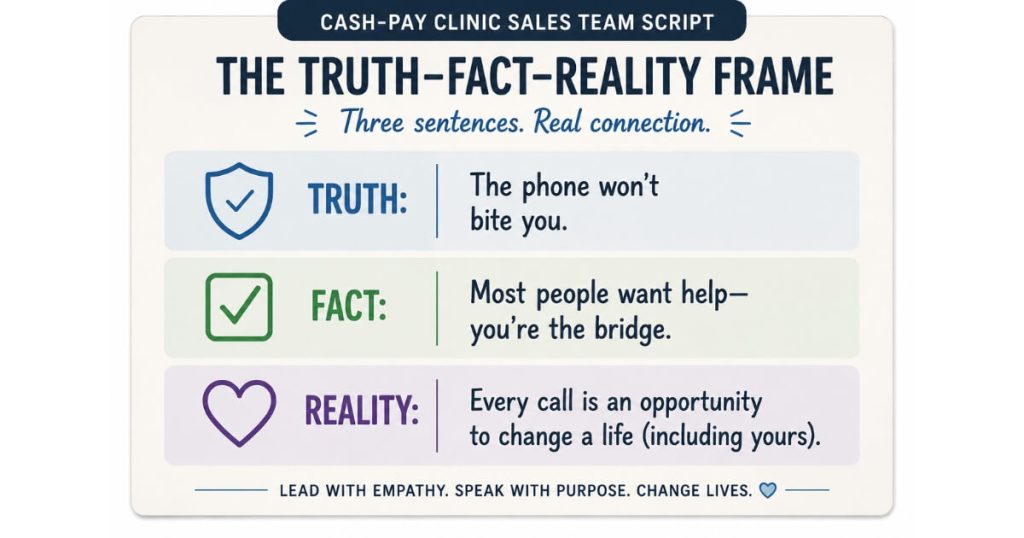
Three sentences, repeated in every weekly team meeting until the team internalizes them.
“The truth is that prospect took some time to fill out a form.
The fact is there’s a reason that they did that.
The reality is that prospect is in pain and they need help.
We are picking up the phone to see if there is a way that we can help these people.”
That is it.
The frame works because it does three things at once:
- The truth reminds the team that the prospect actively reached out. They were not interrupted. They invited the call.
- The fact anchors that the form-fill was deliberate, not accidental.
- The reality reframes the call from a sales pitch into a service mission.
The team is no longer cold-calling a stranger.
The team is following up on an inquiry from someone in pain who needs help.
The Arizona clinic’s Director of Operations rolled this out, and the team’s outbound call volume started moving the same week.
Why does texting feel safer than calling for a cash-pay sales team?
Because text removes every immediate rejection signal.
There is no live no. There is no silence on the other end. There is no audible disappointment.
The team types a message, hits send, and the rejection (if any) arrives asynchronously hours later in a soft format the team has plenty of time to process.
The phone has none of those defenses.
The team member dials. They hear the ring. The prospect picks up or does not.
The next 60 seconds determine whether the conversation is heading toward a booked consult or a hung-up dial tone.
That asymmetry produces an aversion that compounds over time.
Each unsuccessful call adds to the fear.
Each text avoidance reinforces the habit.
By the end of a quarter, the team’s outbound call volume has collapsed and the manager wonders why the leads are not converting.
The fix is not training on phone skills.
The fix is removing the fear at the frame level — and the truth-fact-reality script is the simplest version of that frame work.
How do you reinforce the truth–fact–reality frame so the team actually starts calling?
Three reinforcement layers, run weekly.
1. Open every team huddle with the frame
Start every meeting by restating the message:
“Why are these prospects on our desk?
They took time to fill out a form.
There’s a reason.
They’re in pain.
We’re picking up the phone to see how we can help.”
Two minutes. Every Monday.
2. Pair the frame with a daily activity target
Use outbound dials per shift, not just calls connected.
The metric the team is graded on must be the action they are afraid of, not the outcome of the action.
- The team member who dials 40 times and connects with 5 is winning the metric.
- The team member who texted 40 times and connected with 0 is losing.
3. Review calls weekly
Listen back to one of each team member’s calls during the QA review.
Highlight the moment the call was already a service mission rather than a sales pitch.
The team starts associating the calls with the patient outcome rather than with the rejection risk.
Three layers. Weekly cadence. Results inside 30 days.
A medspa where we added $6.7M in revenue across 3,727 new patients in one year ran exactly this loop across its 4-5 person sales team for years.
What’s the right outbound call volume target for a cash-pay sales team?
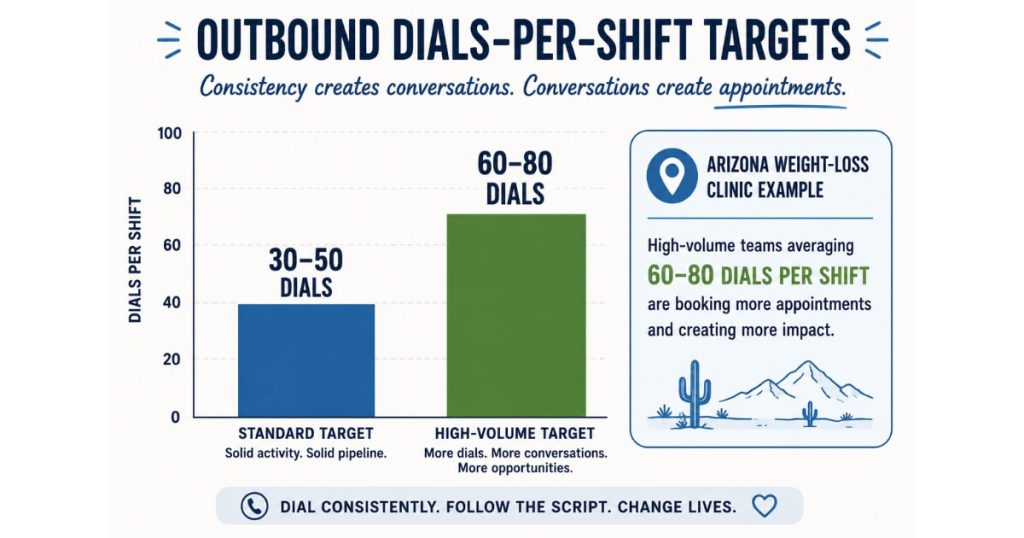
Standard-volume clinics
- 30-50 dials per shift per team member
High-volume clinics
- 60-80 dials per shift per team member
This was the range used in the Arizona weight-loss example.
The number is per-shift dials, not per-shift connects.
The action the team is being trained to take is the dial.
Connect rate is a function of speed-to-lead and time of day, both of which the team can influence with the script.
Dials per shift is purely an effort-and-frame metric.
A 4-5 person team at 40 dials per shift produces 800-1,000 dials a week.
That is the volume required to work a 3,000-4,000-monthly-lead funnel.
Below that, the leads pile up and go cold.
Above it, the team is calling people too aggressively.
The Director of Operations at the Arizona clinic was given that math, and the team’s reluctance shifted because the target was now concrete — “40 dials” — not abstract “call more.”
What does a cash-pay sales team manager do when an individual rep refuses to make calls?
Three escalation steps.
Step 1: One-on-one conversation
Use the truth-fact-reality frame.
Pair it with explicit clarity about the dials-per-shift metric.
Most reps who hear the frame and the number start dialing the next day.
Step 2: Shadow a high-volume caller
If the rep is still below target after two weeks, pair them with a high-dial-volume teammate for a half-day shadow session.
Listening to the teammate work the frame in real time usually breaks the resistance.
Step 3: Evaluate role fit
If the rep is still below target after a month, and the conversion rate on the calls they do make is also weak, the issue is not phone fear.
It is fit.
Reps who genuinely cannot make calls do not belong on a cash-pay clinic sales team.
The role requires it.
Some managers wait too long to make this call.
They hope the rep will come around and end up tolerating a team member who drags the whole sales floor’s volume down.
The frame work makes the diagnostic clean.
Once the frame is in place and the metric is clear, the willing team members start dialing immediately.
The ones who do not have given the manager the answer.
A regenerative medicine clinic we worked with hit a 79.4 percent conversion rate from lead to booked appointment by running this exact escalation with its inside-sales team.
What’s the next step?
If your cash-pay clinic’s sales team is texting more than it is calling — and your conversion rate is stuck while the leads keep coming in — the fix is operational, not motivational.
Book a strategy call.
On the call we:
- Install the truth-fact-reality frame in your team’s weekly cadence
- Set the dials-per-shift target for your specific lead volume
- Design the weekly QA loop that reinforces the frame against recorded calls
- Pair it with the 90-second inbound call script so connects convert at a higher rate
Most cash-pay clinics that install all four — frame, target, QA loop, and inbound script — see outbound call volume move 2-3x inside 30 days, with a proportionate lift in lead-to-booked conversion.
Phone fear is a fixable cultural problem at a cash-pay clinic.
The truth-fact-reality script is the simplest possible starting move.