
How Does a Cash-Pay Medical Clinic Fix Local SEO Citation Errors and Build Neighborhood Pages That Move It Into the Google Map Pack?
Address typos in old directory listings, phone numbers from years ago, duplicate name variants, and unclaimed citations on sites like Brown Book are the silent killer of local SEO at cash-pay medical clinics. One Denver IV and hormone clinic we work with watched its monthly Google Business Profile call volume cut in half over a single month — six calls dropped to three — because of citation drift it didn’t even know existed. Here’s the full citation-cleanup and neighborhood-page playbook we use to fix it.
Why is my cash-pay medical clinic stuck below the Google Map Pack even though my Google Business Profile is set up?
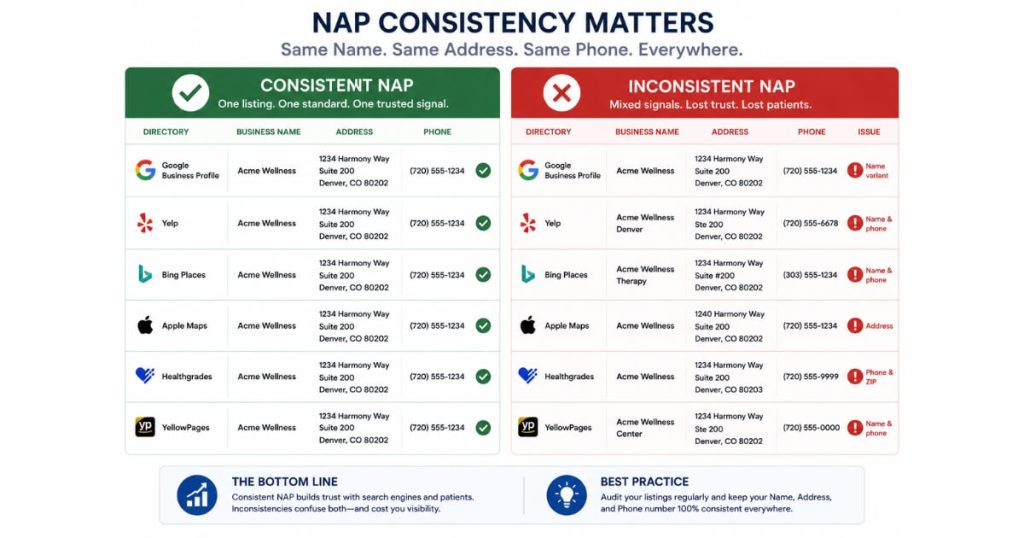
The most common reason a cash-pay medical clinic with a verified Google Business Profile still doesn’t rank in the local Map Pack is NAP inconsistency — your Name, Address, and Phone number do not match across the dozens of directories Google uses to validate your existence.
If Brown Book lists you as:
- “Acme Wellness Therapy” at one address
…and Yelp lists you as:
- “Acme Wellness Denver” at another
…Google’s local algorithm sees two entities, not one, and your authority gets split.
This is the silent ranking killer for clinics that have moved offices, changed phone numbers, or bounced through name variants:
- “Awaken IV Therapy Denver”
- “Awaken IV Therapy”
- “Awaken IV”
…all referring to the same Denver clinic.
The fix is unglamorous but mandatory:
- Audit every citation
- Dispute the ones you don’t own
- Force a single canonical NAP across all of them
In one Denver IV and hormone clinic we work with, the call volume off the Google Business Profile dropped from six per month to three in a single month, traced entirely to citation drift.
The clinic had:
- Four different Brown Book listings
- One claimed by someone else
- Three with mismatched addresses
- A stale Thornton mailing address showing up across other directories
None of that gets fixed by adding more content to your site; it gets fixed by the citation audit.
What’s the right cash-pay clinic citation-cleanup checklist?
Run through this list, in order, for any clinic that’s stuck outside the local Map Pack.
The first four steps usually account for 80% of the lift.
1. Claim every directory listing tied to your clinic’s brand
Search:
“[your clinic name] directory listings”
Check:
- Brown Book
- Yelp
- Bing Places
- Apple Maps
- Foursquare
- Yellow Pages
- Manta
- Hotfrog
- Citysearch
- Mapquest
- Local Chamber of Commerce listings
Claim each one.
If a competitor or a random scraper has claimed a listing in your name, file a dispute with the directory — Brown Book in particular allows owner-disputes that resolve in 7–14 days.
2. Standardize Name, Address, and Phone (NAP) verbatim
Pick one canonical version:
“Awaken IV Therapy”
…at one street address with one phone number.
Rewrite every directory entry to match it character for character.
Suite numbers, abbreviations, and even punctuation matter.
Google reads:
- “Suite 200”
- “Ste 200”
…as different addresses unless other signals corroborate.
3. Remove or correct obsolete mailing addresses
If your clinic had:
- A P.O. box
- A coworking space address
- An old practice location
…still floating around the web, those are pulling down your Map Pack ranking.
Replace them with the current physical address one directory at a time.
4. Reconcile phone-number history
If your clinic has changed phone numbers over the years, every old number that still appears on a directory page weakens the new number’s signal.
Either:
- Update each directory to the current number
- Or remove the stale listing entirely
5. Run a Local Citation Audit tool
Use:
- Moz Local
- BrightLocal
- Whitespark
Verify the canonical NAP is propagating.
Expect 30–60 days before Google’s local algorithm fully re-weights its trust in your profile.
How many cash-pay clinic neighborhood pages should I build, and how do I pick the cities?
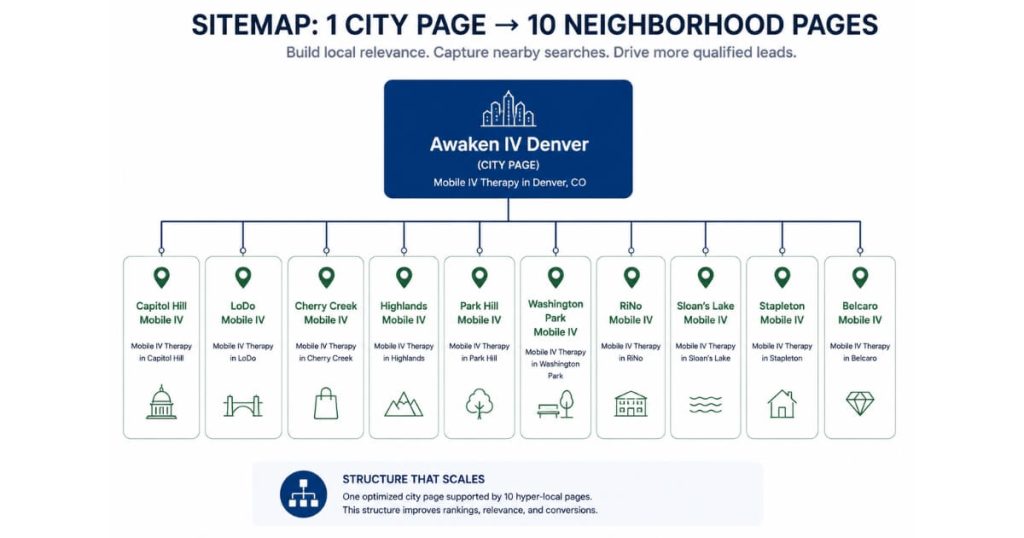
Build one neighborhood page per city or neighborhood that’s within actual driving distance of your clinic — not every city in your state.
The rule of thumb for a single-location cash-pay clinic is:
- Six to ten neighborhood pages
- Each targeting a real catchment area where patients would plausibly drive to you
The mistake we see most often is clinics building 30 pages:
- Denver
- Aurora
- Colorado Springs
- Lakewood
- Thornton
- Arvada
- Westminster
- Centennial
- Fort Collins
- Greeley
- Loveland
…and treating them all equally.
Most of those are far enough away that patients won’t drive in.
The local algorithm sniffs out low-value pages targeting cities outside your service area and discounts the whole set.
The right move is to ask:
Which neighborhoods or suburbs are within 25 minutes of my clinic, and which neighborhoods do my existing patients actually live in?
For one Denver clinic we work with, the real catchment was:
- Lakewood
- Thornton
- Arvada
- Westminster
…not Colorado Springs or Fort Collins.
Those four neighborhood pages do more for the Map Pack than ten state-wide pages would.
We’ve used a near-identical neighborhood-page strategy across other markets — including a regenerative medicine clinic that generated $309,590 in cash-pay revenue in 10 months from SEO alone.
The pattern repeats:
- Tight geographic targeting
- Distinct on-page content for each neighborhood
- Patient testimonials anchored to specific neighborhoods
What should each neighborhood page actually say?
Each neighborhood page should answer four questions a local searcher is asking:
- Where are you?
- How do I get to you from my neighborhood?
- What services do you offer?
- Is there proof that people in my neighborhood actually use you?
Skip those and the page reads like a template — which Google’s local algorithm now penalizes harder than it did three years ago.
Opening paragraph
Reference the neighborhood by name in the first sentence and tie it to the clinic’s primary service.
Example:
“IV therapy and TRT memberships for the Capitol Hill neighborhood of Denver”
Next paragraph
Describe the drive from the neighborhood:
- Landmark cross streets
- Parking guidance
- Distance in minutes
Service section
Explain the core services and include neighborhood-specific testimonials if you have them.
Closing section
Include:
- An embedded Google Map
- A click-to-call CTA
What you do not want is the same boilerplate text across all ten pages with only the city name swapped.
Google catches that pattern instantly.
Write each page from scratch or pay a writer to do it.
Two hundred to four hundred words of original content per neighborhood beats two thousand words of spun template content.
How do I know if my Google Business Profile is actually getting weaker, not just having a slow month?
The leading indicator is direct call volume from the Google Business Profile dashboard month over month.
Sub-metrics:
- Profile views
- Search queries that triggered an impression
- Click-through rate to your website
If profile views dropped 30% in a single month with no seasonal explanation, the issue is almost always citation drift or a new spam-flag on the listing.
The Denver clinic we mentioned earlier dropped from six monthly Google Business Profile calls to three — a 50% decline in a single month.
The cause was traced to:
- The Brown Book disputes
- The Thornton-address contamination
- The name-variant problem
Once those were fixed, call volume began recovering inside the 30-day re-crawl window.
If your call volume is steady but your appointment volume isn’t tracking, the answer is upstream.
See how a $1M-to-$4M HRT clinic we worked with built its 250-member SEO-driven membership program by treating the Google Business Profile as just one input into a larger funnel, not the funnel itself.
How long does it take a cash-pay clinic’s local SEO to recover after citation cleanup?
Plan for a 30 to 60 day re-crawl window after you finish the citation cleanup.
Google’s local algorithm doesn’t re-evaluate a profile in real time; it pulls trust signals from a rolling crawl of the directory web and the Map Pack rankings shift after that crawl completes.
In practice, the first signal is:
- Profile-view recovery in weeks two and three
Direct call volume typically returns in:
- Weeks three to five
Actual Map Pack ranking moves — moving from position six to position three, for example — typically happen in:
- Weeks five to eight
If you haven’t seen any movement by week ten, audit the citations again; you almost certainly missed a directory.
Two things accelerate the recovery:
1. A steady cadence of new Google reviews
One to two per week, ideally from the neighborhoods you’re targeting.
2. New neighborhood pages with original content
Reviews compound trust signals faster than citations do, so the cleanup and the review push should happen in parallel.
Should I run local SEO myself or hire it out at a cash-pay clinic?
Most single-location cash-pay clinics should run the citation cleanup in-house once and then maintain it quarterly.
The cleanup itself is:
- Six to ten hours of detail work
- Claiming directories
- Updating NAP
- Filing disputes
It is not strategically complex; it is tedious.
A virtual assistant or office manager can execute the playbook above as well as an agency once they’ve been trained on it.
What’s worth outsourcing is:
Neighborhood-page content
Neighborhood pages need to be written, not templated, and most clinic teams underestimate how much original content each page needs.
Technical SEO audit
Schema markup, internal linking, and page speed are separate skillsets and usually a one-time engagement.
If you’re growing past two locations, local SEO becomes its own job.
Multi-location cash-pay clinics need:
- A location-level GBP strategy
- A service-level page architecture
- A review-routing workflow that prevents reviews from being attributed to the wrong location
That’s the inflection point where hiring an agency or a full-time SEO inside the practice starts to pay off.