
How Do You Run Facebook Ads for Stem Cells, PRP, HRT, and Other Restricted Cash-Pay Medical Treatments Without Getting the Ad Account Shut Down?
Meta’s restrictive medical-claims policy will disable any ad that names stem cells, PRP, HRT, TRT, hormone therapy, or regenerative medicine — sometimes the same day the ad goes live, sometimes weeks later in a sweep that disables your entire ad account. Here’s the condition-specific ad-copy structure cash-pay clinics use to run profitable Facebook lead-gen campaigns without getting flagged, plus the Business Manager setup that buys you procedural grace if Meta does come knocking.
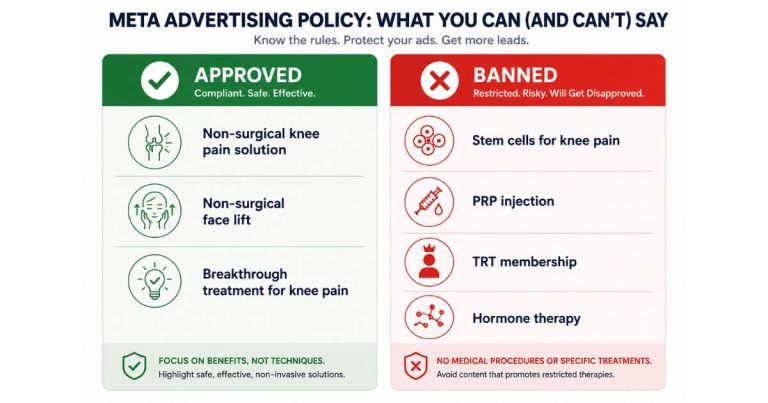
Why does Facebook keep disabling my cash-pay clinic’s ads for stem cells, PRP, HRT, and other regenerative or hormone treatments?
Meta’s healthcare and personal-attributes ad policy treats:
- Stem cells
- PRP
- HRT
- TRT
- Hormone therapy
- Peptides
- Most regenerative-medicine treatments
…as either unapproved medical claims, personal-health targeting violations, or both — and the platform’s automated reviewer will disable any ad that names them in the headline, body copy, or visible image text.
Disapproval usually happens within minutes of submission.
The harsher penalty — entire ad account disabled — is what happens when too many disapprovals stack on a single account.
Unlike Google Ads, where the policy is enforced at the keyword level and you can sidestep it with surgery-avoidance terms, Meta enforces at the ad-content level.
The platform reads:
- Your headline
- Your image
- Your lead-form questions
If any of them surface a restricted treatment name, the ad gets pulled regardless of how compliant the rest of the campaign is.
The fix is to talk about the condition you treat, never the treatment you sell.
Patients in the early stages of solution awareness:
“I have knee pain, I want it to stop”
…convert just as well as patients who already know they want a specific treatment name, and Meta’s policy filter doesn’t catch condition-specific language.
The in-clinic consult is where the actual treatment gets named and sold.
This condition-first approach is the foundation of Facebook ads for speculative treatments without a ban, allowing regenerative, hormone, and cash-pay medical clinics to generate leads while staying compliant with Meta’s increasingly restrictive healthcare advertising policies.
What’s the right Facebook ad campaign structure for a cash-pay medical clinic?
Use:
- One campaign objective: lead generation
- One ad set: a tight geographic radius around your clinic
- One audience size target: 150,000 to 250,000 people inside that radius
- One lead-capture mechanism: Meta’s native instant lead form, not a third-party landing page
The reason for the native lead form is conversion-rate driven.
Meta’s instant form pre-fills the prospect’s:
- Name
- Phone
…from their Facebook profile, which keeps the form-fill rate two to three times higher than a separate landing page would deliver at the same cost-per-click.
It also:
- Strips out a layer of pixel-tracking setup that most clinic teams get wrong
- Keeps the lead inside Meta’s ecosystem where the algorithm can optimize delivery to lookalike-prone prospects
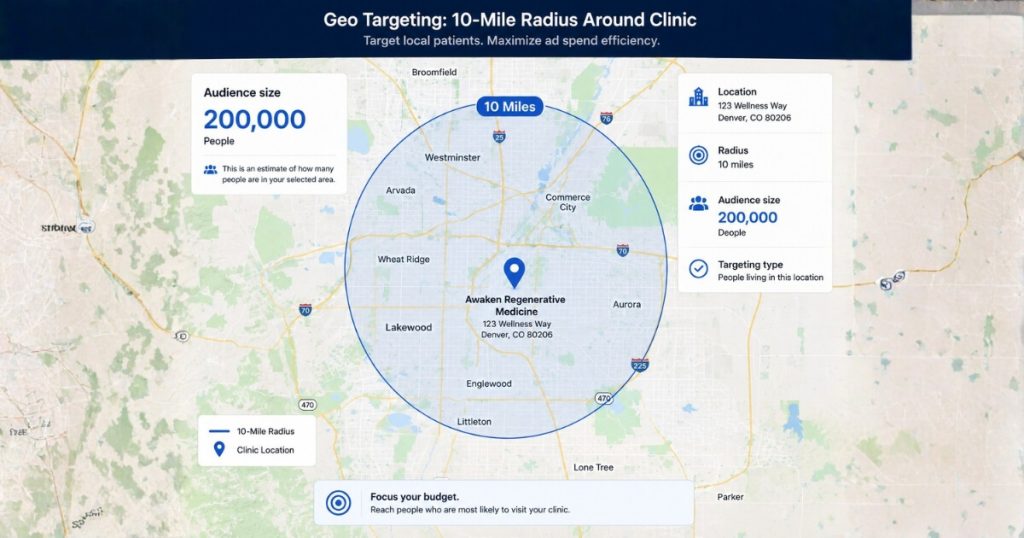
The audience-size guidance — 150,000 to 250,000 — is the sweet spot for a single-location clinic in a mid-sized U.S. metro.
- Smaller than 150,000 → Meta can’t find enough impressions to optimize against your conversion event
- Larger than 250,000 → you start serving impressions to people who aren’t realistically going to drive to your clinic
In dense major cities, keep the radius small and let the audience cap out naturally.
For demographics:
- Male-only for TRT and ED ad sets
- Female-only for women’s hormone
- Broader for weight loss and aesthetics
Age 30–65 is the default range.
Tighten by five years on either end if your historical patient data supports it.
What can I actually say in a Facebook ad for a cash-pay regenerative or hormone clinic?
Talk about the condition the patient is searching for relief from — never the treatment itself.
Compliant phrasing patterns
- “Non-surgical knee pain solution”
- “Non-surgical face lift”
- “Breakthrough treatment for knee pain”
- “Fast relief for neuropathy”
- “Natural energy and focus solution for men over 40”
- “Non-surgical weight loss support”
Banned phrasing patterns
- “Stem cells for knee pain”
- “PRP injection for back pain”
- “HRT for women”
- “TRT membership”
- “Hormone therapy program”
- “Exosomes”
- “Peptide therapy”
…and any other phrase that names a regenerative or hormone treatment by category.
The pattern is consistent across every vertical we’ve helped clinics market.
An orthopedic surgical practice we added $2M in revenue to via Facebook ads never mentioned the surgery by name in the ad — every winning creative led with the patient’s condition:
- Back pain
- Knee pain
- Joint pain
…and used the in-clinic consult as the place to introduce the actual procedure.
Headlines that win in our testing across stem cell, PRP, HRT, and weight-loss campaigns share three structural elements:
1. A condition the patient already knows they have
“Knee pain that won’t go away”
2. A benefit framing that implies relief
“Non-surgical solution”
“Fast relief”
“Back to doing what you love”
3. A softening qualifier
“For adults 40 and over”
“Approved for most insurance” (only if true)
Skip the brand name.
Skip the treatment name.
Lead with the condition.
How should I set up a Meta Business Manager so my cash-pay clinic’s ad account doesn’t get disabled?
Set up a real Business Manager linked to a real corporate Facebook Page, with:
- A verified business identity
- The practice’s domain claimed inside Business Manager settings
The reason:
When Meta’s automated reviewer flags an ad and the clinic owner appeals, Business Managers with:
- Verified business identity
- Domain verification
- A clean ad-policy history
…get appeals reviewed by humans far more often than personal ad accounts or shell business managers.
Core setup steps
1. Create the Business Manager
Use the legal entity name on file with your state’s medical board.
Go to:
business.facebook.com
2. Verify the clinic’s domain
Use either:
- DNS TXT record
- HTML file upload
3. Add the clinic’s Facebook Page
The patient-facing corporate Page — not a personal profile.
4. Create the Ad Account inside Business Manager
Link the payment method to a corporate card on file with the clinic’s legal entity.
What this protects against is a permanent ad-account ban.
Meta will still disable individual ads — that’s unavoidable for clinics in regulated verticals — but with a properly structured Business Manager, your overall account survives the disapproval and you can edit and resubmit.
Without that setup, two or three disapprovals will trigger a permanent account-level ban with no human review.
What should the offer be in a Facebook ad for a cash-pay medical clinic?
Lead with a low-commitment first step — not the high-ticket treatment.
The winning offers across our regenerative, hormone, and weight-loss campaigns are some variant of:
- A free consultation
- A $50–$99 paid assessment that includes labs or an imaging scan
- A discounted gateway service that funnels into the main treatment
The reason a low-commitment offer wins on Facebook specifically:
The platform’s audience is in solution-aware mode at best — patients are scrolling, not actively searching for treatment.
Asking them to commit to a $3,000–$15,000 cash-pay treatment in the ad copy crashes the conversion rate.
A free consult, a free guide, or a discounted lab panel converts five to ten times higher in our testing.
For a high-ticket regenerative or HRT practice, pair the Facebook lead with a fast follow-up call within five minutes.
Meta-sourced leads cool off faster than Google leads do because the patient wasn’t actively searching when they opted in.
Speed-to-lead from a Facebook campaign is the single biggest variable in show-rate, and we’ve seen identical ad creative produce:
- 40% show-rates with a five-minute follow-up
- 12% show-rates with a 24-hour follow-up
Should a cash-pay medical clinic run Facebook ads as the primary channel?
For most cash-pay medical clinics in 2026, Facebook should be a supporting channel, not the primary one.
The platform is the cheapest and fastest way to generate volume — leads can come in within hours of a campaign going live at a $20–$40 cost-per-lead in most markets — but the lead quality is materially lower than Google Ads or organic SEO produces.
- Show-rate is lower
- Average treatment ticket is lower
- Lifetime value is lower
That said, Facebook works as:
- The volume channel that feeds a high-quality sales team
- The awareness channel that warms a market before a search campaign goes live
- The cross-sell channel that targets your existing patient list for new service launches
A medspa we added $6.7M in revenue to in a single year ran Facebook ads as part of a multi-channel stack — not in isolation — and the channel mix is what drove the result, not Facebook alone.
If your clinic doesn’t have a front desk or new-patient coordinator who can answer Meta-sourced leads inside five minutes during business hours, don’t run Facebook ads yet.
Build the sales-team operations first, then turn the ads on.
Otherwise you’re paying $30 a lead to watch the leads ghost.
How do I diagnose whether my Facebook ad is failing because of policy or because of creative?
Two clean signals separate a policy failure from a creative failure.
Policy failure
- The ad gets disapproved or under-delivered in the first 24 hours
- Ads Manager shows a policy notice next to the ad
- Impression count is suspiciously low or zero
For a policy failure, the fix is the condition-specific rewrite outlined above.
Pull every treatment name from:
- The headline
- The body copy
- The image text
- The lead form
…and resubmit.
If it still gets flagged, the image is the most likely culprit.
Check for:
- Visible text mentioning a banned treatment
- Syringes
- Blood vials
- Before/after comparison images on body parts
…which can trigger Meta’s automated visual classifier.
Creative failure
- The ad delivers normally
- Impression count is healthy
- Lead-form completion rate is below 10%
- Cost-per-lead is double the platform benchmark
For a creative failure, test:
1. Five headline variants
Against a single proven body copy.
2. Five image variants
Against the winning headline.
Don’t change everything at once or you won’t know what moved the needle.
Two-week test windows are the minimum to get a statistically meaningful read on Meta’s algorithm at typical clinic ad-budget levels.