
Why Can’t My Busy Insurance Clinic Convert Cash-Pay Inquiries? (The Isolated Cash-Pay Desk Fix)
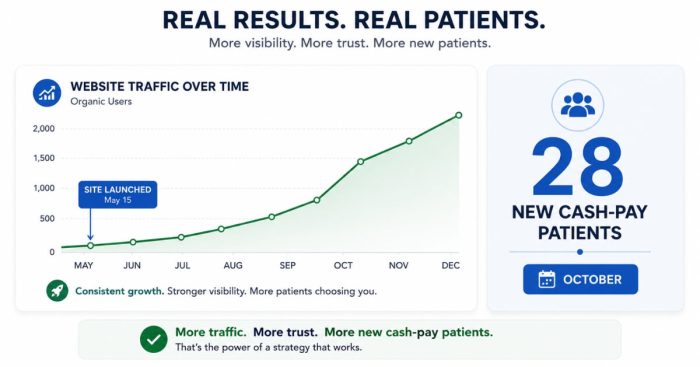
A high-volume insurance clinic we work with booked 28 new cash-pay patients in October—weight loss, peptides, and primary care—just two weeks after launching a new website whose traffic was already spiking. Then the growth hit a wall that had nothing to do with marketing. The receptionist summed it up perfectly during our call: “There’s no time for us to sit on the phone and try to sales-pitch these people… we’ve usually got at least two on the phone at one time, somebody on hold, people checking in and out, and providers standing next to us asking us to do things.” Here’s the FAQ on the fix—and why it isn’t simply “add another body to the front desk.”
Why isn’t my front desk converting cash-pay inquiries?
Because selling a cash-pay program is a sales conversation, while your front desk is running a switchboard. At a busy clinic, those two jobs simply cannot share the same desk.
Listen to what the workload actually sounds like: two active calls, another caller on hold, patients checking in and out, and providers standing at the desk asking for help. In that environment, a cash-pay inquiry—a caller who needs pricing explained, membership details discussed, and objections handled—stops feeling like an opportunity. Instead, it becomes another interruption.
The receptionist on our call also pointed out a second problem. The team didn’t yet know the answers to common membership questions, where to place new enrollees in the system, or how membership billing would be managed.
As a result, there was no time, no process, and no system. Consequently, inquiries your marketing paid for received a rushed 45-second conversation—or no real conversation at all.
The important reframe is this: it isn’t a people problem.
Everyone at that front desk is doing their best.
Instead, it’s a structure problem. The clinic created demand for a sales conversation without creating a dedicated place for that conversation to happen.
Should cash-pay services have their own dedicated staff member?
Yes. You need a full-time person who owns the cash-pay pipeline from beginning to end—not a part-time employee squeezing it in around another job.
During the call, the team discussed using a super-part-time helper who also worked as a real estate agent. However, the office manager reached the correct conclusion herself:
“Truly what we need is someone like Rachel, full-time, who can do this.”
Cash-pay conversion is a real role. That person should:
- Answer new inquiries quickly.
- Present the program and pricing.
- Enroll new patients.
- Set up membership billing.
- Follow up with undecided prospects.
When you assign those responsibilities to someone who’s only available occasionally, the inquiries inevitably flow back to whoever happens to answer the phone first. Unfortunately, that’s exactly the failure you’re trying to eliminate.
We’ve seen this lesson repeated in nearly every high-converting practice we’ve worked with. A specialist practice we work with cut its insurance dependence in half while growing monthly revenue by $40K+ because one person owned the cash-pay pipeline. The front desk didn’t handle it during spare moments.
Ownership—not availability—is what makes patient acquisition consistently convert.
Why should the cash-pay desk be physically isolated from the front desk?
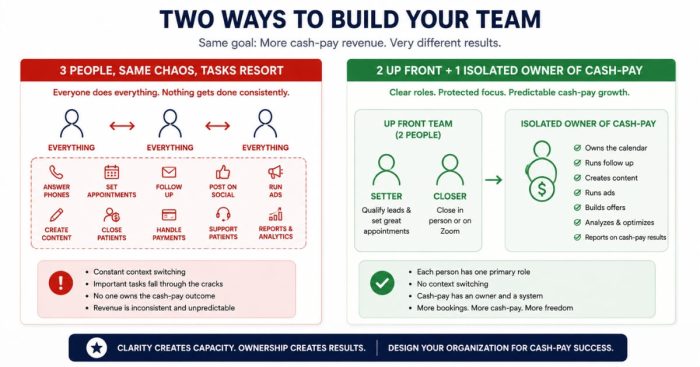
Because adding another person to the same crowded workspace doesn’t increase productivity.
Instead, the work simply gets redistributed.
This was probably the strongest recommendation we made during the call, even though it sounds counterintuitive.
The clinic was already renovating by adding three exam rooms and a lab. Naturally, everyone assumed they should simply place a third employee at the front desk.
Our advice was different.
Put three people behind that desk and they’ll quickly become overwhelmed. Even worse, the new hire won’t spend their day doing the job you hired them to do.
Here’s what usually happens.
Providers begin delegating administrative work to anyone sitting at the front desk. Before long, the new employee is handling refill requests, check-in overflow, and miscellaneous administrative tasks instead of converting cash-pay inquiries.
Fortunately, the solution costs nothing.
Place the cash-pay position somewhere else.
In this clinic’s case, we recommended using a corner of the office manager’s office.
Isolation isn’t about status.
It’s about protecting one person’s attention so the work you hired them to perform remains their primary responsibility.
If physical separation isn’t possible, then create operational separation instead:
- Give them their own phone line.
- Assign their own CRM pipeline.
- Measure their own performance metrics.
- Require providers to route administrative requests through the office manager instead.
Do phone trees fix an overloaded clinic phone?
Usually not.
This clinic already tried one, and patients simply dialed every extension until someone answered.
As the receptionist explained:
“They could press three all day long, but they’re going to keep calling every extension until they get a human being.”
That’s simply the reality of serving busy patients.
Phone trees optimize around your organizational chart.
Patients optimize around speaking with an actual person.
When we asked what consumed roughly 80% of her day, the receptionist answered immediately:
“Answering the phone.”
However, those calls covered nearly twenty different issues.
Most of them came from existing patients asking about:
- Prescription refills
- Appointment rescheduling
- Lab results
- General questions
Instead of relying on menus, route calls through staffing.
Existing patient calls should continue flowing through the front desk.
Meanwhile, every new cash-pay inquiry should immediately reach the dedicated cash-pay specialist through either:
- A separate phone number on your website and advertising.
- A warm-transfer rule such as, “Anything related to weight loss, peptides, or memberships goes directly to Rachel.”
Patients still reach a human immediately.
More importantly, your clinic finally creates the uninterrupted sales conversation those inquiries deserve.
How fast can cash-pay services grow inside an insurance practice?
Very quickly.
This clinic booked 28 new cash-pay patients during October, while website traffic surged only two weeks after launch.
The demand side of this story is exactly why solving the staffing issue became urgent.
After the website launched, traffic climbed almost immediately. Within three months, the growth curve showed a clear upward trend.
The highest-performing pages revealed exactly where market demand existed:
- BPC-157
- Epithalon
- CJC-1295
- Wolverine Blend
- Retatrutide
- Branded searches
Most of those 28 October bookings came from weight-loss services, supported by some of the most competitive pricing in the local market.
The demand existed.
Patients were finding the clinic.
Cash-pay appointments were increasing.
That’s the pattern we see whenever an insurance practice points real medical practice marketing at cash-pay service lines. Demand usually shows up before the operations are ready for it. That’s perfectly normal—as long as you treat the operational gap as this month’s project instead of next year’s.
My phones never stop and my providers are booked out — is that actually a problem?
It’s actually one of the best problems a business can have—but only if you turn that demand into capacity instead of allowing it to burn out your team.
As we told this clinic, having more inbound calls than your staff can answer and providers booked further out than you’d like are good signs. They prove demand exists and your marketing is working.
However, ignoring those problems creates a different outcome.
The front desk burns out.
Cash-pay callers reach voicemail.
Prospective patients book with a competitor.
Eventually, the owner concludes the cash-pay initiative “didn’t really take off.”
Instead, follow the growth sequence in order:
- Staffing — create the isolated cash-pay role.
- Operations — document your membership enrollment and billing process.
- Delegation — route provider administrative requests appropriately.
None of those are marketing projects.
Instead, they’re operational improvements that convert marketing into revenue.
That’s the same operations-first approach behind an HRT clinic that grew from $1M to $4M a year, where membership infrastructure was built before advertising spend significantly increased.
FAQ’s About Converting Cash-Pay Inquiries at a Busy Insurance Clinic
Why do cash-pay leads slip away at high-volume clinics?
Cash-pay inquiries require a real sales conversation about pricing, program details, and membership enrollment.
Meanwhile, a busy front desk is juggling multiple phone calls, patient check-ins, and provider requests.
That’s why these leads often receive rushed attention.
The issue isn’t effort.
It’s structure.
Should I hire a dedicated cash-pay receptionist?
Yes—once inquiry volume justifies it.
This clinic reached that point at roughly 28 new cash-pay bookings per month.
A part-time employee with another career can’t consistently own response speed, follow-up, and membership enrollment.
Without clear ownership, inquiries simply go to whoever answers the phone first.
Where should a cash-pay salesperson sit in the office?
Away from the front desk whenever possible.
A separate office or dedicated workspace protects their attention.
Otherwise, providers naturally begin assigning them unrelated administrative work, and productivity simply shifts instead of increasing.
Protect their:
- Workspace
- Phone line
- CRM pipeline
- Performance metrics
What should an insurance clinic fix first when adding cash-pay services: marketing or operations?
If inquiries are already arriving, fix operations first.
Start by assigning one person to own cash-pay calls.
Next, document the enrollment and membership billing process.
Finally, establish clear provider-delegation rules.
When marketing outpaces operations, the result isn’t growth.
Instead, you get nonstop phones, overwhelmed staff, and competitors booking the patients your marketing generated.
What’s the next step?
If your clinic’s phones never stop but your cash-pay services aren’t growing the way your inquiry volume suggests they should, it’s time to fix the operational bottleneck.
Book a strategy call.
In 60 minutes, we’ll:
- Map your current call flow.
- Design the isolated cash-pay role.
- Outline the physical workspace and phone routing.
- Build your membership enrollment process.
- Show you what clinics that successfully made this transition implemented during their first 90 days.