
What’s the Best Lead Magnet for a Regenerative Medicine Clinic?
The hard truth about regenerative medicine marketing is that most of the right patients aren’t ready to book the first time they find you. They’re researching, they’re nervous, and a “Book a Consultation” button asks for more commitment than they’re ready to give. So they leave — and you never hear from them again. A lead magnet fixes that. It captures the interested-but-not-ready patient at the top of the funnel so you can follow up over the weeks a five-figure decision actually takes. Here’s how to build one that fills your pipeline with serious patients instead of freebie-seekers.
[Insert HERO IMAGE here]
What is a lead magnet, and why does a regenerative medicine clinic need one?
A lead magnet is a valuable free resource — usually a downloadable guide — offered in exchange for a patient’s contact information, and regenerative clinics need one because most patients aren’t ready to book the first time they visit the website.
Regenerative medicine is a high-ticket, high-consideration purchase. Patients don’t typically discover a clinic on Monday and commit to a treatment plan on Tuesday. They research, compare options, talk to family, watch videos, read reviews, and spend weeks deciding who to trust.
That’s where most clinics lose people.
If your website only offers one next step — “Book a Consultation” — you’re only capturing the small percentage of visitors ready today. Everyone else leaves and disappears.
A lead magnet creates a lower-commitment first step. Instead of asking for an appointment, you’re offering something useful that helps them make a better decision.
In exchange, you get their contact information and permission to continue the conversation.
Capturing demand before patients are ready to buy is one of the most effective forms of patient acquisition, and it’s the same principle that helped Orthobiologics Associates generate $309,590 in cash-pay revenue in 10 months while converting leads to appointments at a 79.4% rate.
What’s the best lead magnet for a regenerative or stem cell clinic?
The best lead magnet is a condition-specific decision guide that helps a patient evaluate a problem they’re actively trying to solve.
Specificity wins.
Generic lead magnets such as:
- “The Ultimate Wellness Guide”
- “Healthy Aging Tips”
- “5 Secrets to Better Health”
usually attract low-intent readers.
Instead, create resources such as:
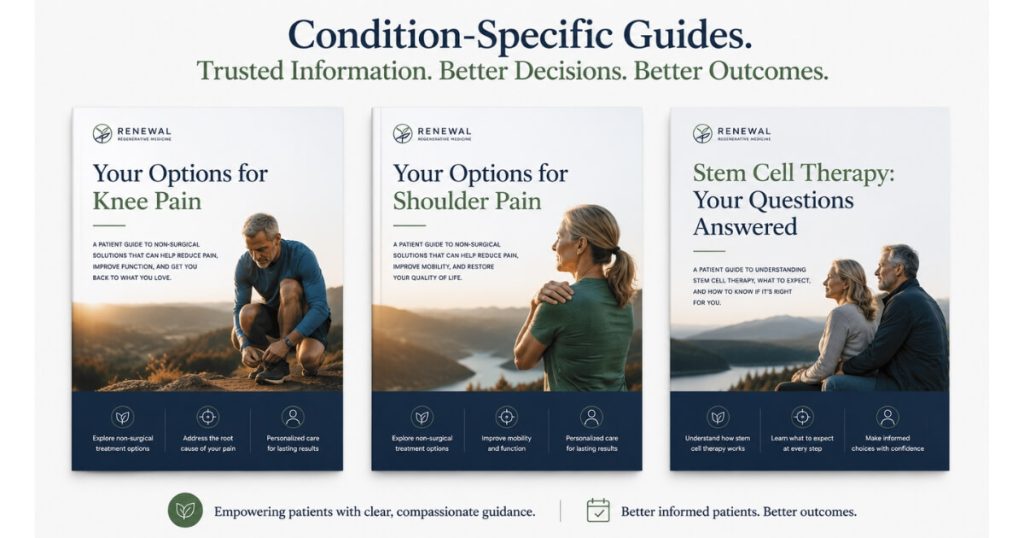
- The Knee Pain Patient’s Guide to Understanding Your Options Before Surgery
- What Every Shoulder Pain Patient Should Know Before Choosing Treatment
- Questions to Ask Before Paying for Stem Cell Therapy
- A Runner’s Guide to Knee Pain and Regenerative Options
- PRP vs Surgery: What Patients Need to Know Before Deciding
These guides speak directly to a patient’s current concern.
The title itself acts as a filter.
Only people facing that specific problem download it.
Decision-focused content consistently performs best because your patient isn’t searching for more treatment options — they’re searching for confidence in the decision they’re already trying to make.
This is why decision guides remain one of the most effective assets in stem cell clinic marketing.
Why does a downloadable guide work so well for high-ticket regenerative patients?
Because regenerative patients are research-driven, skeptical, and deliberate buyers who respond far better to education than pressure.
A patient considering an out-of-pocket regenerative treatment isn’t making an impulse purchase.
They’re trying to answer questions like:
- Will this work for someone like me?
- Am I a candidate?
- Is this worth the investment?
- How does it compare to surgery?
- Which clinic should I trust?
A guide addresses those questions before a sales conversation ever happens.
Instead of pushing for a consultation immediately, you’re providing value first.
That does three things:
First, it demonstrates expertise.
Second, it builds trust.
Third, it positions your clinic as a helpful resource rather than another clinic trying to sell something.
The clinics that educate first become the clinics patients trust when it’s finally time to make a decision.
And trust is ultimately what drives conversion in regenerative medicine.
What should the lead magnet actually contain to attract serious patients instead of freebie-seekers?
It should focus on helping a patient make a real healthcare decision by providing useful, honest information tied to a specific condition.
A high-converting lead magnet typically includes:
- A simple explanation of the condition
- Common treatment options
- Pros and cons of each approach
- Questions patients should ask providers
- Realistic expectations
- Factors that determine candidacy
- Cost considerations
- The next steps patients should consider
The key is usefulness.
The guide should genuinely help someone make a smarter decision whether they choose your clinic or not.
That level of honesty becomes a competitive advantage.
Most clinics oversell.
Most patients expect to be sold.
A guide that acknowledges limitations, discusses alternatives, and avoids hype immediately feels more trustworthy.
That’s exactly why it works.
The goal isn’t to convince everyone.
The goal is to attract serious patients and allow non-serious prospects to filter themselves out.
Keep everything compliant and educational.
Avoid promises, guarantees, or outcome claims.
The guide should feel like an expert helping a patient think through a decision—not a sales brochure disguised as education.
Where should a regenerative clinic promote its lead magnet?
Promote it anywhere a researching patient is already spending time.
That includes:
- Your website homepage
- Service pages
- Condition pages
- Blog articles
- SEO content
- Social media posts
- YouTube descriptions
- Email campaigns
- Paid advertising campaigns
The strongest placement is usually inside related educational content.
For example:
Someone reading an article about knee arthritis can be offered:
“Download The Knee Pain Patient’s Guide to Understanding Your Options Before Surgery.”
Someone reading about PRP can be offered:
“Download Questions to Ask Before Paying for PRP Treatment.”
The lead magnet should feel like the natural next step in the patient’s research process.
The landing page itself should be simple:
- Strong headline
- Brief description
- Three to five bullet points
- Short form
Ask only for:
- Name
- Phone number
The guide itself does most of the qualification.
Every extra field reduces conversion.
Keep friction low and let the nurture sequence do the rest.
What happens after someone downloads the guide?
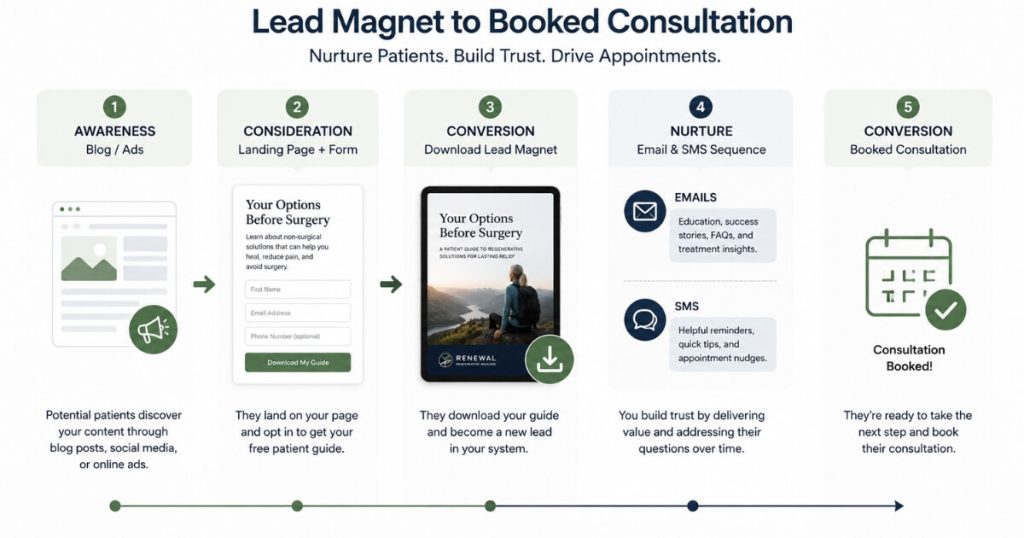
The download starts the relationship. The follow-up system is what creates the consultation.
Most clinics stop at the download.
That’s a mistake.
The real value comes from what happens afterward.
A strong nurture sequence might look like:
Immediately
- Deliver the guide
- Day 2
- Answer a common patient question
- Day 5
- Share a patient story
- Day 8
- Explain candidacy considerations
- Day 12
- Address costs and financing
- Day 18
- Share educational video content
- Day 25
- Invite the patient to schedule a consultation
The cadence should feel helpful rather than aggressive.
Remember:
The patient wasn’t ready when they downloaded the guide.
The purpose of the sequence is to build trust until timing and confidence align.
Many regenerative decisions take weeks or months.
A clinic that captures the lead early and stays present consistently is usually the clinic that wins when the patient finally acts.
Pairing email nurture with retargeting ads makes the effect even stronger.
The guide captures attention.
The nurture builds trust.
The consultation becomes the natural next step.
How do you measure whether a lead magnet is working?
Measure the entire funnel, not just downloads.
Downloads alone are a vanity metric.
The metrics that matter are:
- Cost per lead
- Landing-page conversion rate
- Email engagement rate
- Consultation booking rate
- Consultation show rate
- Treatment conversion rate
- Revenue generated
A successful lead magnet ultimately produces revenue.
If downloads are high but consultations are low, either:
- The topic is attracting the wrong audience, or
- The nurture sequence is weak.
If both downloads and consultations are strong, increase promotion.
Also evaluate lead quality over time.
Regenerative patients often take weeks to convert.
Avoid judging a lead magnet after only a few days.
Track the complete journey from download to consultation to treatment.
When measured properly, a well-designed lead magnet is often one of the lowest-cost patient-acquisition assets a regenerative clinic can own.
FAQ’s About Regenerative Medicine Lead Magnets
Should a regenerative clinic gate its lead magnet behind a form?
Yes. The entire purpose of a lead magnet is exchanging valuable information for permission to continue the conversation. Ask for only the essentials — typically name, email, and phone number — and keep the form short. A download you can’t follow up with has little business value, while a captured lead can be nurtured into a consultation over time.
Do lead magnets attract low-quality leads?
Only if the topic is too broad. Generic wellness resources tend to attract freebie-seekers. Condition-specific decision guides attract patients actively evaluating treatment options. The more specific the topic, the higher the lead quality tends to be.
What’s the difference between a lead magnet and a free consultation?
A consultation asks for a significant commitment immediately. A lead magnet asks for almost none. The consultation captures patients ready today; the lead magnet captures everyone who may be ready in the future. The two work together as different stages of the same funnel.
How long should a regenerative medicine lead magnet be?
It only needs to be long enough to answer the patient’s questions. Most effective lead magnets are concise, highly focused guides of a few pages. A short, useful guide generally outperforms a lengthy ebook nobody finishes.
How long does it take to create one?
Most clinics can create an effective lead magnet in one to two weeks. The biggest factor isn’t design — it’s choosing the right topic. Much of the content already exists inside your physician’s consultations, FAQs, blog articles, and patient education materials. Organize it into a clear, downloadable format and publish it quickly.
What’s the next step?
If your regenerative clinic only gives website visitors one option — book a consultation — you’re losing the majority of patients who need more time before making a decision.
A condition-specific lead magnet captures those patients earlier, builds trust through education, and creates a follow-up system that converts them when they’re ready.
That’s exactly the capture-and-nurture framework we build for regenerative and pain practices — the same approach behind Orthobiologics Associates’ $309,590 in cash-pay revenue and 79.4% lead-to-appointment conversion rate.
If you want help identifying the right lead magnet topic and building the follow-up sequence that turns downloads into consultations, that’s the conversation to book.