
Why Are Memberships the Key to Scaling a Cash-Pay Hormone Clinic? (How Recurring Revenue Ends the Acquire-or-Die Cycle)
Most hormone-clinic owners think the lever to scale is more leads. It isn’t. The lever is what happens after the lead converts — whether that patient becomes a one-time transaction or a recurring member. A clinic built on one-off purchases has to win the same number of new patients every single month just to stay flat, and one slow month means the provider you wanted to hire doesn’t get hired. A clinic built on memberships builds on a foundation that’s already there. This is why a recurring membership model — not another ad channel — is the real key to scaling a cash-pay TRT and hormone clinic.
Why Are Memberships the Key to Scaling a Cash-Pay Hormone Clinic? (How Recurring Revenue Ends the Acquire-or-Die Cycle)
Most hormone-clinic owners think the lever to scale is more leads. It isn’t. The lever is what happens after the lead converts — whether that patient becomes a one-time transaction or a recurring member. A clinic built on one-off purchases has to win the same number of new patients every single month just to stay flat, and one slow month means the provider you wanted to hire doesn’t get hired. A clinic built on memberships builds on a foundation that’s already there. This is why a recurring membership model — not another ad channel — is the real key to scaling a cash-pay TRT and hormone clinic.
Why is a membership model the key to scaling a cash-pay hormone clinic?
Because a membership model gives you stable, predictable cash flow that makes it easy to invest and hire to scale.
Instead of having to win the same number of new patients every single month just to stay flat, the recurring base carries the clinic.
When most of your patients are on membership, you are not living and dying by this month’s acquisition number.
You do not have to worry about acquiring 40 new patients this month simply because you acquired 40 last month.
That pressure disappears.
A single slow month no longer determines whether you can afford the new provider you wanted to hire.
Stable cash flow makes it much easier to scale and invest in the business.
It supports investments in:
- New providers.
- New locations.
- Better systems.
- More marketing.
Most importantly, it lets you make those investments and still sleep at night.
Scaling on one-time transactions means rebuilding your revenue from zero every month.
Scaling on memberships means building on top of a foundation that is already there.
Hormone care is the textbook fit because the treatment is ongoing.
The membership simply matches the medicine.
This is exactly the model behind Eternity Health Partners, the hormone clinic we grew from $1M to $4M a year on a base of 250 active members paying $1,000/month.
The recurring base is what made the growth possible.
What’s wrong with scaling a hormone clinic on one-time transactions?
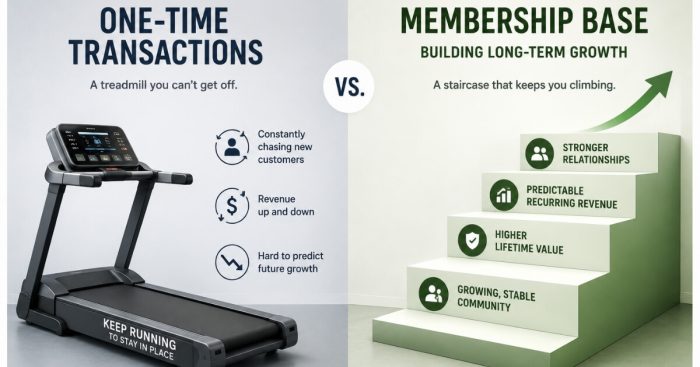
Scaling on one-time transactions traps you in an acquire-or-die cycle.
Every month resets to zero, and growth depends entirely on outrunning churn with new patient volume.
If your revenue is built on one-off purchases, you begin every month at the bottom of the hill.
Then you have to climb it again.
If you acquired 40 patients last month, you now need another 40 this month just to match it.
You need even more than that to grow.
One slow acquisition month means you cannot make the hire or investment you were planning.
The math is exhausting.
It is also fragile because your entire business depends on marketing performing perfectly every single month.
A membership model breaks that cycle.
Patients you have already converted continue paying.
As a result, new acquisition becomes growth on top of a stable base instead of a desperate effort to replace last month’s revenue.
The clinic stops being a treadmill.
Instead, it becomes a compounding asset.
That does not mean acquisition stops mattering.
It means a predictable patient acquisition system finally gets to do its real job.
Its purpose becomes growing the base rather than constantly refilling a leaking bucket.
How does a membership model reduce churn at a hormone clinic?
A membership model reduces churn because it converts the patient relationship from a series of one-time decisions into a single ongoing commitment.
The default becomes staying instead of re-deciding every visit.
When a patient has to actively choose to buy again each time, every refill becomes another opportunity to drop off.
When the patient is a member, continuing is automatic.
Leaving requires a deliberate cancellation.
The inertia works in your favor instead of against you.
That single shift—from re-deciding to staying by default—is one of the most powerful retention mechanics a cash-pay clinic has.
Hormone therapy is especially suited to this because the care is genuinely ongoing.
Patients need continued treatment, monitoring, and adjustment.
The membership aligns with that clinical reality instead of fighting it.
Low churn is the other half of the scaling equation.
Stable cash flow only exists if the membership base does not leak.
A membership that patients renew because the care is working, monitored, and convenient is what keeps the foundation solid enough to build on.
How does recurring revenue let me hire and invest to grow the clinic?
Recurring revenue lets you hire and invest because predictable cash flow makes forward commitments safer.
You can add a provider or open a location knowing the membership base will support it instead of betting everything on next month’s acquisition.
The hardest part of scaling a clinic is that growth requires spending ahead of revenue.
For example:
- You hire the provider before they are fully booked.
- You sign the lease before the new room is full.
- You increase ad spend before the returns arrive.
On one-time-transaction revenue, every one of those commitments is a gamble on next month’s marketing performance.
On membership revenue, the recurring base de-risks that bet.
You know roughly what is coming in each month.
That allows you to make investments with confidence.
Memberships do more than stabilize the clinic.
They give owners the financial confidence to pull the triggers that scaling requires instead of staying small because growth feels too risky.
The clinics that scale fastest in men’s hormone clinic marketing are the ones that built the recurring base first and then invested into it.
They are not the ones chasing volume with a transactional model.
Why is hormone therapy especially suited to a membership model?
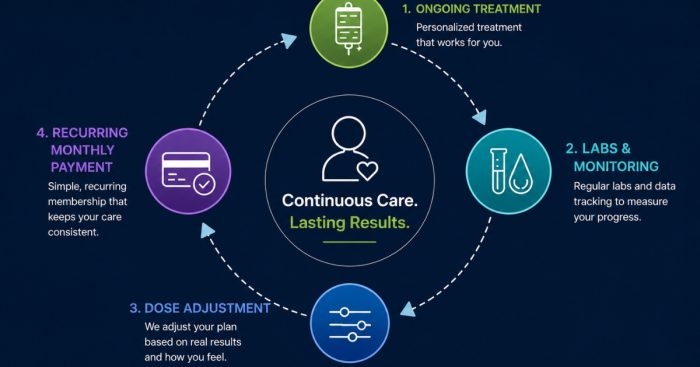
Hormone therapy is especially suited to membership because the treatment is inherently ongoing.
Patients need continuous treatment, monitoring, and dose adjustment.
As a result, a recurring model matches the medicine instead of forcing a subscription onto a one-time service.
TRT and HRT are not single procedures that patients buy once and walk away from.
Patients stay on therapy.
They return for labs and follow-ups.
They also need their protocol managed over time.
That clinical reality is exactly what a membership is built for.
It bundles the ongoing care into a predictable monthly relationship that is convenient for the patient and stable for the clinic.
This is why hormone clinics are some of the highest-LTV, lowest-maintenance cash-pay businesses there are.
The membership and the medicine are naturally aligned.
Compare that to a one-off aesthetic procedure.
There, you would be trying to invent a reason for the patient to keep paying.
With hormones, the reason is the treatment itself.
The owner does not have to manufacture recurrence.
They simply package the care the patient already needs into a model that captures it.
How do I move my hormone clinic from one-off pricing to a membership model?
Move to a membership model by packaging the ongoing care—visits, labs, monitoring, and treatment—into a single recurring monthly price.
Then build the systems that keep members enrolled and convert new patients onto the membership by default.
Start by defining exactly what a member receives each month.
That keeps the value clear and ensures the price reflects the ongoing care the patient already needs.
Next, make membership the default path at the point of sale instead of an upsell offered later.
The easiest member to retain is one who started as a member, not one you tried to convert after a one-time purchase.
Then layer in the retention systems that keep the membership base strong.
These include:
- Regular check-ins.
- Ongoing monitoring.
- Proof that the therapy is working.
Finally, make sure your patient-acquisition engine is feeding the membership rather than simply generating one-time consultations.
The goal is to convert new leads into recurring members.
That is what turns marketing spend into a compounding asset instead of a monthly expense.
Do that, and the recurring base becomes the foundation everything else scales on.
FAQ’s About Membership Models for Scaling a Hormone Clinic
Why is a membership model the key to scaling a cash-pay hormone clinic?
A membership model provides stable, predictable cash flow that makes it easier to invest and hire for growth.
Instead of needing to replace last month’s revenue with another wave of new patients, the recurring membership base supports the clinic.
That stability allows investments in providers, locations, systems, and marketing without relying entirely on monthly acquisition.
Scaling on memberships means building on an existing foundation rather than rebuilding revenue from zero every month.
Hormone care naturally fits this model because treatment is ongoing.
What’s wrong with scaling a hormone clinic on one-time transactions?
One-time transactions create an acquire-or-die cycle.
Every month starts from zero.
If you acquired 40 patients last month, you need another 40 this month just to maintain the same revenue.
Growth requires even more.
A membership model changes that dynamic.
Existing members continue paying, so new acquisition adds to an established foundation instead of replacing lost revenue.
The clinic becomes a compounding asset instead of a treadmill.
How does a membership model reduce churn at a hormone clinic?
Membership changes the patient relationship from repeated buying decisions into an ongoing commitment.
Patients no longer have to decide whether to purchase again at every refill.
Instead, staying becomes the default.
Because hormone therapy requires continued treatment, monitoring, and dose adjustments, the membership naturally aligns with the care patients already need.
That alignment supports lower churn and more stable recurring revenue.
How does recurring revenue let me hire and invest to grow the clinic?
Recurring revenue creates predictable cash flow.
That predictability makes hiring providers, opening locations, and increasing marketing spend far less risky.
Instead of gambling on next month’s acquisitions, the recurring membership base provides confidence that future revenue will support those investments.
Memberships make scaling financially sustainable.
Why is hormone therapy especially suited to a membership model?
Hormone therapy requires ongoing treatment, regular laboratory testing, monitoring, and protocol adjustments.
A recurring membership bundles those services into one predictable monthly relationship.
Unlike one-time procedures, hormone care naturally provides an ongoing reason for patients to remain engaged.
The membership supports the treatment instead of forcing recurrence where none exists.
How do I move my hormone clinic from one-off pricing to a membership model?
Package visits, laboratory testing, monitoring, and treatment into one recurring monthly membership.
Define the value clearly.
Make membership the default option at the point of sale.
Then support it with regular check-ins, monitoring, and proof that treatment is working.
Finally, ensure your patient-acquisition system is converting new leads into members rather than one-time consultation patients.
What’s the next step?
If your hormone clinic is stuck on the acquire-or-die treadmill—winning new patients every month just to stay flat and delaying hires because cash flow is unpredictable—the solution is not another advertising channel.
It is a recurring membership model that converts the patients you already have into a stable foundation you can build upon.
Package the ongoing care.
Make membership the default.
Keep churn low.
Feed the membership through your acquisition engine.
That is how a hormone clinic stops operating like a treadmill and starts compounding.
If you want help designing the membership, the retention systems, and the acquisition engine that feeds it for your specific clinic, that is the conversation to book.
We built this for Eternity Health Partners, which we grew from $1M to $4M a year on a 250-member recurring base at $1,000/month.