
How Do You Pair an Ad-Performance Review With Member Retention at a Cash-Pay Hormone or Weight-Loss Clinic?
Most cash-pay clinic owners run their ad review and their retention conversation in two different rooms, on two different days, as if they were two different problems. They are not. The ad spend decides what it costs to acquire a patient; retention decides whether that cost ever comes back. Reviewing one without the other is how clinics scale a channel that looks cheap and lose money anyway. This is the field-tested approach, grounded in a real cash-pay weight-loss and hormone clinic’s actual channel-by-channel ad numbers, on how to pair an ad-performance review with member retention so every dollar you spend on acquisition is defended by a patient who stays.
Why should a cash-pay clinic review ad performance and member retention together instead of separately?
Because ad performance and member retention are two halves of the same equation — the ads decide what it costs to acquire a patient, and retention decides whether that cost ever pays back, so reviewing them apart is like checking your revenue without checking your expenses.
A clinic can run a brilliant ad campaign and still lose money if patients churn before they recoup the acquisition cost.
Conversely, a mediocre campaign can be wildly profitable if retention is strong enough to compound each patient’s value over many months.
The number that ties them together is the ratio of customer acquisition cost to lifetime value, and you cannot see that ratio if you only ever look at one side of it.
At a real cash-pay weight-loss and hormone clinic, the per-channel customer acquisition cost ran from about $92.80 on Google up to $430.50 on Facebook in a single reporting period.
Whether either of those numbers is good depends entirely on how long the acquired patient stays and how much she spends over that time.
A $430 acquisition cost is a disaster if the patient leaves after one month and a bargain if she stays on a membership for two years.
That is why the ad review and the retention review have to happen in the same meeting.
One number is meaningless without the other, which is exactly the discipline we build into men’s hormone clinic marketing and every recurring-revenue vertical we run.
Which ad-performance metrics actually matter when reviewing a cash-pay clinic’s channels?
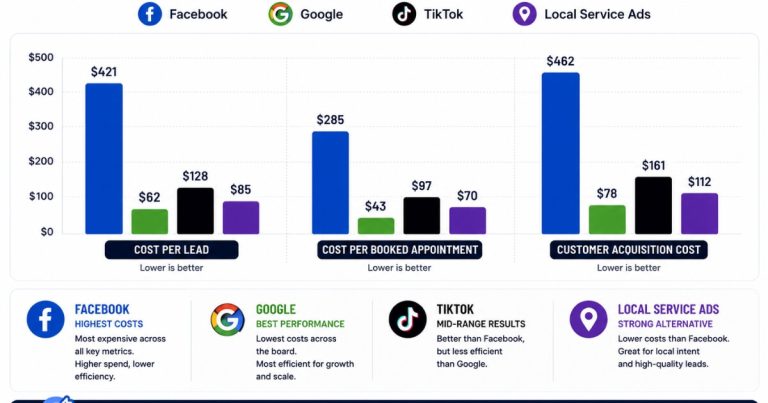
Cost per lead, cost per booked appointment, and customer acquisition cost per channel are the three metrics that matter — and you must compare them across channels, because the same clinic can see wildly different economics on Facebook, Google, TikTok, and Local Service Ads at the same time.
Averaging across channels hides the truth.
At a real cash-pay weight-loss clinic, a single reporting period showed:
- Facebook cost per lead around $19 to $27.
- Google cost per lead as low as $11.60.
- TikTok around $33.
The cost per booked appointment told an even sharper story:
- Google booked patients for as little as $12.54.
- Facebook ran $89 to $143 per booking.
The customer acquisition cost diverged further still: roughly $92.80 on Google versus $430.50 on Facebook.
The lesson is that you do not have one ad cost.
Instead, you have a portfolio of channel costs, and the review’s job is to find which channels are acquiring patients efficiently and which are leaking money.
The clinic that reviews a blended average never sees that Google was acquiring patients at a fifth of Facebook’s cost.
Break every metric out by channel, every month, or you are flying blind.
How does a clinic know whether a channel’s acquisition cost is too high?
A channel’s acquisition cost is too high only when it exceeds a healthy fraction of the patient’s lifetime value — there is no universal dollar threshold, because the same number is profitable for a recurring membership and ruinous for a one-time service.
The judgment is always relative to lifetime value, never absolute.
At a real cash-pay clinic, Facebook acquired patients at roughly $430.50 while Google did it at about $92.80 in the same period.
However, the Facebook number is not automatically bad.
If the patients Facebook brings in convert into a recurring membership worth several thousand dollars over their tenure, a $430 acquisition cost is still a strong return.
The right frame is the CAC-to-LTV ratio.
Aim to recover acquisition cost quickly and keep total lifetime value a healthy multiple of CAC.
The clinics that get this wrong shut off a channel because its raw acquisition cost looks high, without checking whether that channel brings in the longest-staying, highest-spending patients.
Sometimes the expensive channel is the most profitable one because of who it attracts.
You cannot answer “is this too high” from the ad dashboard alone.
You have to know what those specific patients are worth after retention is factored in.
What retention tactics protect the return on a cash-pay clinic’s ad spend?
The retention tactics that protect ad ROI are a structured follow-up cadence, a membership or program that creates a reason to stay, and proactive outreach before the churn window — because every patient you keep multiplies the return on the dollars you already spent to acquire her.
Retention is where ad spend either pays back or evaporates.
The first tactic is a built follow-up cadence — scheduled touchpoints in the first weeks and months that keep the patient engaged, surface results, and set up the next program before the current one ends.
The second is converting transactional patients into members, because a recurring membership turns a one-time acquisition into a compounding asset and is the single biggest lever on lifetime value at a cash-pay clinic.
The third is proactive churn prevention.
Identify the moments patients typically drop:
- A missed refill.
- A finished program.
- A stalled result.
Reach out before they disappear rather than after.
The fourth is using satisfaction surveys and results check-ins both to catch at-risk patients early and to harvest the testimonials that lower your future ad costs.
This recurring-membership discipline is exactly how we grew Eternity Health Partners from $1M to $4M a year on a base of 250 active members at $1,000/month.
None of these are ad tactics.
Yet all of them determine whether your ads were worth running.
Spend on acquisition, but defend the return with retention.
How do you calculate whether ad spend is profitable after factoring in retention?
You calculate it by comparing customer acquisition cost per channel against the realized lifetime value of the patients that channel actually delivers — not against first-visit revenue, because at a cash-pay clinic most of the profit shows up in months two through twenty-four.
The mistake is judging ad spend on the first transaction.
A patient acquired for $92.80 on Google or $430.50 on Facebook may spend only a few hundred dollars on the first visit.
If you stop counting there, the ads look break-even or worse.
However, a retained member on a recurring program keeps paying.
The true profitability calculation has to run the full tenure:
- Take the acquisition cost.
- Subtract it from the total revenue that patient generates over her entire relationship with the clinic.
- Only then do you know whether the channel made money.
This is why retention is the silent multiplier on ad ROI.
Improving retention from, say, three months to twelve months can turn a marginal channel into a highly profitable one without changing a single thing about the ads.
Run the math on lifetime value, segment it by channel, and you will often discover the channel you were about to cut is your best one.
Meanwhile, the channel you were proud of is barely breaking even.
What is the most common mistake cash-pay clinics make when reviewing ad performance?
The most common mistake is judging ad performance on cost per lead in isolation, ignoring which channel produces patients who actually stay — so clinics scale the cheapest leads and starve the channels that bring in the most retainable, highest-LTV patients.
Cheap leads are seductive and frequently worthless.
A channel can produce a low cost per lead and still be the worst channel you run if those leads do not book, do not show, or do not stay.
At a real cash-pay clinic, Google produced both a low cost per lead around $11.60 and a low cost per booked appointment around $12.54.
However, the only way to know Google was genuinely the better channel was to follow those patients downstream into bookings, memberships, and retention, not to stop at the lead cost.
The second half of the mistake is reviewing ads monthly while never reviewing retention at all.
As a result, the clinic optimizes the front of the funnel and ignores the back.
The fix is one combined review:
- Per-channel acquisition cost on one side.
- Per-channel retention and lifetime value on the other.
- Look at both together.
The clinics that scale do not chase the cheapest lead.
Instead, they chase the channel with the best acquisition-cost-to-lifetime-value ratio, and they defend it with retention.
FAQ’s About Pairing Ad Review With Member Retention
Why should a cash-pay clinic review ad performance and member retention together instead of separately?
Because ad performance and member retention are two halves of the same equation — the ads decide what it costs to acquire a patient, and retention decides whether that cost ever pays back, so reviewing them apart is like checking your revenue without checking your expenses.
A clinic can run a brilliant ad campaign and still lose money if patients churn before they recoup the acquisition cost.
Conversely, a mediocre campaign can be wildly profitable if retention is strong enough to compound each patient’s value over many months.
The number that ties them together is the ratio of customer acquisition cost to lifetime value.
At a real cash-pay weight-loss and hormone clinic, the per-channel customer acquisition cost ran from about $92.80 on Google up to $430.50 on Facebook in a single reporting period.
Whether either of those numbers is good depends entirely on how long the acquired patient stays and how much she spends over that time.
A $430 acquisition cost is a disaster if the patient leaves after one month and a bargain if she stays on a membership for two years.
That is why the ad review and the retention review have to happen in the same meeting.
One number is meaningless without the other.
Which ad-performance metrics actually matter when reviewing a cash-pay clinic’s channels?
Cost per lead, cost per booked appointment, and customer acquisition cost per channel are the three metrics that matter — and you must compare them across channels, because the same clinic can see wildly different economics on Facebook, Google, TikTok, and Local Service Ads at the same time.
Averaging across channels hides the truth.
At a real cash-pay weight-loss clinic, a single reporting period showed Facebook cost per lead around $19 to $27, Google cost per lead as low as $11.60, and TikTok around $33.
The cost per booked appointment told an even sharper story, with Google booking patients for as little as $12.54 while Facebook ran $89 to $143 per booking.
The customer acquisition cost diverged further still: roughly $92.80 on Google versus $430.50 on Facebook.
The lesson is that you do not have one ad cost.
Instead, you have a portfolio of channel costs, and the review’s job is to find which channels are acquiring patients efficiently and which are leaking money.
The clinic that reviews a blended average never sees that Google was acquiring patients at a fifth of Facebook’s cost.
Break every metric out by channel, every month, or you are flying blind.
How does a clinic know whether a channel’s acquisition cost is too high?
A channel’s acquisition cost is too high only when it exceeds a healthy fraction of the patient’s lifetime value — there is no universal dollar threshold, because the same number is profitable for a recurring membership and ruinous for a one-time service.
The judgment is always relative to lifetime value, never absolute.
At a real cash-pay clinic, Facebook acquired patients at roughly $430.50 while Google did it at about $92.80 in the same period.
However, the Facebook number is not automatically bad.
If the patients Facebook brings in convert into a recurring membership worth several thousand dollars over their tenure, a $430 acquisition cost is still a strong return.
The right frame is the CAC-to-LTV ratio.
Aim to recover acquisition cost quickly and keep total lifetime value a healthy multiple of CAC.
The clinics that get this wrong shut off a channel because its raw acquisition cost looks high, without checking whether that channel brings in the longest-staying, highest-spending patients.
Sometimes the expensive channel is the most profitable one because of who it attracts.
You cannot answer “is this too high” from the ad dashboard alone.
You have to know what those specific patients are worth after retention is factored in.
What retention tactics protect the return on a cash-pay clinic’s ad spend?
The retention tactics that protect ad ROI are a structured follow-up cadence, a membership or program that creates a reason to stay, and proactive outreach before the churn window — because every patient you keep multiplies the return on the dollars you already spent to acquire her.
Retention is where ad spend either pays back or evaporates.
The first tactic is a built follow-up cadence — scheduled touchpoints in the first weeks and months that keep the patient engaged, surface results, and set up the next program before the current one ends.
The second is converting transactional patients into members, because a recurring membership turns a one-time acquisition into a compounding asset and is the single biggest lever on lifetime value at a cash-pay clinic.
The third is proactive churn prevention.
Identify the moments patients typically drop:
- A missed refill.
- A finished program.
- A stalled result.
Reach out before they disappear rather than after.
The fourth is using satisfaction surveys and results check-ins both to catch at-risk patients early and to harvest the testimonials that lower your future ad costs.
None of these are ad tactics.
Yet all of them determine whether your ads were worth running.
Spend on acquisition, but defend the return with retention.
What’s the next step?
If you are reviewing your clinic’s ad performance every month but never reviewing retention in the same breath, you are optimizing half a business.
The channel with the cheapest lead is not automatically your best channel.
Likewise, the channel with the highest acquisition cost is not automatically your worst.
The answer lives in what those patients are worth after they stay.
Pair the two reviews and the picture finally makes sense.
That combined ad-and-retention review is exactly the conversation we run with hormone and weight-loss clinic owners — the same discipline that took Eternity Health Partners from $1M to $4M a year on the strength of a 250-member recurring base.
On the call we will look at your channel CACs and your retention together and show you where your real profit is.