
Do Hormone Quiz Funnels Actually Work for Getting Low-T Patients?
The 60-second symptom quiz is everywhere in hormone marketing right now.
“Take the Men’s Hormone & Metabolism Quiz, get your action plan.”
And clinic owners keep asking the same question: does this actually produce low-T patients, or just a pile of cheap leads that never book?
The honest answer is that quiz funnels work, but not the way most clinics run them.
The quiz is the front end of a system.
And the system is where the patients are won or lost.
This is the field-tested breakdown of when hormone quiz funnels convert, what makes them work, and how they really stack up against just letting patients book direct.
Do hormone quiz funnels actually convert into paying low-T patients, or just cheap leads?
Yes, they convert into paying patients — but only when the funnel is built to qualify, not just to collect.
A symptom quiz like a 60-second Men’s Hormone & Metabolism Quiz is the front end of a lead-gen system.
And the front end is supposed to produce cheap leads on purpose.
Why?
Because the quiz format lowers the commitment a cold man has to make.
The danger is treating the lead as the finish line.
A quiz lead is a man who just admitted he has:
- A belly that will not budge
- A 2 PM energy crash
- Low drive
- Bad sleep
That is a problem-aware buyer.
It is not a booked patient.
The conversion from lead to low-T patient happens in the three things most clinics skip:
- Fast follow-up within minutes
- A results page or call that connects his answers to a likely hormone or metabolic cause
- An offer to get his actual numbers checked
When those three pieces exist, the quiz outperforms direct booking on cost per acquired patient.
That is because it captures men who would never have clicked a “book a TRT consult” ad.
When those pieces do not exist, the same quiz produces a spreadsheet of leads and zero revenue.
Quiz funnels are one of the highest-leverage tools in patient acquisition for hormone clinics.
But only when the back end is built before the ads go live.
What makes a men’s hormone quiz funnel convert better than a generic “book a TRT consult” ad?
The quiz converts better because it meets a low-T man where his awareness actually is — at the symptom, not at the diagnosis.
Most men eligible for TRT do not wake up thinking, “I need testosterone.”
They think they are lazy, getting old, or losing willpower.
A “book a TRT consult” ad asks them to self-diagnose.
It also asks them to commit to a clinical-sounding appointment before they have accepted the problem.
That is why it only catches the small slice of already-decided men.
A quiz reframes the whole thing.
Hooks like “Not lazy. Low.” or “Training hard, getting softer?” name the symptom he is living.
Then they offer to explain it in 60 seconds with no doctor, no commitment, and no judgment.
By the time he finishes answering questions about belly fat, focus, drive, and sleep, he has talked himself into the idea that something measurable might be off.
The quiz also self-segments.
A man who checks three or more symptoms is a hotter lead than one who checks one.
That gives your sales team a built-in priority order.
That combination — lower entry commitment plus automatic qualification — is why the cost per qualified lead is almost always lower on a quiz than on a direct-booking ad for hormone offers.
What kills the conversion rate on a hormone quiz funnel?
Slow follow-up kills it first.
A disconnected results experience kills it second.
A quiz lead is warm for minutes, not days.
The man took the quiz on impulse because an ad named a problem he feels.
That impulse cools fast.
If your team calls him the next morning, you are calling a different, colder person.
The clinics that win quiz funnels follow up within minutes by text and call, every single time.
The second killer is a results page that does not pay off the promise.
The ad said “get your action plan” or “see if it’s hormones, nutrition, or lifestyle.”
So the results have to actually connect his answers to a likely cause and a clear next step.
Usually, that next step is getting his real numbers checked.
A generic “thanks, someone will contact you” page breaks the trust the quiz just built.
The third killer is targeting the wrong man entirely.
A quiz that runs to a broad audience fills your pipeline with leads who will never pay cash for hormone care.
The audience should be men 35-plus in high-responsibility roles.
That is why the source scripts feature:
- An executive dad
- A stalled lifter
- A pilot on layovers
- A business owner
Those identities self-select the buyer who has both the symptoms and the income.
Fix follow-up speed.
Fix the results payoff.
Tighten the audience.
Then the same funnel that was “not working” starts producing patients.
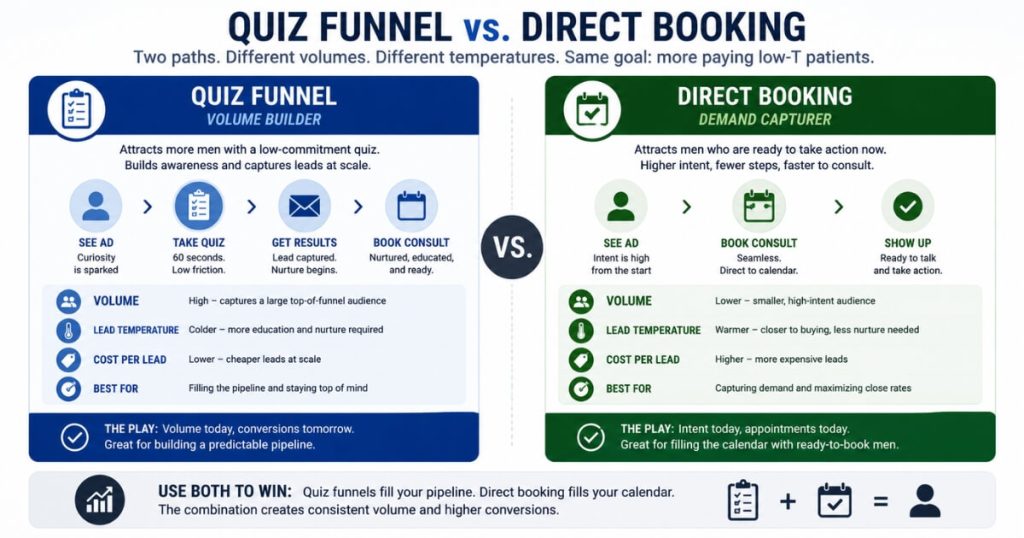
How is a hormone quiz funnel different from just letting patients book directly?
Direct booking captures demand that already exists.
A quiz funnel creates demand from men who have not decided yet.
Those are two different jobs, and most clinics need both.
Direct booking — a “schedule your hormone consult” page, ideally with a credit-card hold — produces the highest-quality, most-ready patients.
But the volume is capped at the number of men actively shopping for TRT right now.
That group is small.
A quiz funnel reaches one layer earlier in the awareness curve.
It captures the much larger group of men who feel the symptoms but have not connected them to hormones.
The trade-off is real.
Quiz leads come cheaper and in higher volume.
But they are colder.
They demand a real follow-up operation and a sales conversation.
Direct-booking patients are warmer and lower-volume.
They need almost no nurture.
The mistake is picking one.
The clinics that scale hormone revenue run direct booking and SEO to harvest the men who are already searching.
Then they run a quiz funnel on paid social and radio to manufacture pipeline from the men who are not.
A hormone clinic we work with at Eternity Health Partners now fields roughly 60 inbound calls a month because the top-of-funnel demand creation and the booking system run together.
The quiz feeds the top.
Direct booking and the sales team close the bottom.
Which channels should a hormone quiz funnel run on for low-T patients?
Paid social and short-form video first, with radio and podcast host-reads stacking on top.
That is where low-T-eligible men are scrolling and listening.
A 60-second quiz is purpose-built for short-form video.
Use channels like:
- YouTube Shorts
They let you open with a symptom hook like:
“High responsibility. Low energy?”
Then you send the click straight into the quiz.
Story-style creative built around a named character outperforms polished brand creative.
Example:
“Mark, 41, promotions up and energy down.”
Why does it work?
Because the man watching sees himself.
Radio is the underrated low-T and TRT channel, especially conservative talk radio.
It stacks naturally with a quiz because the host can send listeners to go take it.
Podcast host-reads work the same way.
Google and YouTube ads pick up the Product Aware men who are already searching for testosterone or TRT by name.
Those should usually run to a landing page or direct booking rather than a quiz.
That audience is further along.
The general rule from the patient-acquisition field is depth before width.
Pick the one channel where your symptom hooks land best.
Maximize it.
Then stack the second channel based on the demographic gap it fills.
The same multi-channel logic drove the result at NuLevel Wellness, where multi-channel ads brought in 3,727 new patients.
The channels were stacked deliberately, not run all at once.
How do you measure whether a hormone quiz funnel is actually working?
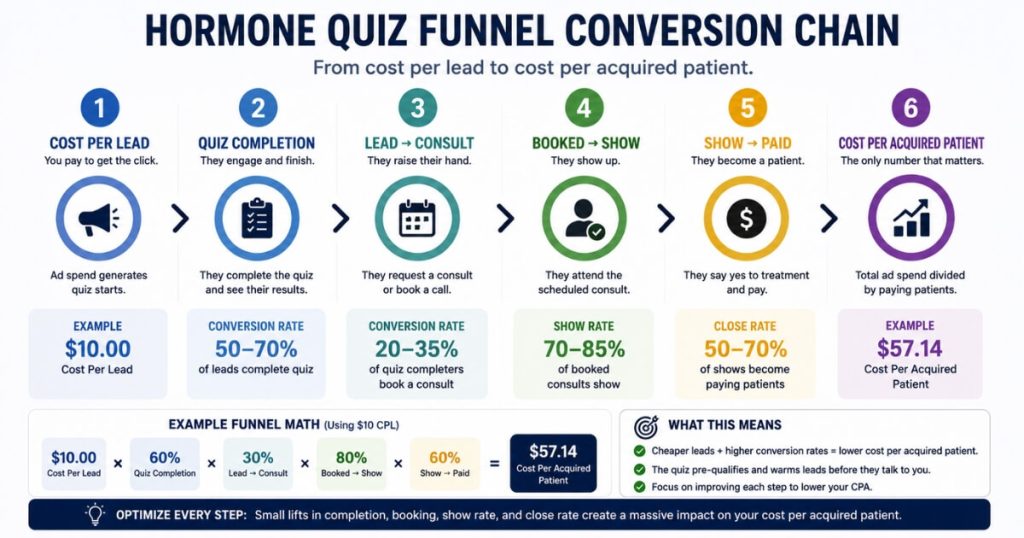
You measure it on cost per acquired patient and revenue.
Never judge it on lead count or cost per lead alone.
A quiz funnel will almost always show a low cost per lead.
That is the format doing its job.
So judging it there tells you nothing about whether it produces low-T patients.
Track the full chain:
- Cost per lead
- Quiz completion rate
- Lead-to-booked-consult rate
- Booked-to-show rate
- Show-to-paid rate
- Cost per acquired patient against lifetime value
Hormone care is recurring high-LTV cash-pay business.
A patient is worth thousands over time.
That means you can pay more per lead than the cost-per-lead number suggests.
The diagnostic power is in the chain.
If cost per lead is great but lead-to-consult is terrible, your follow-up or results page is broken.
Not the funnel.
If consults book but nobody shows, your reminder and qualification steps are weak.
If shows do not pay, your offer or sales conversation is the problem.
Fix the specific stage that is leaking.
Do not declare the whole quiz a failure.
That single-number “the quiz does not work” verdict is how clinics throw away funnels that were one fixed stage away from printing patients.
FAQ’s About Hormone Quiz Funnels
Do hormone quiz funnels actually convert into paying low-T patients, or just cheap leads?
Yes, they convert into paying patients — but only when the funnel is built to qualify, not just to collect.
A symptom quiz like a 60-second Men’s Hormone & Metabolism Quiz is the front end of a lead-gen system.
The front end is supposed to produce cheap leads on purpose.
Why?
Because the quiz format lowers the commitment a cold man has to make.
The danger is treating the lead as the finish line.
A quiz lead is a man who admitted he has a belly that will not budge, a 2 PM energy crash, low drive, and bad sleep.
That is a problem-aware buyer.
It is not a booked patient.
The conversion from lead to low-T patient happens in the three things most clinics skip:
- Fast follow-up within minutes
- A results page or call that connects his answers to a likely hormone or metabolic cause
- An offer to get his actual numbers checked
When those three pieces exist, the quiz outperforms direct booking on cost per acquired patient.
It captures men who would never have clicked a “book a TRT consult” ad.
When those pieces do not exist, the same quiz produces a spreadsheet of leads and zero revenue.
What makes a men’s hormone quiz funnel convert better than a generic “book a TRT consult” ad?
The quiz converts better because it meets a low-T man where his awareness actually is — at the symptom, not at the diagnosis.
Most men eligible for TRT do not wake up thinking, “I need testosterone.”
They think they are lazy, getting old, or losing willpower.
A “book a TRT consult” ad asks them to self-diagnose and commit to a clinical-sounding appointment.
That only catches the small slice of already-decided men.
A quiz reframes the whole thing.
Hooks like “Not lazy. Low.” or “Training hard, getting softer?” name the symptom he is living.
They offer to explain it in 60 seconds with no doctor, no commitment, and no judgment.
By the time he finishes answering questions about belly fat, focus, drive, and sleep, he has talked himself into the idea that something measurable might be off.
The quiz also self-segments.
A man who checks three or more symptoms is a hotter lead than one who checks one.
That gives your sales team a built-in priority order.
That combination — lower entry commitment plus automatic qualification — is why the cost per qualified lead is almost always lower on a quiz than on a direct-booking ad for hormone offers.
What kills the conversion rate on a hormone quiz funnel?
Slow follow-up kills it first.
A disconnected results experience kills it second.
A quiz lead is warm for minutes, not days.
The man took the quiz on impulse because an ad named a problem he feels.
That impulse cools fast.
If your team calls him the next morning, you are calling a different, colder person.
The clinics that win quiz funnels follow up within minutes by text and call, every time.
The second killer is a results page that does not pay off the promise.
The ad said “get your action plan” or “see if it’s hormones, nutrition, or lifestyle.”
So the results have to connect his answers to a likely cause and a clear next step.
Usually, that next step is getting his real numbers checked.
A generic “thanks, someone will contact you” page breaks the trust the quiz just built.
The third killer is targeting the wrong man entirely.
A quiz that runs to a broad audience instead of men 35-plus in high-responsibility roles fills your pipeline with leads who will never pay cash for hormone care.
Fix follow-up speed.
Fix the results payoff.
Tighten the audience.
Then the same funnel that was “not working” starts producing patients.
How is a hormone quiz funnel different from just letting patients book directly?
Direct booking captures demand that already exists.
A quiz funnel creates demand from men who have not decided yet.
Those are two different jobs, and most clinics need both.
Direct booking — a “schedule your hormone consult” page, ideally with a credit-card hold — produces the highest-quality, most-ready patients.
But the volume is capped at the number of men actively shopping for TRT right now.
That group is small.
A quiz funnel reaches one layer earlier in the awareness curve.
It reaches the much larger group of men who feel the symptoms but have not connected them to hormones.
The trade-off is real.
Quiz leads come cheaper and in higher volume, but they are colder.
They demand a real follow-up operation and a sales conversation.
Direct-booking patients are warmer and lower-volume.
They need almost no nurture.
The mistake is picking one.
The clinics that scale hormone revenue run direct booking and SEO to harvest the men who are already searching.
Then they run a quiz funnel on paid social and radio to manufacture pipeline from the men who are not.
The quiz feeds the top of the funnel.
Direct booking and your sales team close the bottom.
Which channels should a hormone quiz funnel run on for low-T patients?
Paid social and short-form video first, with radio and podcast host-reads stacking on top.
That is where low-T-eligible men are scrolling and listening.
A 60-second quiz is purpose-built for short-form video.
Facebook, Instagram, and YouTube Shorts let you open with a symptom hook like:
“High responsibility. Low energy?”
Then they send the click straight into the quiz.
Story-style creative built around a named character outperforms polished brand creative.
Example:
“Mark, 41, promotions up and energy down.”
That works because the man watching sees himself.
Radio is the underrated low-T and TRT channel, especially conservative talk radio.
It stacks naturally with a quiz because the host can send listeners to take it.
Podcast host-reads work the same way.
Google and YouTube ads pick up the Product Aware men who are already searching for testosterone or TRT by name.
Those should usually run to a landing page or direct booking rather than a quiz, because that audience is further along.
The general rule from the patient-acquisition field is depth before width.
Pick the one channel where your symptom hooks land best.
Maximize it.
Then stack the second channel based on the demographic gap it fills.
How do you measure whether a hormone quiz funnel is actually working?
You measure it on cost per acquired patient and revenue.
Never measure it on lead count or cost per lead alone.
A quiz funnel will almost always show a low cost per lead.
That is the format doing its job.
So judging it there tells you nothing about whether it produces low-T patients.
Track the full chain:
- Cost per lead
- Quiz completion rate
- Lead-to-booked-consult rate
- Booked-to-show rate
- Show-to-paid rate
- Cost per acquired patient against lifetime value
Hormone care is recurring high-LTV cash-pay business.
A patient is worth thousands over time.
That means you can pay more per lead than the cost-per-lead number suggests.
The diagnostic power is in the chain.
If cost per lead is great but lead-to-consult is terrible, your follow-up or results page is broken.
Not the funnel.
If consults book but nobody shows, your reminder and qualification steps are weak.
If shows do not pay, your offer or sales conversation is the problem.
Fix the specific stage that is leaking instead of declaring the whole quiz a failure.