
How Do You Onboard a New High-Ticket Regenerative Patient (Agreements & Expectations)?
A regenerative patient about to spend $5,000, $15,000, or $20,000 on a program does not behave like a $300 filler patient.
Onboarding them like one is how clinics end up drowning in no-shows, next-day cancellations, and refund requests.
The high-ticket regenerative buyer is usually a biohacker or a chronic researcher. They have already been let down by traditional medicine and have spent real time reading before they ever called you.
They will say yes to the right process and ghost the wrong one.
This is the onboarding playbook for that patient — the agreements, expectation-setting, deposits and financing, and follow-up cadence that turn an expensive maybe into a booked, paid, happy case.
What should be in a high-ticket regenerative patient agreement?
A regenerative patient agreement should spell out the exact scope of the program, the total price, the deposit and payment schedule, the realistic outcome range, the responsiveness window, and a clear, narrow refund and cancellation policy.
All of that should be in plain language the patient signs before any money or treatment changes hands.
Scope means the specific procedure, the sessions or visits included, and what is explicitly not included.
That way, there is no argument later about a second injection the patient assumed was free.
Price means the full program total, not a per-session number that lets the patient pretend the cost is smaller than it is.
The expectations section is the most important and the most skipped.
It states in writing that regenerative medicine improves function and reduces symptoms for many patients over weeks to months.
It also states that results vary by person and condition, and that no specific outcome is guaranteed.
The refund and cancellation section should be narrow and specific:
- Deposits are non-refundable once the workup begins.
- Cancellations require a set notice window.
- Refunds, if any, are tied to clearly defined conditions rather than to disappointment.
A patient who reads and signs that agreement has already done most of the work of becoming a good patient.
The goal is not to protect the clinic from the patient.
It is to make sure the patient who signs is the one who shows up, pays, and trusts the process.
If you are building this front-end from scratch, our stem cell clinic marketing playbook covers how the agreement fits the larger patient-acquisition machine.
Should regenerative clinics take a deposit before booking high-ticket patients?
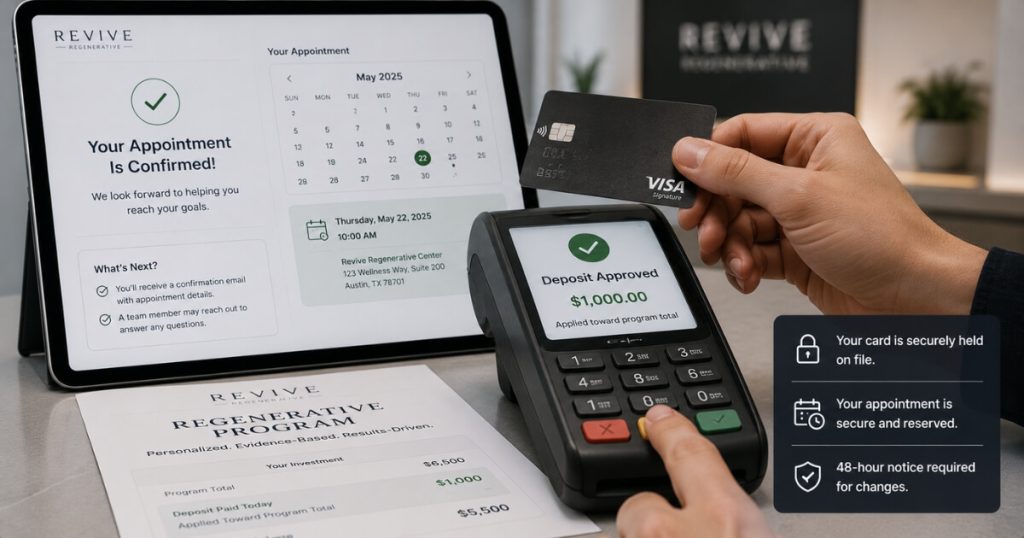
Yes — a deposit or a credit-card hold is the single highest-leverage change a regenerative clinic can make to cut no-shows and protect provider time on high-ticket cases.
A patient who has put money down behaves completely differently from one who only made a verbal commitment.
The deposit converts a soft intention into a real one.
It also filters out the tire-kickers before they consume a consult slot a serious patient could have used.
For a $5,000 to $20,000 program, a deposit of a few hundred to a couple thousand dollars is normal.
It is best framed as applied toward the total.
Tell the patient it secures their spot and is credited to their program.
Do not frame it as a penalty for changing their mind.
Pair the deposit with a signed agreement that makes it non-refundable once the diagnostic workup or labs begin.
Now you have removed the two biggest causes of lost revenue at the top of a high-ticket funnel:
- The no-show
- The next-day cold-feet cancellation
Clinics that skip the deposit out of fear of scaring patients away usually find the opposite.
It signals confidence.
And the patients who would have ghosted were never going to convert anyway.
How do you set realistic expectations for regenerative treatment outcomes?
You set expectations by telling the patient the truth in plain language, in writing and out loud, before they pay.
Regenerative medicine improves function and reduces symptoms for many people over weeks to months.
Results vary.
There is no guarantee.
High-ticket regenerative patients are usually biohackers and chronic researchers.
- They are people let down by traditional medicine who have spent real time reading before they ever called you.
- They do not want a hard sell.
- They will spot an over-promise instantly, because they have heard it from someone else already.
The conversation should cover:
- The realistic timeline to results
- The realistic range of outcomes for their condition
- What recovery looks like
- The follow-up cadence
Put the same language in the agreement they sign.
That way, the verbal conversation and the written record match.
Honest expectation-setting feels like it should lower conversion.
For this buyer, it does the opposite.
It builds the trust that makes them say yes.
It also eliminates the post-treatment disappointment that drives refunds and bad reviews.
The patient told the truth who got a good-but-not-miraculous result stays happy.
The patient promised a miracle who got a good result asks for a refund.
You can see what this trust-first approach produces in the practice of Dr. Joy Kong, who scaled her regenerative and aesthetics practice out of her own schedule by building a process patients believed in.
How do you reduce refunds and no-shows for high-ticket regenerative care?
You reduce refunds and no-shows by combining four things:
- A deposit
- A signed agreement with honest expectations
- A fast and structured follow-up cadence
- A sales process that screens for fit before the patient ever books
No-shows are mostly an answer-rate and follow-up problem.
Leads who are not contacted quickly and confirmed repeatedly are the ones who disappear.
Refunds are mostly an expectations problem.
Patients ask for their money back when reality does not match what they were promised.
That makes honest pre-treatment expectation-setting the cheapest refund-prevention tool that exists.
The deposit handles the cold-feet cancellation.
The signed agreement handles the disputed scope and disappointed-outcome refund.
The structured follow-up handles the forgot-or-got-busy no-show.
That includes:
- Confirmation calls
- Reminders
- A warm pre-visit touch
Underneath all of it is patient selection.
A clinic that qualifies hard, sets price and expectations clearly, and only books real-fit patients will have dramatically fewer refunds and no-shows than one that books everyone and sorts it out later.
The best show rates do not come from the scariest cancellation policies.
They come from the cleanest front-end.
The proof is in the numbers: Orthobiologics Associates reached a 79.4% lead-to-booked conversion rate by tightening exactly this kind of front-end sequence.
Should regenerative clinics offer financing or payment plans for high-ticket programs?
Yes — financing or in-house payment plans expand the pool of patients who can say yes to a $5,000 to $20,000 program without lowering your price or eroding the perceived value of the treatment.
Many patients genuinely want the care.
They also genuinely cannot write a single check for the full amount.
For them, financing is the difference between a booked case and a lost one.
Use a third-party medical financing partner for patients who qualify.
Offer a structured in-house plan with a meaningful deposit up front for those who prefer it or do not qualify elsewhere.
The key rule: financing should never become a way to avoid the deposit or the agreement.
The patient on a payment plan still signs the same agreement.
They still put real money down to start.
Present the program total first and the monthly option second.
That way, the patient anchors on the value and then sees financing as the bridge that makes it attainable.
Do not anchor on a small monthly number that makes the total feel like a trick.
There is a related tactic worth borrowing from membership programs: proration.
When a clinic credits a consult or lab fee toward the first program payment, the patient feels like they are getting that money back.
It is the same psychology that makes a membership discount on a $5,000 or $6,000 regen procedure feel like a no-brainer.
Done this way, financing protects your pricing and your margin.
It also converts the serious patient who simply needed a path to yes.
What does a complete regenerative patient onboarding sequence look like?
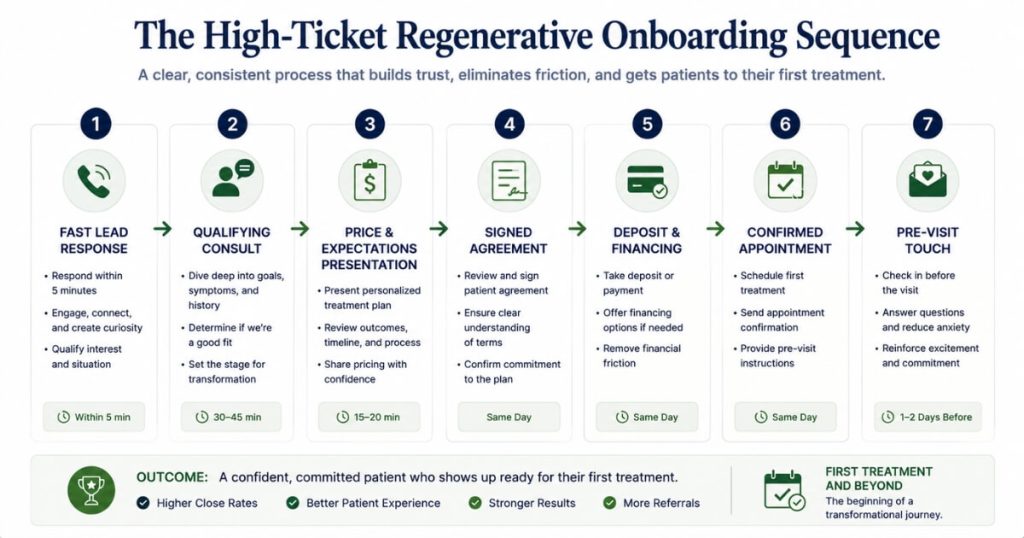
A complete sequence runs from first contact to first treatment in a fixed order:
- Fast lead response
- A qualifying consult
- A price-and-expectations presentation
- A signed agreement
- A deposit or financing arrangement
- A confirmed appointment
- A pre-visit touch that warms the patient before they walk in
It starts with answering or returning the lead fast.
The clinic that responds first usually wins the high-ticket patient.
The consult qualifies for fit before anyone talks scheduling.
That includes:
- Condition
- Expectations
- Ability to pay
The presentation lays out the program total and the honest outcome range together, so the patient buys with clear eyes.
Then the agreement is signed and the deposit or financing is collected in the same sitting.
That matters because the gap between yes and payment is where high-ticket patients cool off.
Only then is the appointment confirmed and entered into a CRM that triggers reminders automatically.
Finally, a pre-visit touch — a call or message that reconfirms the plan and answers last questions — turns a booked patient into one who actually shows.
Each step removes a specific failure point.
A clinic that runs all of them in order will out-convert and out-retain one that improvises the same steps differently every time.
The agreement and the expectation-setting are not paperwork bolted on at the end.
They are the load-bearing middle of the sequence.
They are what make the whole thing hold.
FAQ’s About Onboarding Regenerative Medicine Patients
What should be in a high-ticket regenerative patient agreement?
A regenerative patient agreement should spell out the exact scope of the program, the total price, the deposit and payment schedule, the realistic outcome range, the responsiveness window, and a clear, narrow refund and cancellation policy.
All of that should be in plain language the patient signs before any money or treatment changes hands.
Scope means the specific procedure, the number of sessions or visits included, and what is explicitly not included.
That prevents arguments later about a second injection or a follow-up that the patient assumed was free.
Price means the full program total, not a per-session number that lets the patient pretend the cost is smaller than it is.
The expectations section is the most important and the most skipped.
It states in writing that regenerative medicine improves function and reduces symptoms for many patients over weeks to months.
It also states that results vary by person and condition, and that no specific outcome is guaranteed.
The refund and cancellation section should be narrow and specific:
- Deposits are non-refundable once the workup begins.
- Cancellations require a set notice window.
- Refunds, if any, are tied to clearly defined conditions rather than to disappointment.
A patient who reads and signs that agreement has already done most of the work of becoming a good patient.
The goal is not to protect the clinic from the patient.
It is to make sure the patient who signs is the patient who shows up, pays, and trusts the process.
Should regenerative clinics take a deposit before booking high-ticket patients?
Yes — a deposit or a credit-card hold is the single highest-leverage change a regenerative clinic can make to cut no-shows and protect provider time on high-ticket cases.
A patient who has put money down behaves completely differently from a patient who has only made a verbal commitment.
The deposit converts a soft intention into a real one.
It filters out the tire-kickers before they consume a consult slot that a serious patient could have used.
For a $5,000 to $20,000 program, a deposit in the range of a few hundred to a couple thousand dollars is normal.
It is best framed as applied toward the total rather than as a fee.
The framing matters.
Tell the patient the deposit secures their spot and is credited to their program.
Do not frame it as a penalty for changing their mind.
Pair the deposit with a signed agreement that makes the deposit non-refundable once the diagnostic workup or labs begin.
Now you have removed the two biggest causes of lost revenue at the top of a high-ticket funnel:
- The no-show
- The next-day cold-feet cancellation
Clinics that skip the deposit because they are afraid of scaring patients away usually find the opposite.
The deposit signals confidence and seriousness.
The patients who would have ghosted were never going to convert anyway.
How do you set realistic expectations for regenerative treatment outcomes?
You set expectations by telling the patient the truth in plain language, in writing and out loud, before they pay.
Regenerative medicine improves function and reduces symptoms for many people over weeks to months.
Results vary.
There is no guarantee.
High-ticket regenerative patients are usually biohackers and chronic researchers.
They are people who have been let down by traditional medicine and have spent real time reading before they ever called you.
Also, they do not want a hard sell.
They will spot an over-promise instantly, because they have heard the over-promise from someone else already.
The expectation conversation should cover:
- The realistic timeline to results
- The realistic range of outcomes for their specific condition
- What the recovery or downtime looks like
- What the follow-up cadence will be
Put the same language in the agreement they sign.
That way, the verbal conversation and the written record match.
Honest expectation-setting feels like it should lower conversion.
But it does the opposite for this buyer.
It builds the trust that makes them say yes.
It also eliminates the post-treatment disappointment that drives refund requests and bad reviews.
The patient who was told the truth and got a good-but-not-miraculous result stays happy.
The patient who was promised a miracle and got a good result asks for their money back.
How do you reduce refunds and no-shows for high-ticket regenerative care?
You reduce refunds and no-shows by combining a deposit, a signed agreement with honest expectations, a fast and structured follow-up cadence, and a sales process that screens for fit before the patient ever books.
No-shows are mostly an answer-rate and follow-up problem.
Leads who are not contacted quickly and confirmed repeatedly are the ones who disappear.
Refunds are mostly an expectations problem.
Patients ask for their money back when reality does not match what they were promised.
That makes honest pre-treatment expectation-setting the cheapest refund-prevention tool that exists.
- The deposit handles the cold-feet cancellation.
- The signed agreement handles the disputed scope and the disappointed-outcome refund.
- The structured follow-up handles the simple forgot-or-got-busy no-show.
That includes:
- Confirmation calls
- Reminders
- A warm pre-visit touch from the team
Underneath all of it is patient selection.
A clinic that qualifies hard at the top of the funnel, sets price and expectations clearly, and only books patients who are a real fit will have dramatically fewer refunds and no-shows than a clinic that books everyone and sorts it out later.
The clinics with the best show rates are not the ones with the scariest cancellation policies.
They are the ones with the cleanest front-end process.
Should regenerative clinics offer financing or payment plans for high-ticket programs?
Yes — financing or in-house payment plans expand the pool of patients who can say yes to a $5,000 to $20,000 program without lowering your price or eroding the perceived value of the treatment.
Many patients genuinely want the care.
They also genuinely cannot write a single check for the full amount.
For those patients, financing is the difference between a booked case and a lost one.
Use a third-party medical financing partner for patients who qualify.
Offer a structured in-house plan with a meaningful deposit up front for those who prefer it or do not qualify elsewhere.
The key rule is that financing should never become a way to avoid the deposit or the agreement.
The patient on a payment plan still signs the same agreement.
They still put real money down to start.
Present the program total first and the monthly option second.
That way, the patient anchors on the value and then sees the financing as the bridge that makes it attainable.
Do not anchor on a small monthly number that makes the total feel like a trick.
Financing done this way protects your pricing and your margin.
It also converts the serious patient who simply needed a path to yes.
What does a complete regenerative patient onboarding sequence look like?
A complete sequence runs from first contact to first treatment in a fixed order:
- Fast lead response
- A qualifying consult
- A price-and-expectations presentation
- A signed agreement
- A deposit or financing arrangement
- A confirmed appointment
- A pre-visit touch that warms the patient before they walk in
It starts with answering or returning the lead fast.
The clinic that responds first usually wins the high-ticket patient.
The consult qualifies for fit before anyone talks scheduling.
That includes condition, expectations, and ability to pay.
The price-and-expectations presentation lays out the program total and the honest outcome range together.
That way, the patient is buying with clear eyes.
Then the agreement is signed and the deposit or financing is collected in the same sitting.
That matters because the gap between yes and payment is where high-ticket patients cool off.
Only then is the appointment confirmed and entered into a CRM that triggers reminders and confirmations automatically.
Finally, a pre-visit touch from the team — a call or message that reconfirms the plan and answers last questions — turns a booked patient into a patient who actually shows.
Each step removes a specific failure point.
A clinic that runs all of them in order will out-convert and out-retain a clinic that improvises the same steps in a different order every time.