
How Do You Convert Insurance Inquiries Into Cash-Pay DPC Members?
The most valuable phone call your practice gets every day starts with the worst possible question: “Do you take my insurance?” Most front desks answer yes or no. In doing so, they hand the entire conversation away. The moment you answer that question literally, you’ve agreed to compete on co-pays instead of on care. The clinics that build profitable direct primary care and membership models don’t dodge insurance callers. They convert them. This is the inside-sales playbook for turning “do you take my insurance?” into “Friday at 2 works great.” It covers the exact reframes, value language, and objection handling that move an insurance inquiry into a cash-pay DPC member.
Why Do Insurance Inquiries Convert to Cash Pay So Well?
Because the person asking about insurance is already a qualified lead. They have a problem. They’ve decided to seek care. And they’ve picked up the phone. The only thing they haven’t decided is who they’ll see and how.
That makes the inbound insurance call the highest-leverage moment in your entire patient acquisition funnel. The demand already exists, and you’re not paying to create it again.
The mistake almost every practice makes is treating “do you take my insurance?” as a verification task instead of a sales conversation. The caller is not really asking whether you’re in-network. They’re asking two underlying questions: can I afford to be seen, and how soon can I get in? Insurance is just the proxy they reach for, because it’s the only framework they know.
When you answer the literal question, you commit to competing on a $30 co-pay against every other in-network clinic in town. When you answer the underlying questions, you get to compete on availability and value — where cash-pay wins.
This is why a tight script matters more than a bigger ad budget for most practices. You’ve already generated the lead. Converting a higher percentage of inbound calls to cash-pay memberships costs nothing, and it compounds immediately. Every member you add is recurring revenue you keep month after month, rather than a one-time co-pay you bill, fight for, and discount.
What Do You Say When a Caller Asks “Do You Take My Insurance?”
Don’t answer yes or no. Pivot to availability first. The reframe that does the heavy lifting is: “Honestly, the biggest difference right now is going to be availability for you, so let me take a look.” That single sentence moves the conversation off the insurance rail. It lands on the one axis where cash-pay always wins. That axis is how fast the patient can actually be seen.
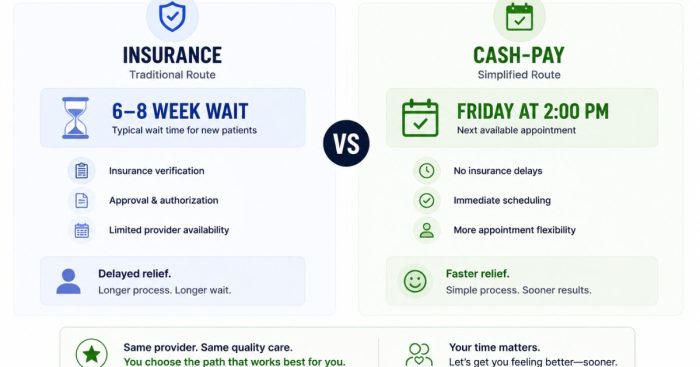
From there, the script surfaces the real insurance wait and immediately presents the alternative. “So it looks like right now we’re booked out about six to eight weeks for any new-patient insurance visits. But let me see what I can do.” Then: “So we can actually get you in as a new cash-pay patient, and it’s just $200 for your initial visit. I could get you in as soon as this upcoming week. Would that work better for you?”
You have just reframed the entire decision. The patient is no longer choosing between insurance and cash. They’re choosing between six weeks from now and this Friday. Almost nobody in pain or worry chooses to wait six weeks.
The structure matters. Lead with the availability gap. Name the cash price plainly, so there’s no mystery. Close the offer with a near-term date and a question. Notice the script never bashes insurance and never refuses it. It simply makes the cash-pay path the faster, clearer, more attractive option and lets the caller pick it. That honesty is what keeps the call ethical and the patient trusting.
How Do You Make a Cash-Pay Membership Sound Cheaper Than Using Insurance?
Compare the total annual cost, not the sticker price of one visit. The line from the field-tested script is: “We have cash-pay membership programs where it actually ends up being a bit cheaper than what your co-pays may be if you end up doing lab work or any a-la-carte stuff with us.” That one sentence quietly expands the patient’s frame. It moves them from thinking about one transaction to thinking about a full year of care.
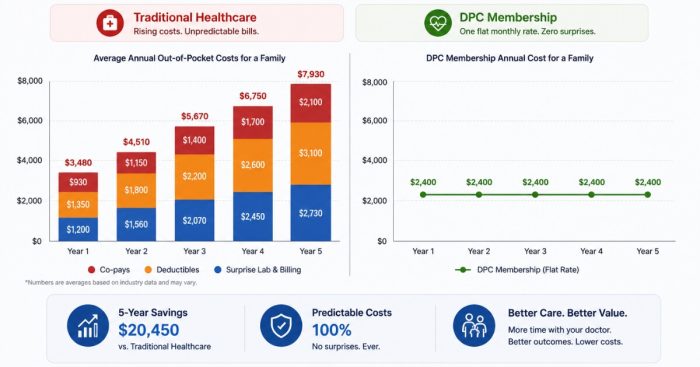
Left to their own math, patients compare a $30 co-pay to a $200 cash visit. They conclude cash is more expensive, and stop thinking. Your job on the call is to widen the comparison they’re running.
The real cost of insurance-based primary care over a year adds up fast. There are co-pays on every visit. There’s a deductible they pay out of pocket before anything is covered. There are surprise bills for labs and tests that “weren’t covered the way you thought.” And there’s the cost of waiting weeks for appointments. A flat membership that bundles unlimited visits, basic labs, and direct access to the physician routinely beats that total. But only if your front desk frames it as the annual comparison.
The value language that lands is concrete and patient-centered: “Members get exclusive access to things insurance patients don’t — same-week appointments, longer visits, and you can message the doctor directly.” You’re not selling a discount. You’re selling a different category of care that happens to cost less in aggregate. Price the initial visit clearly, name the membership benefits specifically, and let the math and the perks make the argument for you.
How Do You Handle the Most Common Objections on These Calls?
Acknowledge the objection, then reframe it. Never argue. Three objections account for the vast majority of these calls, and each has a clean, honest response that keeps the patient moving toward a booked appointment.
The first is “but I’m already paying for insurance.” Don’t dispute it. Reframe what insurance is for instead. “That makes sense — and your insurance is still there for hospitalizations, surgeries, and specialists. This membership is for the everyday primary care you actually use, and it’s built to be faster and more personal than what insurance gives you for that.” You’ve reframed the membership as a complement to their coverage, not a replacement. That dissolves the either/or framing.
The second is “what does cash pay actually get me?” This is the script’s favorite objection, because it’s a buying signal. Answer with access and exclusivity: “Our members get exclusive access to stuff insurance patients don’t get access to.” Then name the perks specifically.
The third is “I need to think about it.” Remove the risk and protect the date. Offer the low-cost initial visit with no membership commitment, so they can experience the difference firsthand before deciding anything. Across all three, the principle is identical. You are not winning a debate. You are removing the friction between the caller and a same-week appointment.
How Do You Close the Call Without a Hard Sell?
Use an assumptive close. Name a specific day and time rather than asking permission to book. The script doesn’t end with “would you like to schedule?” It ends with: “When’s your next available appointment? I can get you in Friday at 2.” You assume the booking has been agreed and offer a concrete slot. That makes saying yes the path of least resistance.
Hard-sell pressure backfires on healthcare calls, because the patient is making a trust decision, not a clearance-rack purchase. The assumptive close works precisely because everything before it has already done the persuading. You replaced a six-week wait with a same-week date. You replaced a confusing co-pay with a clear $200 price. And you handled the objection that was on the caller’s mind. By the time you name Friday at 2, the patient has no reason left to say no. The close is the easy part when the script ahead of it is built right.
One discipline separates clinics that convert from clinics that don’t. Every front-desk person runs the same script, every time, and the practice tracks the conversion rate on insurance inquiries the way it tracks ad spend. A script that lives only in the best receptionist’s head doesn’t scale. Written down, role-played, and measured, it becomes the most reliable growth lever in the building.
What Does Converting These Calls Do to the Numbers?
It can reshape the entire economics of the practice, turning an insurance-dependent clinic into a profitable cash-pay one. The phone is usually the single highest-leverage point in the funnel, because the lead has already raised their hand. Tightening the script that handles “do you take my insurance?” often returns more revenue than any new campaign you could launch.
The proof is in the practices doing it. Dr. Groysman’s SGB practice cut its insurance dependence in half by converting inbound demand into cash-pay treatment, instead of routing every caller into the insurance queue. Eternity Health Partners built a membership base of 250 members at $1,000 per month — a quarter-million dollars in recurring monthly revenue — by treating every inbound inquiry as a membership opportunity rather than a verification task.
That’s the real payoff of the script. Every insurance caller you convert to a cash-pay member is recurring revenue you keep. It’s a patient you can actually serve well, because you’re not capped by reimbursement. And it’s one less lead you have to pay to generate again. The demand is already calling. The only question is whether your front desk is equipped to convert it.
FAQ’s About Converting Insurance Inquiries to Cash DPC
Is it legal and ethical to steer an insurance caller toward cash pay?
Yes — as long as you are honest about both options and never misrepresent the patient’s insurance benefits. You are not refusing to see insurance patients or hiding that you accept insurance. You are presenting an accurate availability comparison and a clearly priced cash-pay alternative, then letting the patient choose.
The ethical line is misrepresentation. Do not invent a longer insurance wait than is real. Do not claim the patient’s plan won’t cover something you haven’t checked. Do not imply cash pay is required when it isn’t. Inside that line, leading with availability and value is simply giving the patient the full picture.
Most patients who call asking about insurance are really asking “can I afford to be seen and how soon.” A transparent cash-pay membership often answers both better than a co-pay does.
What do you say when a caller asks “do you take my insurance?”
Don’t answer yes or no first. Pivot to availability. The line that works is: “Honestly, the biggest difference right now is going to be availability for you, so let me take a look.”
Then surface the real insurance wait — six to eight weeks for a new-patient visit is common. Immediately offer the cash-pay alternative with a near-term date: “I can actually get you in as a new cash-pay patient as soon as this week, and it’s just $200 for your initial visit.”
You have reframed the entire decision, from “insurance vs. cash” to “six weeks from now vs. Friday at 2.” That is a far easier yes.
How do you make a cash-pay membership sound cheaper than using insurance?
You compare total annual cost, not the sticker price of one visit. The script line is: “We have cash-pay membership programs where it actually ends up being a bit cheaper than what your co-pays may be if you end up doing lab work or any a-la-carte stuff with us.”
Most patients only ever compare a $30 co-pay to a $200 cash visit, and stop there. The real comparison is the full year: co-pays on every visit, deductibles before anything is covered, surprise bills for labs and tests, and the value of their time.
A flat membership that bundles visits, basic labs, and direct access to the doctor frequently beats that math. But only if your front desk frames it as an annual comparison, instead of a single transaction.
What objections come up most, and how do you handle them?
The three most common are “but I’m already paying for insurance,” “what does cash pay actually get me?”, and “I need to think about it.” For the first, acknowledge it and reframe: their insurance still exists for hospitalizations and specialists, while this membership is for the primary care they actually use.
For the second, lead with exclusivity and access: “Our members get exclusive access to things insurance patients don’t get.” Then name the concrete perks — same-week appointments, longer visits, direct messaging with the doctor.
For “I need to think about it,” remove the risk and keep the date. Offer the low-cost initial visit with no membership commitment, so they can experience the difference before deciding. The goal is never to argue. It’s to make the cash-pay path the obviously easier and better choice.
Do you need a hard-sell closer to convert these calls?
No — the highest-converting close is an assumptive one. After the patient says the cash-pay option sounds good, the script doesn’t ask “would you like to book?” It says: “When’s your next available appointment? I can get you in Friday at 2.” You assume the booking and offer a specific slot.
Hard-sell pressure raises resistance on a healthcare call, where trust matters. An assumptive, helpful close lowers it. The entire conversation is engineered so that by the time you name a day and time, saying yes is the path of least resistance. You’ve already replaced a six-week wait with a same-week appointment, and replaced a confusing co-pay with a clear price.
How much does converting insurance inquiries to cash actually move the needle?
It can be the difference between an insurance-dependent practice and a profitable cash-pay one. Dr. Groysman’s SGB practice cut its insurance dependence in half by converting inbound demand into cash-pay treatment. Eternity Health Partners built a membership base of 250 members at $1,000 per month — a quarter-million dollars in recurring monthly revenue — by treating every inbound inquiry as a membership opportunity rather than an insurance-verification task.
The phone is usually the single highest-leverage point in the funnel, because the lead is already raising their hand. Tightening the script that handles “do you take my insurance?” often returns more revenue than any new ad campaign, because you’re converting demand you already paid to generate.