
How Do You Optimize Google and TikTok Ads for a Med Spa?
Most med spas are not losing money on ads because the platforms are broken. They ask Google and TikTok to do the same job. They leave dead ads running next to winners. They point their Google campaigns at a website that will never get approved. They grade everything on cost per lead while zero appointments actually get booked. This is the optimization playbook, pulled straight from the work. It covers what each channel is for, the creative and offers that convert, and what to cut and how fast. It also covers how to stop wasting spend on the wrong audience, and the one number that tells you whether any of it is working.
What Is the Difference Between What Google Ads and TikTok Ads Should Do for a Med Spa?
TikTok is your discovery engine. It finds patients for treatments they are not yet searching for. Google is your capture engine. It catches patients who already type your treatment name into the search bar.
These two channels play opposite roles. The most common med spa ad mistake is running the same offer the same way on both. TikTok skews female and aesthetic-curious. That makes it the place for a filler special, a PRP microneedling deal, or a laser offer to find brand-new patients who were scrolling, not shopping. The job there is to interrupt, intrigue, and pull people into your funnel cheaply.
Google does the opposite. Someone searching “botox near me,” “lip filler,” or “CO2 laser” already knows what they want. They are choosing who to buy from. The job there is to put a fast, on-message landing page in front of that intent and convert it before a competitor does.
Run TikTok to build demand and feed the calendar at a low cost per lead. Run Google to capture the demand that already exists at higher intent. This split follows the same logic as the broader treatment-to-channel map for cash-pay clinics. You can see the full map on the med spa marketing hub.
When you ask each channel to do the other one’s job, both underperform. TikTok cannot out-convert pure search intent. Google cannot manufacture demand that does not exist yet.
How Do You Know Which Med Spa Ad to Keep Running and Which to Turn Off?
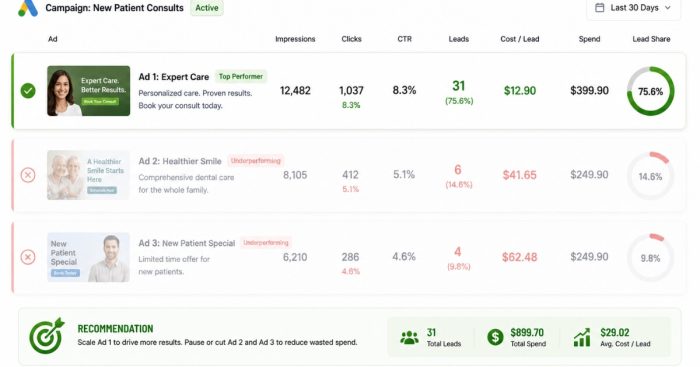
Look at where the leads are actually coming from. Don’t just count how many ads are live. Concentrate budget on the single offer producing them.
Here is what that looks like in a real account. A Seattle aesthetics clinic ran three TikTok ads on a fifty-dollar-a-day budget. On the surface it looked like a healthy, diversified setup. But out of eleven total leads, nine came from one offer — a six-hundred-dollar-off PRP microneedling with collagen deal.
That ad was the unambiguous winner. A SilFirm ad in the same account produced almost nothing, so the team killed it immediately. A dead ad sitting in a shared campaign quietly steals impressions and spend from the performer next to it. A lip filler ad had pulled only one lead, so the team kept it on a short leash to give it a fair window.
The decision rule is simple. Identify the offer carrying the lead volume. Kill the ones that have had enough spend to prove themselves and did not. Never let a sentimental or untested ad cannibalize the winner.
There is a second, related rule that trips up almost everyone. Don’t drop a new creative into your best-performing campaign. A new ad in the winning campaign competes against your own top performer and steals its budget. Build a separate campaign for each new creative instead. Run them against each other so you can read the results cleanly, without muddying your only proven asset.
Why Are My Med Spa Google Ads Getting Disapproved and Barely Spending?
Your website is the likely culprit. If it contains restricted medical content — semaglutide, tirzepatide, HRT, or TRT — it trips Google’s healthcare and medication policies. This happens even when you are only advertising filler.
This is one of the most expensive silent failures in med spa advertising. The budget looks set. The campaigns look live. But almost nothing actually spends. In one real case, a clinic told Google it could spend up to a hundred and sixty-five dollars a day. Across seven days that should have allowed over eleven hundred dollars of spend.
The account actually spent three dollars and forty-seven cents. Google limited or disapproved nearly every ad and asset group by policy. The single lead it managed to scrape together cost two hundred and twenty-five dollars. The offer wasn’t the problem. Google was throttling the entire account over website content that had nothing to do with the ads.
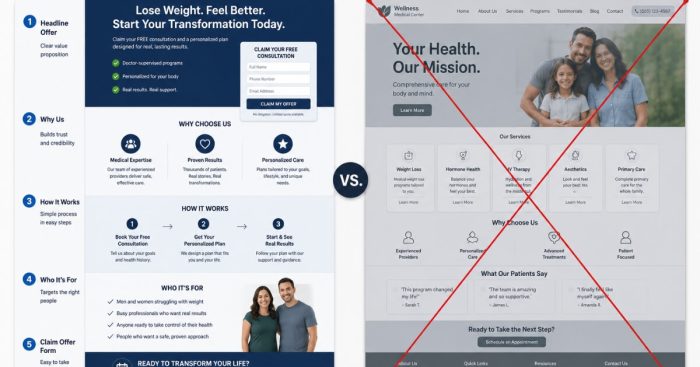
Don’t argue with the platform or wait weeks on an ad team to rebuild your site. Instead, stop running ads to the full website. Build a dedicated, single-offer landing page containing only the treatment you are advertising. Include the offer, a why-us section, how-it-works, who-it-is-for, and a single claim-offer form.
Host that page in your own funnel system. This also repairs conversion tracking, since you own the form and the thank-you page. A clean, single-purpose landing page gets approved. It spends the budget you set. And it converts intent that was previously being thrown in the trash.
What Creative and Offer Actually Work in Med Spa TikTok Ads?
The creative that wins on med spa TikTok is a real video of the procedure being performed, or an authentic patient story. State the offer plainly inside the ad. Skip the polished brand b-roll.
The aesthetic audience on TikTok is primarily female. They respond to seeing the actual treatment and a believable result far more than to a logo-driven brand spot. Where you can get consent, footage of the procedure itself outperforms almost anything else. It answers the unspoken question every scroller has: what does this actually look like, and is it real?
Authentic patient stories do the same work. The polish that wins brand awards on other channels tends to read as an ad on TikTok. And people scroll past ads.
The offer carries as much weight as the creative. A strong, specific, seasonal deal like six hundred dollars off PRP microneedling with collagen massively outperformed vaguer or higher-friction offers in the same account. It pulled nine of eleven leads on its own. State the price or the discount inside the ad so the scroller self-qualifies before they ever click.
Protect your testing discipline. Build a separate campaign for each new creative, rather than stacking them into your winner. Let them compete against each other. Done right, TikTok will deliver a lower cost per lead than any other paid channel for aesthetic offers. You’ll also build a roster of proven winners you can rebuild into always-on campaigns once a promotion ends.
How Do You Reduce Wasted Med Spa Ad Spend on the Wrong Audience?
Tighten your targeting based on what the lead data is telling you. Usually that means income level and geography. Accept that a small amount of out-of-area reach is unavoidable on TikTok.
When the leads coming in do not match the patient you want, pull the income-targeting lever first. One clinic kept generating leads who could not commit to paying. They added income targeting to filter for buyers who can actually afford cash aesthetics. That’s the right instinct: cheap leads who never buy are not cheap.
Geography is the second lever, but it comes with a caveat that confuses a lot of owners. On TikTok, a person far outside your service radius can still see your ad. That happens because someone in their social circle engaged with it. A single lead from two hundred miles away is usually a circle-of-influence artifact, not a targeting failure. Tightening the radius too aggressively in response can starve a campaign that is otherwise working.
The bigger source of wasted spend is almost always upstream of audience settings. Look for a policy-flagged website that will not let Google spend, or a non-converting ad squatting in a shared campaign. Fix the structural leaks first. Then refine income and radius based on the quality of the leads you are actually pulling.
This is exactly the kind of diagnosis that compounds at scale. At a weight-loss and medspa clinic, the same disciplined channel work helped add $6.7M in revenue in one year across 3,727 new patients. The clinic didn’t get there by chasing more channels. It cut waste and concentrated spend where the right buyers actually were.
How Should a Med Spa Measure the Real Cost of a Booked Appointment From Ads?
Measure cost per booked-and-held appointment, not cost per lead. Med spa leads routinely look cheap, but the booked-appointment math tells the truth.
A clinic can generate eleven leads at a great cost per lead and still book zero appointments. Maybe no one answers the phone. Maybe the leads do not speak the language the front desk speaks. Maybe follow-up just drags. That gap between a lead and a held appointment is where most med spa ad budgets quietly die. Cost per lead hides it completely.
To measure what actually matters, track the full chain: leads, contacted, conversations that went somewhere, deposits paid, appointments booked, and appointments held. Divide spend by held appointments and you get your true number. That’s the one number that reflects both the ad and the operation behind it.
Two structural fixes protect that number. First, take a deposit or a card hold at the moment of booking, so the appointment actually holds instead of evaporating. Second, close the operational leaks sitting right next to your ads. Even something as small as a phone that rings ten times after hours before reaching voicemail will make impatient callers hang up, turning paid leads into abandoned calls.
The best ad in the world still loses to slow follow-up. That’s why dialed-in operations turn paid spend into outsized returns. You can see that difference in results like an orthopedic surgical practice that added $2M in revenue from Facebook ads alone. The ads were good, but the follow-up and the booking process were what banked the money.
FAQ’s About Optimizing Med Spa Google and TikTok Ads
What is the difference between what Google ads and TikTok ads should do for a med spa?
TikTok is your discovery engine for treatments people are not yet searching for. Google is your capture engine for the patients already typing your treatment name into the search bar. They are not interchangeable. The biggest med spa ad mistake is running the same offer the same way on both.
TikTok skews female and aesthetic-curious. It’s where a filler special, a PRP microneedling deal, or a laser offer goes to find new patients who were scrolling, not shopping. The creative is a video of the procedure or a real patient story, with the offer stated in the ad.
Google catches the bottom of the funnel. Someone searching botox near me, lip filler, or CO2 laser already knows what they want and is choosing who to buy from. The Google job is to put a fast, on-message landing page in front of that intent and convert it before a competitor does.
Run TikTok to build demand and feed the calendar at a low cost per lead. Run Google to capture the demand that already exists at a higher intent. When you ask each channel to do the other one’s job, both underperform.
How do you know which med spa ad to keep running and which to turn off?
Look at where the leads are actually coming from, not how many ads are live. Concentrate budget on the single offer producing them. In a real example from a Seattle aesthetics clinic, three TikTok ads ran on a fifty-dollar-a-day budget. Out of eleven total leads, nine came from one offer — a six-hundred-dollar-off PRP microneedling with collagen deal.
That ad was the clear winner. A SilFirm ad in the same account produced almost nothing, so the team turned it off immediately. A dead ad in a shared campaign quietly steals impressions and spend from the winner. A lip filler ad had pulled only one lead, so the team kept it on a short leash.
The decision rule is simple. Identify the offer carrying the lead volume. Kill the ones that are not converting after they have had enough spend to prove themselves. Don’t let a sentimental or untested ad cannibalize the performer. Past a seasonal promotion, the winning offer is the one worth rebuilding into an always-on campaign, because the leads have already told you what people want.
Why are my med spa Google ads getting disapproved and barely spending?
Your website is the likely culprit. If it contains restricted medical content — semaglutide, tirzepatide, HRT, or TRT — it trips Google’s healthcare and medication policies, even when you are only advertising filler.
In the field this looks dramatic. One clinic told Google it could spend up to a hundred and sixty-five dollars a day. That should have allowed over eleven hundred dollars across seven days. It actually spent three dollars and forty-seven cents, because Google limited or disapproved nearly every ad and asset group by policy.
Don’t argue with Google or wait on the ad team. Instead, stop running ads to the full website. Build a dedicated, single-offer landing page that contains only the treatment you are advertising — the offer, why-us, how-it-works, who-it-is-for, and a claim-offer form.
Host that page in your own funnel system. This also fixes conversion tracking, since you control the form and the thank-you page. A clean, single-purpose landing page gets approved, spends the budget, and converts intent the old setup was throwing away.
What creative and offer actually work in med spa TikTok ads?
The creative that wins on med spa TikTok is a real video of the procedure being performed, or an authentic patient story. State the offer plainly inside the ad. Skip the polished brand b-roll. The aesthetic audience on TikTok is primarily female, and they respond to seeing the actual treatment and a believable before-and-after far more than to a logo-driven brand spot.
The offer matters as much as the creative. In practice, a strong, specific, seasonal deal like six hundred dollars off PRP microneedling with collagen massively outperformed vaguer or higher-friction offers in the same account. It pulled nine of eleven leads on its own.
State the price or discount in the ad so the scroller self-qualifies. Capture consent and use footage of the procedure where you can. And don’t pile every new creative into your best campaign. A new ad dropped into the winning campaign competes against your own top performer and steals its budget. Build a separate campaign for each new creative instead, and let them run against each other so you can read the results cleanly.
How do you reduce wasted med spa ad spend on the wrong audience?
Tighten your targeting based on what the lead data is telling you. Usually that means income level and geography. Accept that some out-of-area impressions are unavoidable on TikTok.
When the leads coming in do not match the patient you want, pull the income-targeting lever first. One clinic kept getting leads who could not commit, so it added income targeting to filter for buyers who can actually pay cash for aesthetics.
Geography is the second lever, but with a caveat. On TikTok, a person far outside your radius can still see an ad because someone in their social circle engaged with it. A single lead from two hundred miles away is often a circle-of-influence artifact, not a targeting failure. Over-tightening the radius can starve a working campaign.
The bigger source of wasted spend is usually upstream of targeting. Watch for ads running to a policy-flagged website that will not spend, or a non-converting ad sitting in a shared campaign. Fix those first. Then refine income and radius based on the quality of the leads you are actually getting.
How should a med spa measure the real cost of a booked appointment from ads?
Measure cost per booked-and-held appointment, not cost per lead. Med spa leads routinely look cheap, but the booked-appointment math tells the truth. A clinic can generate eleven leads at a great cost per lead and still have zero booked appointments. Maybe no one answers the phone. Maybe the leads do not speak the language the front desk speaks. Or maybe follow-up is just slow.
The gap between lead and booking is where med spa ad budgets die. To measure it, track the full chain — leads, contacted, conversations that went somewhere, deposits paid, appointments booked, appointments held. Divide spend by held appointments to get your true number.
Two structural fixes protect that number. Secure a deposit or card hold at booking, so the appointment actually holds. And fix the operational leaks around the ads, like a phone that rings ten times after hours before reaching voicemail, which makes impatient callers hang up.
The best ad in the world still loses to a slow follow-up process. The booked-appointment cost is the only metric that reflects both the ad and the operation behind it.