
How Do You Align Paid Ads With Your Sales Process So Leads Actually Convert?
Most cash-pay clinics think they have an ad problem. They almost always have a sales-process problem. A paid ad buys you attention — a stranger raising their hand — and nothing more. What turns that hand-raise into cash is everything after the click. How fast you call. What your booker knows before the consult. Whether you hold the appointment with a card. And whether the whole chain is wired together, or stitched from parts. This is the honest answer to why ad leads die without a matching sales process — and how to connect ads to speed-to-lead, a qualified consult, and a close.
Why Do Paid-Ad Leads Die Without a Matching Sales Process at a Cash-Pay Clinic?
A paid ad only buys you attention. The sales process is what turns that attention into cash. Most cash-pay clinics spend everything optimizing the ad. Meanwhile, the process that’s supposed to catch the lead stays half-built.
A GLP-1, hormone, or weight-loss lead is a stranger who raised their hand — not a buyer yet. So what happens if nobody calls them inside minutes? Or if the person who does call is reading a thin script with no patient data in front of them? Or if there’s no credit card to hold the consult, and the booking lives in a calendar nobody is watching?
The lead evaporates. It doesn’t matter how good the ad was.
We see clinics run three platforms at once on tiny budgets. Meanwhile, the intake form collects only contact info, and the offshore booker can’t even take payment. In that picture, the ad isn’t the bottleneck. The process is.
So how do you fix it? Treat the ad and the sales process as one connected system. The ad sets the expectation. The funnel captures qualifying data. An automation alerts a human to call fast. The consult uses that data to close. And a payment step filters out the people who were never going to buy.
Skip any link, and you’re paying for leads the process simply cannot convert. This is the core discipline behind every patient acquisition system that scales — the ad is one-fifth of the machine, not the whole machine.
How Fast Do You Need to Call a Paid-Ad Lead, and How Do You Make Speed-to-Lead Automatic?
You should be calling a paid-ad lead within minutes, not hours. The only reliable way to hit that target is to automate the alert, so a human is told to dial before the lead cools.
A cash-pay lead from a TikTok, Facebook, or Google ad is at peak intent the moment they submit. Every hour you wait, the close rate drops. Meanwhile, the patient moves on to the next clinic they find.
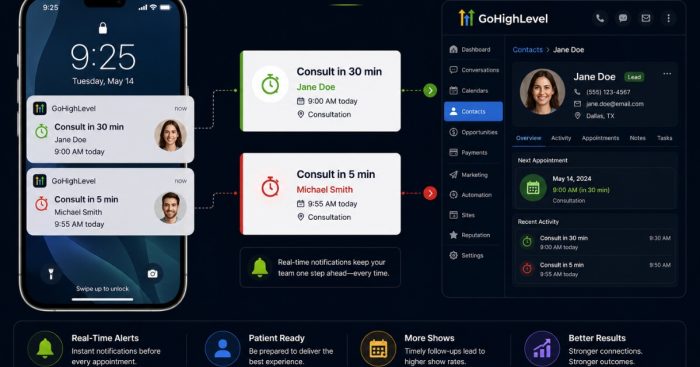
So how do you make speed-to-lead automatic? Build the booking into a funnel that fires automations the instant a lead arrives. The system should push the appointment into the schedule right away. Then it should ping the team with alerts — one when the consult is 30 minutes out, another at 5 minutes out. That way, nobody has to remember to check a calendar.
Who calls, and from where, matters too. Have the booker call from inside your CRM — GoHighLevel, for example — so every call is recorded and tied to the patient profile. As a result, you get a coachable record and a single source of truth, instead of calls scattered across personal cell phones.
Speed-to-lead isn’t a personality trait you hope your team has. It’s an automation you wire once and enforce. Ultimately, the clinic that wins the lead is simply the one that calls first.
What Information Should the Intake Form and Booking Script Collect Before the Consult?
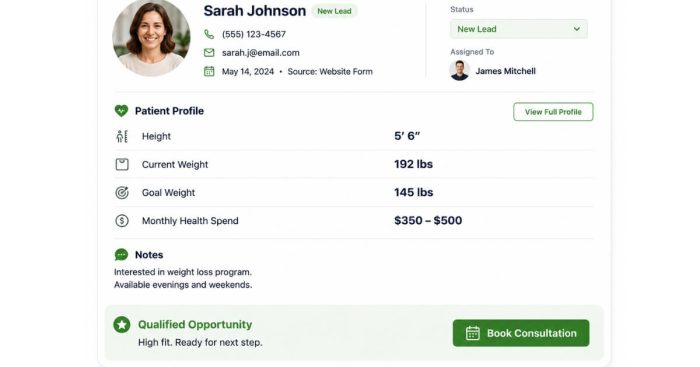
The intake form and booking script should collect the qualifying data your consultant needs to sell. For weight loss, that means height, current weight, goal weight, and current monthly health spend — not just a name and a phone number.
A common and costly mistake is stripping the form down to contact info to make booking faster. Then the booker enters dummy data for everything else. This feels efficient, but it actually hands the consultant a blank profile. As a result, they spend the first half of the call gathering basics the form should have captured.
So what happens when the real data is already in the CRM before the consult? The consultant can open with the patient’s own numbers: “I see your current weight is here and your goal is here — what have you tried so far?” It’s faster, more personal, and it lands straight on the patient’s motivation.
The monthly-health-spend question is the most powerful of all. Why? Because asking how much someone already spends across their gym membership, supplements, and nutrition frames the clinic’s price as an investment they’re already making — before any number is even quoted.
If you must keep the public form short to lift submission rates, that’s fine. Just push the qualifying questions into the booker’s script instead, so the data still lands in the profile. Either way, the consultant should never walk into a call blind.
Should You Take a Credit Card to Hold the Consult, and Who Should Collect It?
Yes. A credit-card hold on the consult is the single best filter for separating buyers from tire-kickers. However, it has to be collected by someone the patient trusts — and that usually isn’t an offshore booker.
The credit card does two things at once. First, it dramatically cuts no-shows, because the patient now has skin in the game. Second, it pre-qualifies intent, so the consultant spends time only on people who are serious.
Here’s the friction: patients won’t hand a card to a booker they perceive as a faceless offshore voice. Frankly, they’re right not to. So the fix isn’t to abandon the card — it’s to route it to a trusted point in the process. Collect it on a secure scheduling page tied to the funnel. Or have an in-house team member take it during confirmation, rather than asking the offshore booker to do it on the first call.
The mistake we see repeatedly? Clinics build a separate, shorter, no-credit-card calendar to avoid that awkward moment. But this quietly removes the exact filter that was protecting the consultant’s time.
So keep the payment step in the system. Just move it to a moment and a person where the patient feels comfortable. After all, the hold isn’t really about collecting money on day one — it’s about only putting qualified, committed people in front of your closer.
Should a Cash-Pay Clinic Run Multiple Ad Platforms at Once or Focus the Budget on One?
A cash-pay clinic should focus the budget on one platform until it’s working, then expand. Running TikTok, Facebook, and Google simultaneously on small budgets almost always means three platforms going slow, instead of one platform going fast.
The instinct to “see if anything sticks” is understandable. However, spreading thin starves every channel of the data it needs to optimize.
Google is the clearest example. Feed a conversion campaign only $10 a day, and you’re telling Google to play with one arm tied behind its back. If a single click on a high-intent term costs a few dollars, a $10 budget gets spent in three clicks. As a result, the algorithm never gathers enough signal to learn who actually converts. As a rule of thumb, we don’t recommend running a Google search campaign below about $40 a day — the platform needs volume to optimize toward conversions.
But here’s the deeper point: focus isn’t only a media-buying decision. It’s a sales-process decision. One platform producing a steady, predictable flow of leads lets you fix the booking script, the speed-to-lead automation, and the consult — before you ever scale spend.
Three trickles across three platforms make it impossible to tell what’s working. Worse, it doesn’t give your team enough reps to get good at the call. So pick one channel, fund it properly, and get the whole chain converting. Only then should you add the second.
How Do You Wire Ads to Speed-to-Lead to Consult to Close as One Connected System?
You wire it by treating the ad, the funnel, the automation, the consult, and the payment as five links in one chain. Importantly, you don’t scale spend until every link holds.
Start at the ad. It should set an honest expectation of the offer and the next step. From there, the funnel captures the qualifying data — height, current and goal weight, monthly health spend — and writes it to the patient profile in the CRM.
The instant the lead submits, an automation books the appointment. It also alerts the team at 30 minutes and 5 minutes before the call. The consult is then run by a trusted human calling from inside the CRM, so it’s recorded. They open with the patient’s own numbers and frame price against the spend the patient already volunteered. Finally, a credit-card step — placed where the patient is comfortable — holds the appointment and filters out the unqualified.
Each link feeds the next. The ad determines lead quality. The captured data determines consult quality. The speed determines contact rate. And the payment determines show and close rate.
So when one platform’s chain is fully converting, scale that budget. Only then should you duplicate the system onto a second channel.
This is what dialed-in execution looks like at scale. For example, an orthopedic surgical center that added $2M in revenue from Facebook ads alone did it because the offer, the ad, and the follow-up were all in place. Similarly, Eternity Health Partners, which now fields around 60 inbound calls a month and grew revenue 4x, did it by building the intake and consult chain to catch every one.
Ultimately, the clinics that grow predictably build the chain once and protect every link — instead of tinkering with the ad while leads fall through the gaps behind it.
FAQ’s About Aligning Paid Ads With Your Sales Process
Why do paid-ad leads die without a matching sales process at a cash-pay clinic?
A paid ad only buys attention. The sales process is what turns that attention into cash. Most clinics optimize the ad while leaving the catching process half-built.
A weight-loss or hormone lead is a stranger who raised their hand — not yet a buyer. If nobody calls fast, if the booker has no patient data, if there’s no card to hold the consult, the lead evaporates regardless of ad quality.
The fix: treat the ad and sales process as one system. The ad sets expectations, the funnel captures data, automation alerts a human to call fast, the consult uses that data to close, and payment filters out non-buyers.
How fast do you need to call a paid-ad lead, and how do you make speed-to-lead automatic?
Call within minutes, not hours. The only reliable way to do this is to automate the alert, so a human is told to dial before the lead cools.
A lead is at peak intent the moment they submit. Every hour of delay drops the close rate, since the patient moves on to the next clinic.
Build the booking into a funnel that fires automatically: it pushes the appointment into the schedule and pings the team at 30 minutes and 5 minutes out. Have the booker call from inside your CRM, like GoHighLevel, so every call is recorded.
Speed-to-lead isn’t a personality trait — it’s an automation you wire once. The clinic that wins is simply the one that calls first.
What information should the intake form and booking script collect before the consult?
The form should collect the data your consultant needs to sell — for weight loss, that’s height, current weight, goal weight, and monthly health spend.
A common mistake: stripping the form to just contact info, then having the booker fill in dummy data. This hands the consultant a blank profile and wastes the first half of the call.
When real data is already in the CRM, the consultant can open with the patient’s own numbers. This is faster, more personal, and speaks directly to motivation.
The health-spend question is the most powerful one. Asking what someone already spends on gyms, supplements, and nutrition frames your price as an investment they’re already making. If the public form must stay short, push these questions into the booker’s script instead.
Should you take a credit card to hold the consult, and who should collect it?
Yes — it’s the single best filter for separating buyers from tire-kickers. But it must be collected by someone the patient trusts, usually not an offshore booker.
The card cuts no-shows, since the patient now has skin in the game. It also pre-qualifies intent, so the consultant only spends time on serious patients.
Patients won’t hand a card to a voice they perceive as offshore and faceless — and they’re right not to. The fix is routing the card to a trusted point: a secure scheduling page, or an in-house team member during confirmation.
Avoid building a separate, no-card calendar just to dodge this moment. That removes the exact filter protecting your consultant’s time.
Should a cash-pay clinic run multiple ad platforms at once or focus the budget on one?
Focus on one platform until it works, then expand. Running TikTok, Facebook, and Google at once on small budgets usually means three channels going slow, not one going fast.
Google is the clearest example. A $10-a-day budget gets burned in a few clicks, so the algorithm never learns who converts. We don’t recommend going below roughly $40 a day on Google search.
Focus is a sales-process decision too. A steady flow from one platform lets you fix your script, automation, and consult before scaling spend. Pick one channel, fund it properly, and only then add a second.
How do you wire ads to speed-to-lead to consult to close as one connected system?
Treat the ad, funnel, automation, consult, and payment as five links in one chain. Don’t scale spend until every link holds.
The ad sets honest expectations. The funnel captures qualifying data and writes it to the CRM. Automation books the appointment instantly and alerts the team before the call. The consult runs through a trusted human calling from the CRM, opening with the patient’s own numbers. A credit-card step, placed where the patient is comfortable, filters out the unqualified.
Each link feeds the next: ad quality, data quality, speed, and payment all compound. When one platform converts fully, scale it — then duplicate the system on a second channel.