
How Do You Improve Lead Quality From Regenerative Medicine Ad Campaigns?
Most regenerative clinics do not have a lead-volume problem. Instead, they have a lead-quality problem disguised as success. Many practices celebrate plenty of form fills, a low cost per lead, and impressive dashboard metrics. However, the calendar still looks thin because the campaign was quietly optimized to find people who complete forms—not patients willing to pay cash for PRP, prolozone, or a shockwave therapy series.
Improving lead quality from a regenerative medicine ad campaign means intentionally trading some lead volume for stronger buying intent. That starts by targeting solution-aware searches, adding meaningful qualifiers to your offer, screening prospects before the consultation, and measuring performance beyond the lead itself. Ultimately, the goal is to generate fewer leads that consistently book, show up, and begin treatment. The strategies below come directly from real-world experience with a successful regenerative medicine clinic.
Why are my regenerative medicine ads producing lots of leads but few real consults?
Because lead volume and lead quality are two completely different goals, most regenerative medicine campaigns accidentally optimize for the wrong one.
When you run a lead form to the widest possible audience with a low-friction offer, advertising platforms learn to find people who happily complete forms. Unfortunately, they do not necessarily learn to find people ready to invest in a treatment plan.
As a result, your dashboard may look impressive while your consultation schedule remains disappointingly thin.
Remember, a low cost per lead simply measures how cheaply someone submits their contact information. It does not measure whether that person will invest in PRP, prolozone, or a shockwave therapy series.
Instead, stop chasing the lowest CPL and start chasing patient intent.
For example, in one live regenerative pain campaign, the initial results included only three leads—one inbound phone call and two online form submissions. Although the volume was modest, every inquiry came from a highly motivated prospect.
One patient even drove four and a half hours from the oil fields specifically for PRP because he had already decided on the treatment and simply needed the right provider.
That is what high-quality lead generation looks like.
Rather than filling your CRM with casual inquiries, you attract patients who are ready to schedule, travel, and begin treatment.
For a broader strategy on attracting regenerative patients, read our guide to stem cell clinic marketing.
What targeting and keywords produce the highest-quality regenerative medicine leads?
Solution-aware search terms consistently produce the highest-quality regenerative medicine leads because these patients already know the treatment exists and are actively looking for a provider.
Not every keyword performs equally. In fact, keyword performance itself becomes a quality signal.
In our live campaign data, the highest-performing keyword groups were:
- Shockwave therapy
- Alternative to surgery
- Peptide therapy
- Prolozone
- Broad regenerative medicine searches
This pattern is important.
Someone searching “shockwave therapy for knee pain” or “PRP near me” has already researched treatment options and is comparing providers.
By comparison, someone casually reading about joint pain is often months away from making a financial commitment.
Therefore, prioritize:
- Named treatment searches
- Named symptom searches
- Local treatment searches
- Provider-focused keywords
Additionally, two simple adjustments improve lead quality before you ever increase your advertising budget.
First, let your clinic branding qualify patients naturally.
A practice positioned as a regenerative medicine clinic immediately attracts people searching for non-surgical solutions while filtering out patients expecting a routine insurance copay.
Second, review your Search Terms Report regularly.
Instead of looking only at the keywords you bid on, study the exact phrases patients actually type into Google.
For example, in a parallel campaign, prospective patients searched phrases such as:
- Laser lipolysis near me
- Abdominal liposuction
- Competitor brand names
Meanwhile, the front desk only heard people describe their concern as “stomach.”
That difference matters.
Patients often search using different language than they use during consultations. Understanding those differences allows you to improve both your targeting strategy and your sales conversation.
How do I design an offer and qualifiers that attract better regenerative leads?
Design your offer so that taking the next step requires a reasonable level of commitment. At the same time, clearly identify the treatment, body part, and ideal patient directly within the advertisement.
The biggest improvement comes from matching your funnel to your objective.
For example:
- A simple lead form generates maximum volume.
- A landing page with pre-qualification questions generates higher-quality leads.
- A scheduling page requiring a credit-card hold attracts patients who are ready to book.
Because regenerative medicine treatments require a meaningful financial investment, the middle and higher-friction options almost always outperform the easiest funnel.
Unfortunately, many clinics complain about poor-quality leads while running the lowest-friction campaign possible.
Those two outcomes almost always go together.
Instead, include two to four pre-qualification questions that both filter prospects and establish expectations.
For example, ask:
- Which joint or body area is bothering you?
- How long have you experienced this problem?
- Have you already tried injections or been advised to undergo surgery?
- Can you attend multiple in-office treatment visits if recommended?
These questions accomplish two important goals.
First, they eliminate casual inquiries.
Second, they prepare serious patients for the consultation before they ever meet the provider.
Likewise, avoid offers centered around free consultations or deep discounts.
Those promotions typically attract bargain hunters who never intend to purchase treatment.
Instead, offer a consultation that explains your treatment philosophy while communicating pricing transparently.
Regenerative medicine patients are investing in a comprehensive treatment plan and a trusted provider—not simply searching for the cheapest option.
For example, the provider in our campaign explained a structured clinical sequence: prolozone first to reduce inflammation, followed by PRP so the growth factors are not competing against swelling.
Patients who appreciate that level of planning are exactly the people your advertising should attract.

What pre-qualification questions or call steps screen out low-quality regenerative leads?
The pre-consult conversation is your highest-leverage quality filter. In fact, it often has a greater impact than any audience or targeting adjustment.
Across the regenerative and cash-pay clinics we have managed, one factor consistently predicts whether a lead becomes a patient: the quality of the initial conversation with the front desk.
When your team sets clear expectations and gently redirects poor-fit inquiries, consult close rates improve far more than most campaign tweaks ever will.
The provider in our campaign summed it up well. They were much happier with the patients arriving because those patients:
- Were more engaged.
- Understood what regenerative treatment involved.
- Showed up for their scheduled appointments.
Importantly, that improvement came from a stronger intake process—not from launching an entirely new advertising campaign.
Build a concise intake script that confirms:
- The area of pain or injury.
- How long the issue has existed.
- Previous treatments.
- Whether surgery has been recommended.
- Willingness to complete a treatment series.
- Basic financial readiness for a cash-pay program.
An experienced intake coordinator can usually identify a strong-fit patient within just a few minutes.
However, avoid automatically rejecting borderline prospects.
Some of the best long-term patients begin as uncertain inquiries.
For example, one lunchtime phone call during our campaign became a booked complimentary consultation simply because the front desk answered warmly, addressed the patient’s questions, and confidently guided them to the next step.
Finally, personalize your first text message.
After replacing an automated, robotic text with one that sounded genuinely human, response rates increased immediately.
Remember, the goal is not to reject people.
Instead, the objective is to ensure every patient arrives at the consultation understanding the treatment process and feeling prepared to move forward.
How should I measure regenerative ad lead quality instead of just cost per lead?
Measure every stage after the lead—not just the cost to generate one.
Cost per lead tells you how much you paid to collect contact information.
However, it says nothing about whether that person books a consultation, attends the appointment, or starts treatment.
As a result, clinics that optimize exclusively for CPL often scale campaigns that simply fill the CRM with no-shows.
Instead, monitor the complete patient journey.
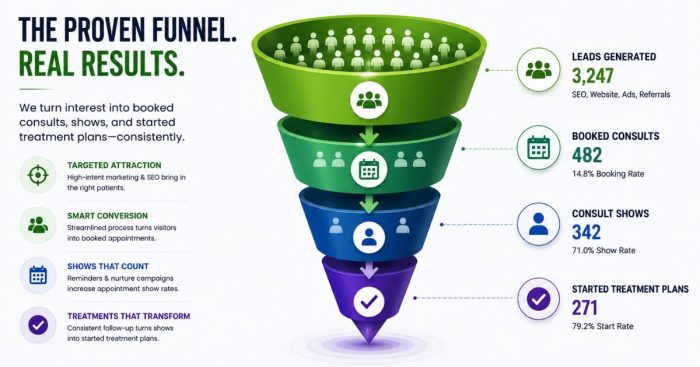
Track these four metrics together:
- Lead-to-consult booked rate
- Consult show rate
- Consult-to-treatment-start rate
- Revenue per lead
When you review these numbers together, quality issues become much easier to identify.
A campaign with a higher cost per lead often generates significantly more revenue because those patients actually progress through the funnel.
Real-world results demonstrate this principle.
Orthobiologics Associates reached a 79.4% lead-to-booked conversion rate by improving lead quality and tightening the intake process before consultations.
Likewise, Elite Pain Doctors generated $2,095,039 in 10 months alongside 26 organic leads per month, proving that quality—not sheer lead volume—is what fills a regenerative clinic with revenue.
Beyond quantitative metrics, monitor qualitative feedback as well.
Ask yourself:
- Are providers happier with the patients arriving?
- Are patients more engaged during consultations?
- Are show rates improving?
- Do patients already understand the treatment before they arrive?
When both your providers and front desk begin describing patients as better prepared and easier to convert, your campaign is already improving. Within a few weeks, those improvements typically appear as stronger consult-to-treatment-start rates.
Will improving lead quality reduce my total lead volume, and is that a problem?
Yes, tighter targeting and stronger qualifiers usually reduce overall lead volume. For regenerative medicine clinics, however, that is almost always the right tradeoff.
A regenerative practice does not need hundreds of leads every month.
Instead, it needs enough qualified prospects to keep the schedule full of cash-pay consultations that convert into treatment plans.
When a campaign shifts from broad, problem-aware targeting to solution-aware searches and meaningful pre-qualification, lead volume naturally decreases.
At the same time, consult volume and revenue often stay the same—or increase.
That is the outcome you should aim for.
The only common exception is a brand-new campaign with little or no conversion data.
Early in the campaign, running a slightly broader audience can help the advertising platform gather enough information to identify your ideal patients.
Once sufficient data exists, tighten the targeting and qualification process.
The long-term goal remains the same:
Fewer, higher-quality leads.
The fastest-growing regenerative clinics are not the ones producing the biggest lead numbers.
Instead, they are the clinics where:
- Providers enjoy seeing the patients who arrive.
- Front desk teams book a high percentage of inbound calls.
- Patients willingly travel several hours because they have already decided this is the clinic they trust.
Ultimately, lead volume is a vanity metric.
A full schedule of patients beginning treatment is the metric that truly matters.
FAQ’s About Improving Regenerative Medicine Ad Lead Quality
Why are my regenerative medicine ads producing lots of leads but few real consults?
Because lead volume and lead quality are different objectives. A low-friction lead form teaches advertising platforms to find people who complete forms—not patients ready to pay for PRP, prolozone, or a shockwave therapy series. Instead of maximizing lead volume, focus on attracting stronger buying intent with solution-aware keywords, meaningful qualifiers, and lead-to-consult optimization. A $40 lead that never books ultimately costs more than a $120 lead who becomes a patient.
What targeting and keywords produce the highest-quality regenerative medicine leads?
Solution-aware searches consistently produce the strongest leads because patients already know the treatment they want. In our campaign data, shockwave therapy generated the highest-quality traffic, followed by “alternative to surgery,” peptide therapy, prolozone, and broader regenerative medicine terms. Prioritize named-treatment and named-symptom keywords, use your clinic branding to qualify prospects, and regularly review your Search Terms Report to understand exactly how patients search.
How do I design an offer and qualifiers that attract better regenerative leads?
Match the funnel to your goal. Lead forms maximize volume, landing pages with qualifying questions improve quality, and scheduling pages attract patients who are ready to book. Include two to four pre-qualification questions about pain location, symptom duration, previous treatments, and willingness to complete a treatment series. Finally, use a transparent consultation offer instead of heavy discounts because regenerative medicine patients invest in a treatment plan—not a coupon.
What pre-qualification questions or call steps screen out low-quality regenerative leads?
Your pre-consult conversation is the strongest quality filter available. Confirm the patient’s area of pain, symptom history, previous treatments, surgical recommendations, willingness to complete treatment, and financial readiness. At the same time, avoid dismissing borderline inquiries too quickly because some become excellent long-term patients. Finish with a personalized first text message instead of a generic automated response to improve engagement.
How should I measure regenerative ad lead quality instead of just cost per lead?
Track the entire patient journey rather than focusing only on cost per lead. Measure lead-to-consult booked rate, consult show rate, consult-to-treatment-start rate, and revenue per lead. In addition, pay attention to qualitative indicators such as provider satisfaction, patient engagement, and stronger show rates. Together, these metrics provide a much more accurate picture of campaign performance.
Will improving lead quality reduce my total lead volume, and is that a problem?
Usually, yes—and that is often a positive outcome. Regenerative medicine clinics need qualified cash-pay patients, not the highest possible number of inquiries. The only exception is a brand-new campaign that still needs conversion data for optimization. Once enough data exists, prioritize higher-quality leads over higher lead volume because a full treatment schedule always matters more than impressive dashboard metrics.