
What Website and Funnel Setup Does a New Regenerative Medicine Clinic Need?
A new regenerative medicine clinic does not need a beautiful website. Instead, it needs a website and funnel that work together to do one job: turn strangers into booked, high-ticket consults—and then make sure not a single one of those leads dies in an inbox. Unfortunately, most clinics get the first half backwards. They spend money on a designer who builds a pretty brochure nobody can find. Then, they wire the contact form to an email address where leads quietly disappear. By contrast, the clinics that scale do the opposite. They build a site engineered to rank, route every lead into one CRM, book high-ticket cases on a calendar, and let automation handle the follow-up. As a result, every lead gets tracked, nurtured, and worked. This is the minimum viable website and funnel a new regenerative clinic needs to launch—and the order to build it in.
Do I need a new website to launch a regenerative medicine clinic, or can I fix my existing one?
In most cases, you need a new website.
The reason is simple: most regenerative clinic websites were built by generic web designers who never structured them to rank or convert.
Typically, the pattern looks the same. A local design company builds the first site. Then another vendor takes over. Eventually, the project stalls.
As a result, the clinic ends up with a brochure website that lacks service pages, condition pages, SEO structure, and meaningful lead capture.
Even worse, the contact form often dumps submissions into an email inbox.
Consequently, leads disappear.
When traffic does not arrive and inquiries are not worked, the website becomes little more than a digital business card.
Unfortunately, a business card nobody sees does not help the business grow.
That is why traffic matters more than aesthetics.
A website designed around search visibility and conversion will outperform a beautiful brochure almost every time.
Generally speaking, rebuild when the site has:
- No SEO structure
- No integrated lead capture
- No booking functionality
- No service pages
- No condition pages
However, one asset is usually worth saving: content.
If a previous agency already wrote quality pages, migrate them.
After all, the more content you preserve, the less you need to create from scratch.
Therefore, the ideal solution is often a new design, a new structure, and the same hard-won content.
For the broader picture of how regenerative growth works from end to end, see our guide to stem cell clinic marketing. The website is only the first step in a much larger patient-acquisition funnel.
What pages does a regenerative medicine clinic website actually need?
Every regenerative medicine website needs a clear structure.
At minimum, that structure should include:
- A homepage
- A service page for every treatment
- A condition page for every problem treated
- Location-and-treatment pages
- An about page
- A contact or booking page
First, build your service pages.
These pages explain what you sell.
For example, they may cover:
- PRP injections
- Regenerative injections
- Stem cell banking
- Hormone replacement therapy
- Medical weight loss
- Peptide therapy
- Botox and fillers
- Microneedling
- Body contouring
Next, create condition pages.
These pages target what patients actually search for.
Common examples include:
- Osteoarthritis treatment
- Joint pain treatment
- Erectile dysfunction treatment
- Hair loss treatment
- Low testosterone
- Low energy and fatigue
Importantly, patients often search for problems before they search for treatments.
For example, someone looking for osteoarthritis relief may not know PRP exists.
Therefore, you need both a problem page and a solution page.
Additionally, those pages should link to one another.
After that foundation is in place, create location-plus-treatment pages.
This is where many new clinics fall behind.
Rather than publishing one generic hormone page, create pages such as:
- Hormone replacement therapy for men in Fargo
- Osteoarthritis treatment in Fargo
- PRP injections in Fargo
Then duplicate that framework for nearby cities and any state where telehealth licensing allows treatment.
As a result, your city-by-treatment SEO grid grows quickly.
Consequently, a new clinic can gain search visibility much faster than waiting for a homepage to rank.
Finally, support everything with a video-forward homepage and an optimized Google Business Profile.
Together, those assets strengthen conversion and local visibility.
Why does a regenerative clinic need a CRM like GoHighLevel and not just an email inbox?
Because high-ticket regenerative consults are too valuable to lose in an inbox.
More importantly, an inbox cannot tell you which marketing efforts actually worked.
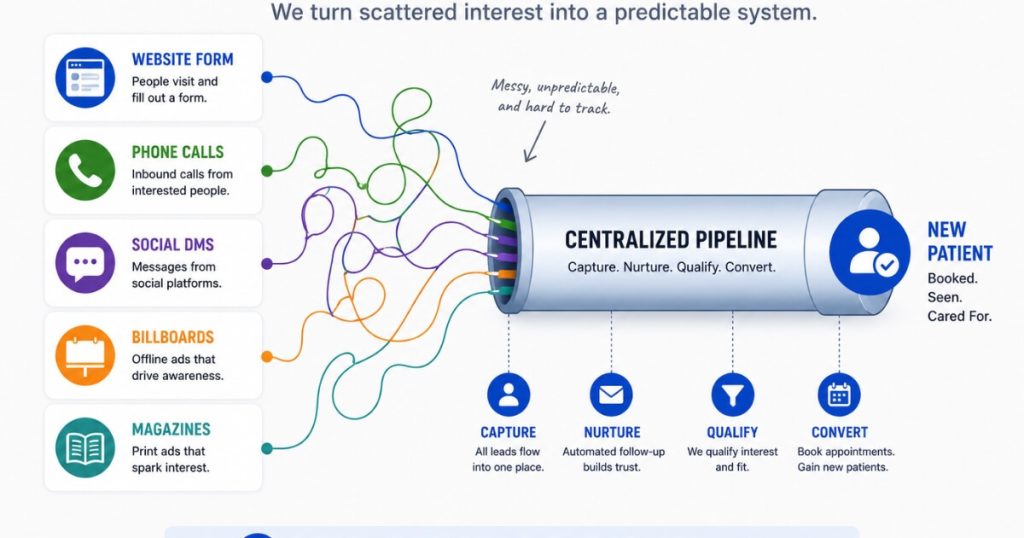
Think about how leads arrive at most clinics.
Website forms land in an email inbox.
Meanwhile, radio calls go unanswered.
Social media messages show up in DMs.
Word-of-mouth referrals arrive through phone calls.
Additionally, billboards and local publications create inquiries that often cannot be tracked.
As a result, everything becomes fragmented.
Eventually, the clinic starts guessing.
Did that $3,000 campaign work?
Which source produced appointments?
What was the actual cost per patient?
Without a CRM, those questions remain unanswered.
A CRM solves that problem by funneling every lead into one system.
Consequently, every inquiry becomes a tracked record.
GoHighLevel is often the preferred platform because it combines:
- Lead capture
- Pipeline management
- Phone systems
- Text messaging
- Email marketing
- Review generation
Instead of managing multiple tools, the clinic operates from one dashboard.
Furthermore, clinics that previously had no CRM often see revenue increase by 20–30%.
Not because they bought more ads.
Rather, they stopped losing leads.
To improve attribution, add a “How did you hear about us?” field to every form.
Likewise, use call-tracking numbers on every marketing channel.
That way, you can calculate cost per booked appointment and invest more heavily in what works.
How should a new regenerative clinic handle booking and lead capture on the site?
Replace the inbox-only contact form with a form that pushes every submission directly into the CRM.
Additionally, every submission should create a pipeline record automatically.
First, update the website form.
Instead of sending inquiries to an email address, route them into the CRM pipeline.
Once that system is active, match the funnel intensity to the offer.
For lower-ticket services such as hair restoration or body contouring, a simple lead form works well.
After all, those offers benefit from volume.
However, high-ticket regenerative and stem cell consultations require more commitment.
Therefore, route those prospects directly to a booking calendar.
In some cases, a credit-card hold or small deposit also makes sense.
Generally speaking, the larger the treatment investment, the more qualification the funnel should require.
Next, build a pipeline that reflects the real patient journey.
For example:
- Prospect
- Appointment Booked
- Blood Work Pending
- Imaging Pending
- Consultation Attended
- New Patient
When the pipeline mirrors reality, the team always knows the next action step.
As a result, conversion improves.
Moreover, weekly pipeline reviews become far more productive.
This is the same operational discipline behind Orthobiologics Associates, which generated $309,590 in cash-pay revenue at a 79.4% lead-to-booked conversion rate with zero ad spend.
What follow-up automation does a new regenerative clinic need on day one?
At launch, three automations are essential:
- Service-specific nurture sequences
- Missed-call follow-up
- Automated review requests
First, build nurture campaigns based on patient intent.
Generic follow-up wastes opportunities.
Instead, a hormone lead should receive an HRT-focused sequence.
Meanwhile, a regenerative medicine lead should receive regenerative education.
Likewise, stem cell inquiries should enter a stem-cell-specific nurture track.
Because everything runs through one platform, the CRM can automatically deliver the right messaging.
Consequently, there is no need for a separate email marketing tool.
The second critical automation is missed-call follow-up.
Radio, billboards, local magazines, and referrals all generate inbound calls.
However, many callers never leave a voicemail.
Without automation, those opportunities disappear forever.
Fortunately, an automatic text-back recovers a meaningful percentage of those leads.
Finally, implement review-generation automation.
Regenerative medicine often creates dramatic patient outcomes.
Therefore, happy patients should become Google reviews.
In turn, those reviews create referrals and strengthen every other marketing channel.
Patient acquisition starts the process.
However, nurture, upsells, reactivation, and reviews maximize lifetime value.
That is why these automations should be active from day one.
What is the minimum viable website and funnel a new regenerative clinic should launch with?
The minimum viable setup includes:
- An SEO-structured website
- Service pages
- Condition pages
- A city-by-treatment SEO grid
- CRM-integrated lead capture
- A booking calendar
- Automated follow-up
Ideally, all of those systems should run through a single platform such as GoHighLevel.
Rather than thinking about separate tools, think about one funnel.
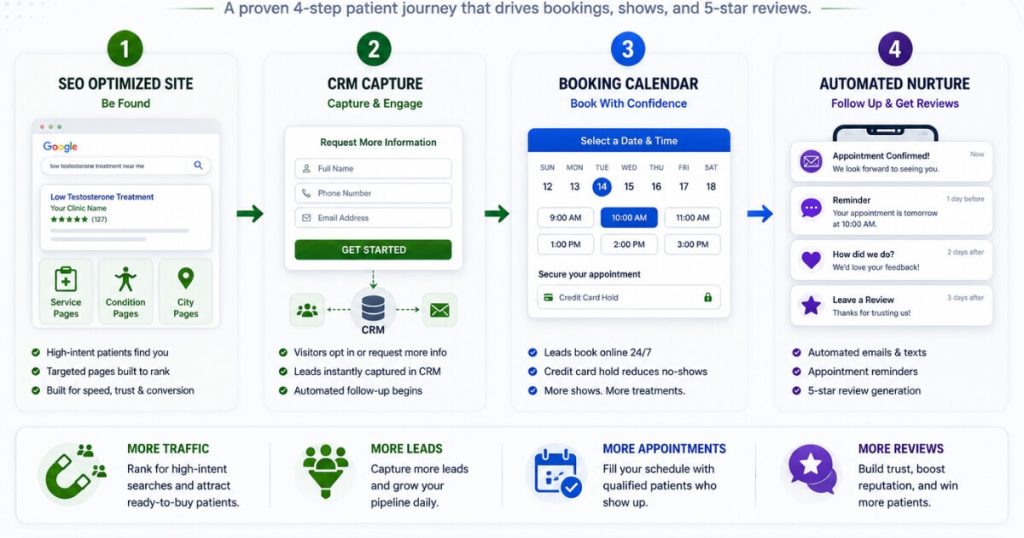
Traffic enters from search, Google Business Profile, and paid channels.
Next, every lead—whether it comes from a form, phone call, DM, or offline source—flows into the same CRM.
From there, the team works the pipeline.
Meanwhile, nurture campaigns, missed-call recovery, and review requests run automatically.
That is the entire machine.
Importantly, you do not need every marketing channel active on launch day.
Instead, you need one website that ranks and converts.
At the same time, you need one CRM that captures and follows every lead.
Get those two pieces right and the growth ceiling becomes much higher.
The same principles helped power Elite Pain Doctors to $2,095,039 in 10 months.
Ultimately, the treatments may be world-class either way.
What separates growing clinics from stalled clinics is whether the website and funnel consistently capture, book, and follow up with every lead.
FAQ’s About Website and Funnel Setup for Regenerative Clinics
Do I need a new website to launch a regenerative medicine clinic, or can I fix my existing one?
In most cases, you need a new website because many regenerative clinic sites were never structured for SEO or conversions. If the site lacks service pages, condition pages, lead capture, and booking functionality, rebuilding is usually more efficient than patching pages one by one. However, quality content should almost always be preserved and migrated.
What pages does a regenerative medicine clinic website actually need?
You need a homepage, service pages, condition pages, location-and-treatment pages, an about page, and a booking page. Together, these pages target both treatment searches and condition-based searches while supporting local SEO growth.
Why does a regenerative clinic need a CRM like GoHighLevel and not just an email inbox?
Because a CRM tracks every lead and every source. In contrast, an inbox cannot provide attribution, automate follow-up, or create accountability. As a result, clinics with CRMs often convert more leads without increasing advertising spend.
How should a new regenerative clinic handle booking and lead capture on the site?
Every form submission should enter the CRM automatically and create a pipeline record. Lower-ticket offers can use lead forms, while high-ticket regenerative consultations should route directly to a booking calendar and may require a deposit.
What follow-up automation does a new regenerative clinic need on day one?
Launch with service-specific nurture campaigns, missed-call text-back automation, and automated review requests. Together, these systems improve conversion rates, recover lost opportunities, and strengthen local reputation.
What is the minimum viable website and funnel a new regenerative clinic should launch with?
The minimum setup includes an SEO-focused website, service pages, condition pages, city-specific treatment pages, CRM-integrated lead capture, online booking, and automated follow-up. Together, those components create a complete patient-acquisition system.
What’s the next step?
If you are launching a regenerative medicine clinic, start with the fundamentals.
Build a website that ranks.
Then build a funnel that converts.
Next, connect every lead source to a CRM.
Finally, automate follow-up from day one.
Most clinics focus on design before systems.
However, the clinics that scale focus on lead capture, booking, nurturing, and conversion first.
If you want help designing the website, building the funnel, implementing the CRM, and mapping the entire patient journey, that is the conversation to book.
We will map the complete regenerative medicine growth system on the call.