
How Do You Market a New Regenerative Service (Like Ozone Therapy) to Existing Patients?
You just added ozone therapy—or PRP, or a new stem cell protocol—to your menu, and your first instinct is to run ads for it. Stop. The first and cheapest place to launch any new regenerative service is the patient list you already own. The people who have already paid you, trusted you, and left happy are the warmest, lowest-cost buyers you will ever reach. Yet most clinics ignore them completely on launch day. This playbook explains how to market a new regenerative service to existing patients using an education-first email sequence, the order that converts best, and why your patient database beats your ad account every time you launch something new.
Why are existing patients the cheapest source of revenue when you launch a new regenerative service?
Because you have already paid the acquisition cost once.
More importantly, the trust required to purchase a new offer is already in place.
A patient who has already received platelet-rich plasma, hormone therapy, or a joint injection from your clinic does not need to be convinced that you are legitimate, experienced, or worth visiting.
That work is already done.
By contrast, the cold market requires significantly more effort.
You need advertising.
You need landing pages.
You need retargeting campaigns.
You need a sales process.
Only then do you earn the opportunity to book an appointment.
Your existing patients need far less.
In many cases, they simply need an email.
The cost difference is substantial.
Acquiring a new regenerative patient often costs hundreds or even thousands of dollars in advertising and follow-up labor.
Reactivating a patient already in your database costs little more than sending a sequence.
That is why the fastest-growing clinics treat their patient database as the first launch channel for every new service.
Before spending money on cold traffic for ozone therapy, PRP, or a stem cell treatment, you should first communicate with the people who already know and trust you.
They convert faster.
They book sooner.
They refer friends and family.
As a result, every successful launch should begin with the database—not the ad account.
For a broader look at how patient reactivation fits into a complete growth strategy, see our guide to stem cell clinic marketing.
What should the email sequence look like when launching ozone therapy or a new regenerative service?
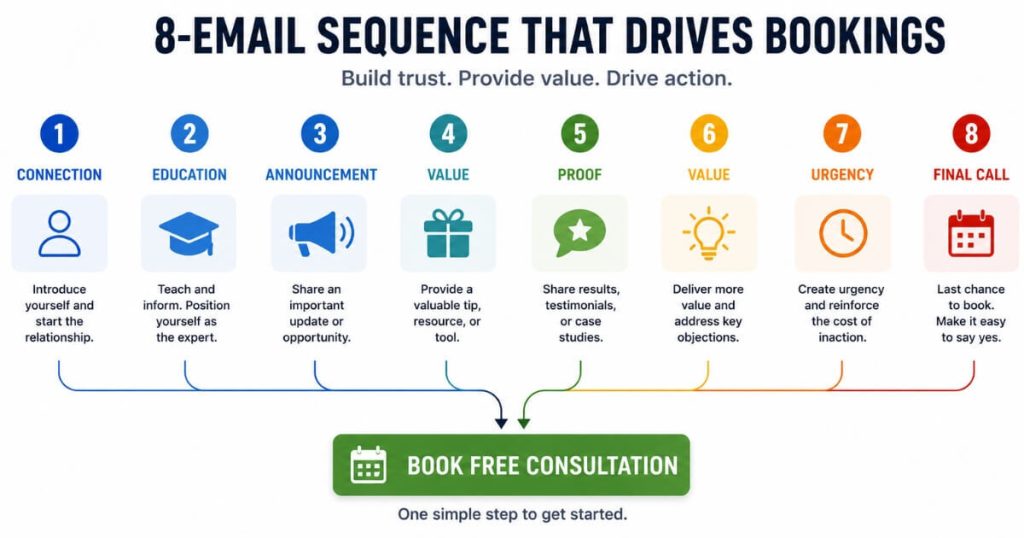
The most effective launch sequence contains six to eight emails delivered over two to three weeks.
More importantly, the order matters.
Successful regenerative medicine launches follow a predictable progression.
The first email should reconnect with the patient and thank them for choosing your clinic.
At the same time, offer a free consultation.
The second email should focus on shared goals.
Talk about health improvement.
Discuss common conditions you treat, such as arthritis, fibromyalgia, headaches, facial pain, and chronic disease.
This allows patients to identify themselves in the message.
The third email introduces the new service.
Keep it simple.
For example:
“Have you heard about our new ozone therapy program?”
Position the service as exciting news rather than a sales pitch.
The fourth email should educate patients on regenerative medicine as a category.
Discuss the broader treatment ladder, including PRP, cytokine therapy, stem cell rejuvenation, and ozone therapy.
The fifth email should deliver value without asking for anything.
For example, explain how nutrition, supplements, curcumin, quercetin, or CoQ-10 may support treatment outcomes.
The sixth email should focus entirely on social proof.
Share testimonials.
Highlight outcomes.
Let patients tell the story.
The seventh email should introduce urgency by reminding patients about the free-consultation offer.
Finally, the eighth email should focus on outcomes.
Paint a picture of living with less pain, improved mobility, or greater quality of life.
Throughout the entire sequence, maintain a single call to action:
Book a free consultation.
The exact word count is not what matters.
The sequence does.
Connection.
Education.
Announcement.
Proof.
Urgency.
That order consistently converts.
Why should you lead with education instead of a direct pitch for a new service like ozone therapy?
Because most patients do not yet understand the service.
They may know they have joint pain.
They may know they have fatigue.
However, they often do not know ozone therapy exists.
They do not know what it does.
They do not know whether it applies to their condition.
When you lead with pricing or a direct offer, you ask patients to buy something they cannot evaluate.
That creates resistance.
Education solves that problem.
By teaching first, you help patients understand regenerative medicine, the conditions it may support, and how different therapies fit together.
As awareness increases, the offer becomes easier to understand.
As a result, conversion improves.
Education also changes how patients perceive your communication.
Most people ignore sales emails.
Many people read helpful emails.
The clinic that teaches becomes the clinic patients trust.
That trust becomes a competitive advantage when patients are finally ready to book.
The same principle drives regenerative medicine SEO, content marketing, social media, and patient education campaigns.
Provide value first.
The booking follows.
A new-service launch simply compresses that philosophy into a two- or three-week email campaign.
How important is social proof and testimonials in a regenerative-service launch?
Social proof is one of the highest-converting elements in the entire launch sequence.
Regenerative medicine is still unfamiliar to many patients.
Because of that, they often trust other patients more than they trust marketing claims.
A dedicated testimonial email can accomplish what pages of clinical explanation cannot.
For example, a patient describing relief from chronic pain feels more persuasive than a treatment description.
A story about avoiding surgery feels more powerful than a feature list.
A long-term patient explaining why they continue returning year after year creates credibility that marketing copy alone cannot match.
Include three or four concise testimonials in a dedicated email near the end of the sequence.
Place it after the educational emails but before the final urgency reminder.
Video testimonials perform even better.
In addition, these assets can be reused across your entire marketing ecosystem.
The same stories support your website.
They strengthen social media.
They improve advertising performance.
They help future launches.
That is exactly how Dr. Joy Kong became the number-one stem cell expert on YouTube and scaled out of the day-to-day of her practice.
The proof you gather for one launch can become the foundation for long-term brand authority.
What is the single call to action across the whole launch sequence?
Use one offer.
Repeat it consistently.
The best call to action is:
Book a free consultation.
Many clinics make the mistake of changing the offer from email to email.
One email promotes ozone therapy.
The next promotes a package.
Another asks for a phone call.
This approach fragments attention and reduces response rates.
A launch performs best when every message points to the same next step.
The free consultation works because it removes risk.
Patients do not have to commit to treatment.
They do not have to commit to pricing.
Instead, they simply agree to a conversation.
That consultation creates the opportunity for your team to evaluate the patient and recommend the most appropriate treatment.
It is also where cross-selling happens.
A patient interested in ozone therapy may ultimately become a PRP patient.
Another may move into a stem cell program.
By keeping the offer simple and consistent, every email works together to move patients toward the same outcome.
How do you measure whether a new-service launch to existing patients actually worked?
Measure consultations.
Measure attendance.
Measure revenue.
Do not focus on open rates.
Open rates and click rates tell you whether people saw the emails.
They do not tell you whether the campaign produced revenue.
Instead, track:
- Consultations booked
- Consultations attended
- Consultation-to-treatment conversion rate
- Cash-pay revenue generated
Tag every patient who enters through the campaign.
This allows you to attribute revenue directly to the launch.
Then analyze consultation-to-sale performance.
That metric often reveals whether the offer itself is strong.
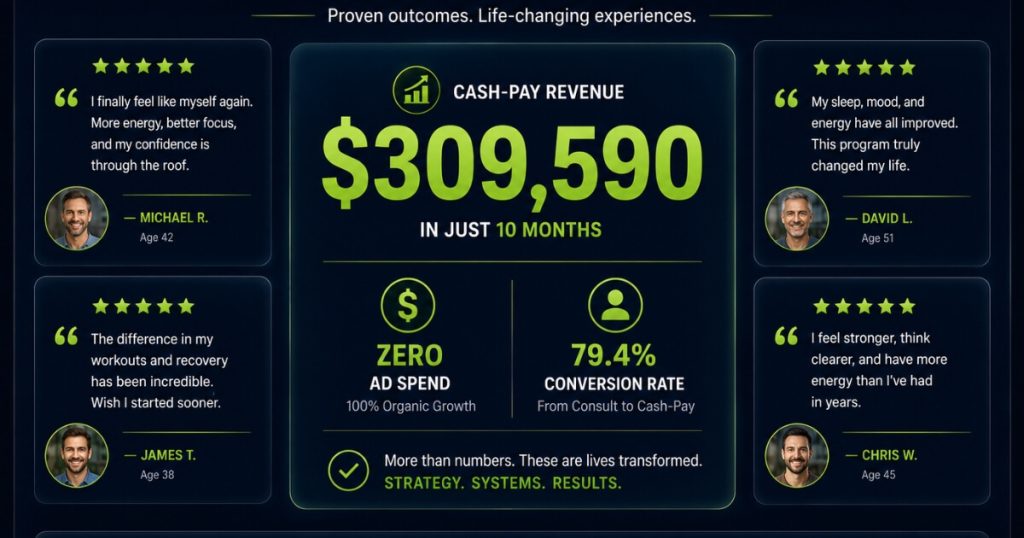
A powerful benchmark comes from Orthobiologics Associates — $309,590 in cash-pay revenue in ten months at a 79.4% consultation-to-sale conversion rate.
When the patient list is warm, the offer is clear, and the consultation process converts effectively, a single email launch can outperform months of cold advertising.
Track revenue.
Track conversions.
Then repeat the sequence for every future service launch.
FAQ’s About Marketing a New Regenerative Service
Why are existing patients the cheapest source of revenue when you launch a new regenerative service?
Because you have already paid the acquisition cost and earned the trust. Existing patients require far less marketing effort than new prospects. Instead of relying on ads, landing pages, and sales processes, you can often reactivate patients with a simple email sequence. They also tend to convert faster and refer others.
How many emails should a new-service launch sequence have, and over what timeframe?
A six-to-eight-email sequence delivered over two to three weeks works well for regenerative medicine. Start with relationship-building and education, introduce the new service, provide value, add testimonials, create urgency, and maintain a consistent call to action throughout the campaign.
Why lead with education instead of pitching ozone therapy directly?
Most patients are unfamiliar with ozone therapy and other regenerative treatments. Education helps them understand the service, the benefits, and whether it applies to their situation. As awareness increases, resistance decreases, making the offer easier to accept.
How important are testimonials in the launch?
Testimonials are among the most powerful conversion tools available. Patients often trust real-world outcomes more than marketing claims. Including patient stories and video testimonials helps the service feel proven, credible, and trustworthy.
What should the call to action be in every email?
Use one consistent offer: book a free consultation. A single call to action reduces confusion, removes risk, and creates a straightforward path to conversion. It also gives providers an opportunity to recommend the most appropriate treatment plan.
How do you know if the launch worked?
Track consultations booked, consultations attended, conversion rates, and revenue generated. Avoid focusing on vanity metrics like open rates. The real measure of success is how much cash-pay revenue the campaign produces.