
How Do You Launch GLP-1 Ads and Move Patients Into a TRT Program?
GLP-1 weight loss is the cheapest front door a cash-pay clinic has right now — leads for as little as $30, appointments under $100 — but the front door is not the business.
The business is what happens after the patient loses the weight.
The clinics that win do two things at once: they run a compliant GLP-1 ad that fills the calendar, and they engineer a patient journey that quietly moves the right weight-loss patients into TRT and hormone care, where the lifetime value is several times higher.
This is the playbook — the GLP-1 ad and landing page on the front end, and the path that transitions a weight-loss patient into a recurring hormone program on the back end.
Why can’t you run GLP-1 ads on Google the way you run other treatments?
You can run GLP-1 ads on Google.
You just cannot say the words that get them rejected.
Tirzepatide, semaglutide, and peptide will not get an ad or a landing page approved.
So you do not put them in the ad copy or on the page.
The landing page says:
- GLP-1s
- Skinny shot
and nothing else.
You bid on high-intent search terms, including:
- Weight loss injections
- Semaglutide
- Tirzepatide
- Ozempic
- Mounjaro
- Lipotropic injections
- GoodRx coupon searches people are running right now
Use tight phrase match so you do not pick up crazy variations.
The ad and the page stay clean.
The keyword list does the targeting.
Weight loss injections is reliably the top click, with overflow from branded campaigns landing in the same bucket.
This is the same reason chasing LegitScript certification is usually not worth it for a cash-pay weight-loss clinic.
The cost and friction do not pay for themselves when the keyword strategy already works.
Keep the visible copy compliant.
Keep the page mostly text so your ad rank stays high, because most people do not make it down the page anyway.
Then let the phrase-match keyword list catch the demand.
The broader logic for why GLP-1 lives on Google while filler lives on TikTok is in our med spa marketing hub.
What does a GLP-1 landing page that actually converts need on it?
Lead with the promise.
Price it competitively.
Strip out anything that adds friction or a compliance risk.
The headline that works is the GLP-1-wide promise:
15% to 20% weight loss.
People like the promise and the proof more than they like features.
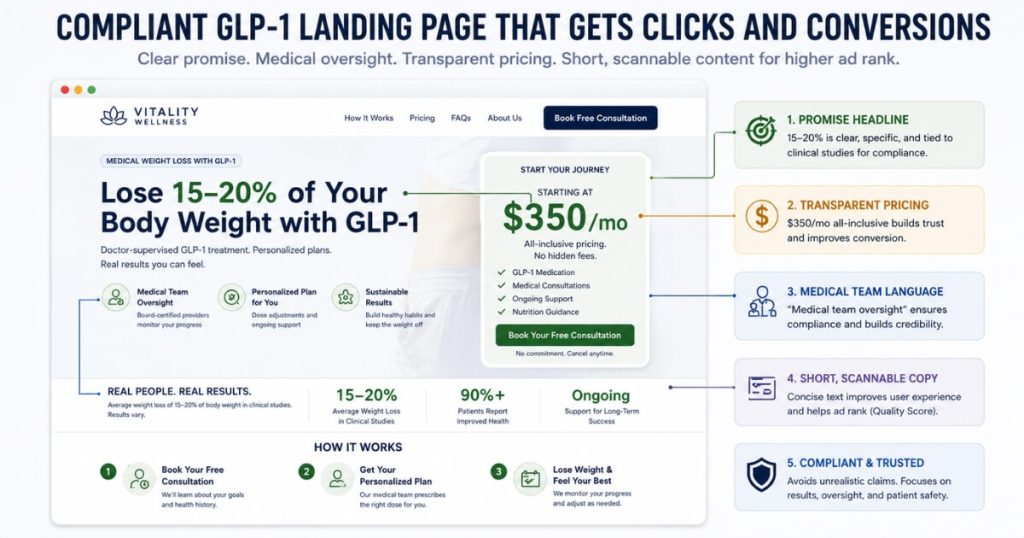
Price competitively.
A lot of clinics are already sitting around the $350-a-month number, so be honest about where you land against that.
Do not lead with in-person.
Being in-person is usually not a meaningful differentiator for a GLP-1 buyer.
The opposite has often been true in practice.
Use the words:
- GLP-1s
- Skinny shot
Avoid the drug names.
Say medical team, not physician, unless every consult is genuinely with a physician.
Do not advertise oral tablets you do not offer.
Most patients do not love them anyway.
Keep a light scarcity element if it is true, because nothing on the page should be false.
Then keep the rest of the page as short text so your Quality Score and ad rank stay strong.
Most visitors never scroll past the headline and the offer.
So do not bury the offer under a how-it-works essay.
Send the booking to a simple scheduling page.
Track conversions inside one pipeline so you can see exactly what each appointment costs.
How do you launch the GLP-1 campaign and what should it cost?
Launch at around $200 a day on maximize-clicks for the first five or so days.
Then switch to conversions once you have data.
You need traffic before Google has anything to optimize against.
So the first five days will probably feel rough.
That is expected, not a failure.
Once conversions are flowing, let Google optimize for conversions and start pruning.
The benchmark is booked appointments for under $100, which is a clear win.
Leads can come in as low as $30 in a strong market.
But the number swings hard on the state and its search volume.
You do not hit $30 leads out of the gate.
That is the optimization target, not the launch number.
From there, it is a simple, ongoing game:
- Check the search-terms report for what people are actually typing.
- Add relevant searches as keywords.
- Add irrelevant searches as negatives.
- Repeat that loop until the cost per appointment grinds down.
Track everything in one pipeline rather than scattering sources.
Tag the lead source as GLP on Google Ads.
When someone schedules, drag the contact into the booked stage so the team has one clean view.
But a cheap GLP-1 appointment is only the beginning of the value.
The whole point of a $30 lead is what you do with that patient over the next year.
That is where TRT and hormone care come in.
How do you move a weight-loss patient into a TRT or hormone program?
Build the cross-sell into a follow-up intake form the patient fills out.
That way, the patient sells themselves on the next program instead of relying on the provider to upsell.
The mechanism is a follow-up consult intake form.
Run it at 90 days for weight-loss patients.
Write it so the patient self-reports their wins.
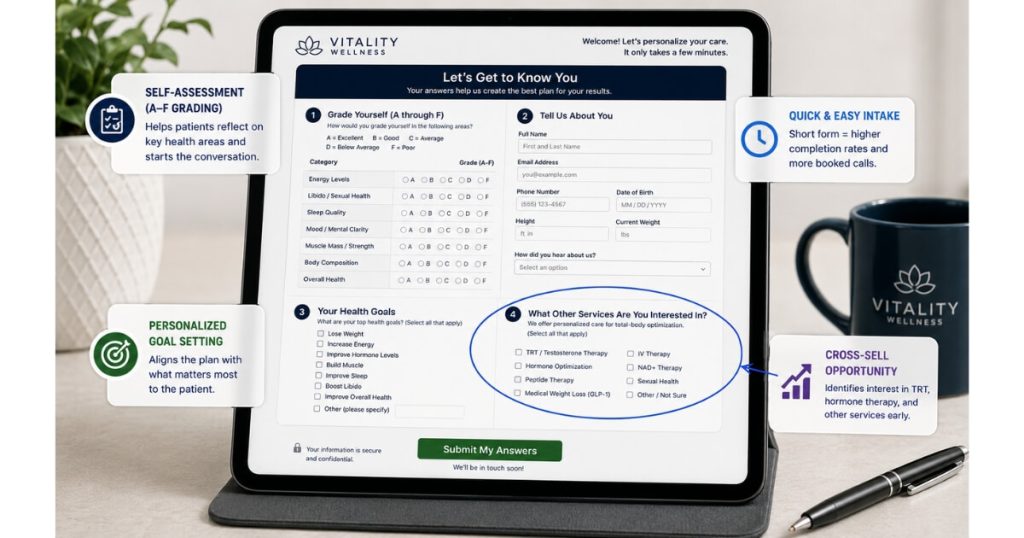
The questions do the selling:
- Original health goals
- Where they have noticed the most improvement
- A grade-yourself-A-through-F section across sleep, mood, energy, and how well they followed the treatment plan
When a patient who was an F in sleep now grades a B, they see their own progress on paper.
That is what makes them want to keep going.
The old way put the entire cross-sell on the provider’s talent in the room.
Templating it into a form lets the patient resell themselves.
Getting patients to fill these out is the hard part.
So use an iPad in the waiting room to make it frictionless.
Then one open question does the cross-sell:
What other services are you interested in learning about?
Include options for:
- Hormones
- TRT
- HRT
- Peptides
- Longevity
The patient raises their hand for the higher-LTV program without a pitch.
Because the average weight-loss patient stays around six months, running the form at 90 days gets you two reads on their progress.
It also gives you two natural windows to surface the hormone offer.
This is exactly how a high-volume weight-loss front end becomes a hormone practice.
It is the engine behind clinics like NuLevel Wellness, a weight-loss and medspa clinic where we added $6.7M in revenue in one year across 3,727 new patients.
What does the TRT patient journey look like once they convert?
A year-long, milestone-based journey built in your CRM.
Anchor it with an eight-week follow-up consult.
Add check-ins that keep the relationship warm in between.
The mistake is leaving a long gap early.
A two-week check-in followed by nothing until week eight is too long when the relationship is just starting.
So the cadence is built to close that gap:
- Welcome on entry
- Four-week check-in that triggers the task to schedule follow-up labs and the consult
- Six-week check-in to confirm the appointment is set
- Eight-week consult where the real milestone happens
A week before that consult, the same kind of follow-up intake form goes out.
It re-engages the patient on why they came and what they want next.
Around week nine — a week after the eight-week consult, when they are warm and feeling the results — you ask for the Google review.
That is the moment they are most ready to leave a five-star one.
The entire journey runs automatically inside the CRM.
Contacts move through pipeline stages on their own.
Tasks generate for the team at each milestone.
Nobody has to remember the next step.
That operational discipline is what lets a recurring hormone program compound.
It is what took Eternity Health Partners from $1M to $4M with 250 members at $1,000 a month.
What nurture content keeps TRT and hormone patients engaged for a year?
An experience-based email sequence of at least 12 emails that walks men through what actually happens over the first 6 to 12 months of TRT or hormone therapy.
Most clinics’ TRT nurture emails are too basic.
They do not go in-depth on the journey the patient is actually on.
The fix is content tied to the lived experience rather than generic clinic announcements.
The first email covers dosing and administration.
The second covers what you might start to feel as the protocol takes hold.
The third covers how and when to reach out with questions.
From there, the sequence continues across the year.
It should be roughly a touch a month, mapped to the same milestones as the patient journey.
At least 12 emails are needed so the relationship never goes quiet between consults.
The same sequence works for HRT with light edits, since TRT and HRT are nearly identical journeys for the patient.
This nurture layer protects retention through the three-month optimize phase and into month-to-month maintenance.
Maintenance is where the real lifetime value of a hormone patient lives.
A GLP-1 patient who pays $350 a month for six months is a good customer.
A hormone patient who stays on maintenance for years, started from that same GLP-1 ad, is the entire reason the front-end math works.
FAQ’s About Launching GLP-1 Ads and TRT Cross-Sell
Why can’t you run GLP-1 ads on Google the way you run other treatments?
You can run them.
You just cannot say the words that get them rejected.
Tirzepatide, semaglutide, and peptide will not get approved, so they stay off the ad and the page.
The page says:
- GLP-1s
- Skinny shot
Then you bid on phrase-match terms like:
- Weight loss injections
- Ozempic
- Mounjaro
- Lipotropic injections
The keyword list does the targeting.
This is also why chasing LegitScript certification is usually not worth it.
What does a GLP-1 landing page that actually converts need on it?
Lead with the 15% to 20% weight-loss promise.
Price competitively against the roughly $350-a-month market.
Remove friction.
Say medical team, not physician, unless every consult is with a physician.
Do not advertise oral tablets you do not offer.
Do not lead with in-person.
Keep the page mostly short text so ad rank stays high.
Most visitors never scroll past the offer.
How do you launch the GLP-1 campaign and what should it cost?
Launch around $200 a day on maximize-clicks for about five days.
Then switch to conversions once data exists.
Expect the first five days to feel rough.
The benchmark is appointments under $100.
Leads can reach $30 in a strong market, though it varies by state and search volume.
Then run the loop:
- Add relevant search terms as keywords.
- Add irrelevant ones as negatives.
- Keep optimizing.
How do you move a weight-loss patient into a TRT or hormone program?
Use a follow-up intake form at 90 days.
Make the patient self-report their wins.
Ask about:
- Original goals
- Biggest improvements
- Sleep, mood, energy, and treatment-plan follow-through
Use a grade-yourself-A-through-F section.
Seeing their progress on paper makes them want to continue.
Then ask what other services they are interested in.
List:
- Hormones
- TRT
- HRT
- Peptides
- Longevity
The patient raises their hand without a pitch.
What does the TRT patient journey look like once they convert?
It is a year-long journey in the CRM.
Anchor it with an eight-week consult.
Add a four-week and six-week check-in so there is no long gap early on.
The intake form goes out a week before the consult.
The Google review ask comes around week nine, when the patient is warm.
Stages, tasks, and emails all fire automatically.
What nurture content keeps TRT and hormone patients engaged for a year?
Use at least 12 experience-based emails covering the first 6 to 12 months.
Start with:
- Dosing and administration
- What the patient will start to feel
- How to reach out with questions
Then continue roughly monthly.
The same sequence works for HRT with light edits.
This layer protects retention into month-to-month maintenance, where lifetime value lives.