
How Do You Get Peptide and Hormone Ads Approved on Google in 2026?
For a long time it looked like you simply could not run Google Ads for hormone, TRT, and peptide treatments.
Done properly, you can — but not by arguing with the policy.
You get approved by building the entire campaign around the condition instead of the named therapy, by structuring a value ladder so the ad never has to sell one restricted treatment, and by moving every treatment claim off the ad and the landing page and onto the thank-you page.
This is the field playbook for getting peptide and hormone ads approved on Google in 2026: the policy landscape, the campaign and landing-page structure that keeps accounts alive, the language that gets them suspended, and the compliant phrasing that converts.
Note: this is third-party advertising-compliance advice, not medical or drug guidance.
Can you actually run Google Ads for hormone, TRT, and peptide treatments in 2026?
Yes — if you build the campaign around the condition instead of the treatment, and if you have a value ladder that lets a patient enter at more than one price point.
For years, it appeared that running Google Ads for hormone, TRT, and peptide-related treatments was impossible.
However, that is no longer the case when campaigns are structured correctly.
The key is the value ladder.
If you have multiple ways to help a patient with low testosterone, chronic fatigue, or knee pain, the ad does not need to sell a specific treatment.
Instead, it sells the condition and the possibility of a solution.
Patients enter the value ladder at the level that makes sense for them.
That structural shift changes everything.
Condition first.
Treatment later.
As a result, the ad and landing page remain focused on the problem and non-surgical solutions rather than a restricted therapy.
The treatment education happens after the lead has already converted.
Clinics growing hormone and TRT programs on recurring cash-pay economics depend on this distinction.
The same condition-first strategy appears throughout our med spa marketing work, where restricted offers are acquired through compliant paid-channel structures.
What words still get hormone and peptide ads disapproved or accounts suspended on Google?
Google still does not let you say stem cell treatment, PRP, hormones, hormone replacement therapy, or bioidentical hormone replacement therapy — and naming the restricted therapy anywhere Google reads it is the fastest path to a disapproval, then a suspension.
Many clinics assume the restrictions only apply to ad copy.
They do not.
Google evaluates far more than headlines and descriptions.
The platform also reads:
- Campaign names
- Ad-group names
- Ad names
- Landing-page content
For example, naming something “TRT Campaign” or “Stem Cell Ad Group” immediately signals restricted content.
That creates risk before a single impression is served.
Instead, focus every label and every line of copy on the condition.
Discuss:
- Symptoms
- Challenges
- Daily limitations
- Non-surgical solutions
Avoid naming the therapy itself.
That approach protects account health while maintaining compliance.
How should you name campaigns, ad groups, and keywords so Google does not flag them?
Name everything after the condition, never after the treatment — and build the keyword list off the condition language people actually type.
Campaign naming discipline matters.
Do not create:
- TRT Campaign
- Stem Cell Campaign
- Hormone Therapy Campaign
Instead, use condition-based naming conventions.
Structure campaigns around the problem patients want solved.
Once the campaign is built, optimize for lead generation and connect conversion tracking immediately.
For keyword research, use Google’s Keyword Planner.
Search condition-related phrases such as:
- Nonsurgical knee pain treatment
- Low testosterone symptoms
- Chronic fatigue treatment options
- Men’s health solutions
Then collect:
- Search volume
- Competition levels
- Related keyword suggestions
Build campaigns around those searches.
From top to bottom, the account should read like a campaign focused on solving a problem—not promoting a restricted treatment.
What should the landing page and thank-you page look like to stay compliant and still convert?
The landing page talks only about the condition; the thank-you page is where you finally educate on the treatment.
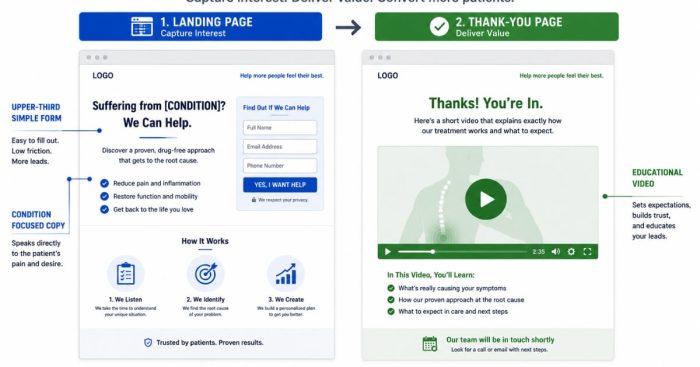
The landing page should remain simple.
Avoid pop-ups.
If using an embedded form, place it in the upper third of the page.
Keep the form limited to:
- Name
- Phone number
- ZIP code (if required)
The page should focus entirely on:
- The condition
- The symptoms
- The daily impact
- The existence of non-surgical options
Do not mention:
- Stem cells
- TRT
- Hormone therapy
- Peptide therapy
Instead, discuss the patient’s problem and the possibility of relief.
After the opt-in, the thank-you page becomes the education stage.
Most successful thank-you pages mirror the landing page and add educational content such as:
- Videos
- Treatment explanations
- Next-step instructions
This is where treatment-specific information belongs.
The visitor is now a lead rather than a cold prospect.
That distinction matters.
This exact structure helped an HRT and TRT practice grow from $1M to $4M in annual revenue by capturing leads on the condition and educating them on treatment after the conversion.
What offer and ad format work best for restricted hormone and peptide campaigns on Google?
A free consultation is the default offer, and plain text ads are all you need to launch.
A free consultation remains the most reliable offer.
Typically, that means:
- A 15-minute phone consultation
- A 20-minute phone consultation
- An in-person consultation for local clinics
Lead magnets can also perform well.
For example, downloadable ebooks often work effectively when paired with a follow-up call sequence.
In those cases:
- The ebook becomes the offer.
- The phone conversation becomes the sales process.
Google Search campaigns do not require elaborate creative assets.
Simple text ads are enough.
Focus on:
- Condition-based headlines
- Condition-based descriptions
- Multiple ad variations
Then let Google’s optimization engine learn from real conversion data.
Every thank-you-page visit should be tracked as a conversion event.
That creates accurate cost-per-lead reporting and allows optimization around lead quality.
How does a value ladder make restricted treatments profitable on Google Ads?
Because the ad never has to carry the sale of one expensive named therapy — it only has to capture a patient who has the condition.
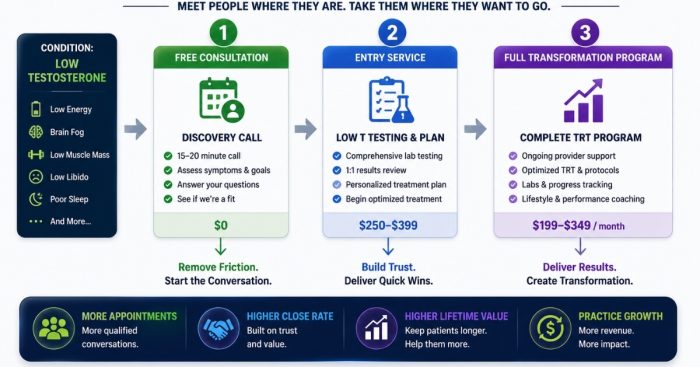
A proper value ladder creates multiple entry points.
One condition may lead to:
- A free consultation
- An entry-level service
- A recurring membership
- A premium treatment plan
The Google campaign simply captures demand.
After that, education and follow-up guide patients toward the appropriate treatment level.
This approach is particularly effective for:
- Low testosterone
- Chronic fatigue
- Knee pain
- Hormone optimization
The economics improve because the campaign is not responsible for selling a high-ticket treatment immediately.
Instead, it generates qualified leads who enter a broader revenue system.
That same principle drives performance across paid channels.
For example, at a weight-loss and med spa clinic where we added $6.7M in revenue in one year across multi-channel paid ads, front-end offers captured demand while the value ladder converted those leads into long-term revenue.
FAQ’s About Getting Peptide and Hormone Ads Approved on Google
Can you say “peptide” or “hormone” anywhere in a Google Ads campaign in 2026?
Not in the ad copy, campaign name, ad-group name, ad name, or landing-page headlines.
Google evaluates all of those elements.
Terms such as hormones, hormone replacement therapy, bioidentical hormone replacement therapy, PRP, and stem cell treatment remain restricted.
Keep campaign assets focused on the condition.
Treatment-specific education should appear only after lead conversion.
Why does naming a campaign “stem cell” or “TRT” get it disapproved?
Because Google reads campaign names, ad-group names, and ad names.
Using restricted treatment names signals prohibited content before an ad is even served.
Condition-based naming avoids that problem.
What goes on the landing page versus the thank-you page?
The landing page focuses on the condition, symptoms, and non-surgical solutions.
It includes a simple conversion form and avoids treatment-specific references.
The thank-you page contains treatment education and often includes an educational video explaining the clinic’s approach.
What offer should you run for a restricted hormone or peptide campaign?
A free 15- or 20-minute consultation is the standard offer.
Local clinics may also use in-person consultations.
Lead magnets such as ebooks can work well when paired with follow-up calls.
How do you track conversions without naming the treatment?
Track the lead submission itself.
Configure a conversion whenever a visitor reaches the thank-you page after submitting their information.
The conversion event does not need to reference the treatment.
Why does a value ladder matter for getting these ads to pay off?
Because the campaign only needs to attract someone experiencing the condition.
Once they become a lead, multiple treatment paths and price points allow them to enter the clinic’s ecosystem at the level that fits them best.
What’s the next step?
Getting peptide and hormone ads approved on Google in 2026 is not about finding loopholes.
Instead, it is about building a campaign structure that gives Google nothing to flag.
Focus every campaign element on the condition.
Keep restricted treatments off the ad and landing page.
Move treatment education to the thank-you page.
Track conversions based on opt-ins.
Then support everything with a value ladder that turns condition-based leads into recurring revenue.
That structure protects compliance while still producing qualified, cost-effective leads.
If you run a hormone, TRT, or peptide practice and want the account structure, landing pages, thank-you pages, offer, and value ladder built correctly, that is the conversation to book.
We will map your compliant Google Ads structure on the call.