
Should a Cash-Pay Clinic Hire a Marketing Agency or Build Marketing In-House?
Medicine is a practice — and so is building medical practices.
If you have never treated a specific problem before, you either consult someone who has or learn the hard way through your own time and budget.
Marketing a cash-pay clinic works exactly the same way.
The agency-versus-in-house decision is not really about labor costs or org charts. Instead, it is about whether you pay to discover the answers yourself or buy the experience from a team that has already solved the problems you will encounter scaling from $20K a month to $2M a month.
This is the answer-first breakdown of when each path makes sense, including cost, speed, expertise, and the hybrid model most clinics should eventually adopt.
Is it cheaper to hire an agency or build a marketing team in-house?
On paper, a single in-house marketer appears less expensive than an agency retainer.
However, that comparison is misleading.
The real comparison is not salary versus retainer.
Instead, it is the cost of one person versus the cost of an entire marketing function.
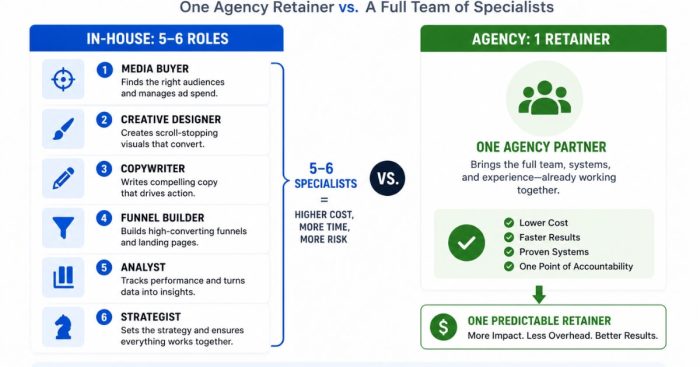
To replicate what a competent agency delivers, you typically need:
- A media buyer
- A copywriter
- A creative team
- A funnel and landing-page builder
- An analytics specialist
- A strategist who has scaled cash-pay clinics before
That means five or six salaries.
Additionally, it requires:
- Software subscriptions
- Ad-platform tools
- Management oversight
- Ongoing training
Before a single lead arrives, you are already well into six figures annually.
By contrast, an agency spreads those costs across multiple clients.
As a result, you gain access to the entire team for a fraction of the cost.
The hidden expense of building in-house is tuition.
Specifically, it is the money spent while your hires learn cash-pay medical marketing using your advertising budget.
Every clinic scaling from $20K a month to $2M a month encounters similar challenges.
If your team has never solved those challenges before, you fund the mistakes.
That is why many clinics choose to work with experienced medical practice marketing consultants rather than building every capability from scratch.
In most cases, buying experience is less expensive than paying to develop it internally.
Which gets you to revenue faster — agency or in-house?
An experienced agency almost always reaches revenue faster.
The reason is simple.
It eliminates the learning curve.
Building in-house requires:
- Recruiting
- Hiring
- Onboarding
- Testing channels
- Iterating creative
- Discovering which offers convert
That process often consumes months before meaningful results appear.
An agency that has already scaled clinics in your category starts from a different position.
It has already run:
- Filler campaigns
- GLP-1 funnels
- TRT search campaigns
- Neuropathy VSLs
- Cash-pay lead-generation systems
Because of that experience, it understands the acquisition math before launch.
The difference is often dramatic.
An agency can launch in weeks.
An in-house build may take an entire quarter.
Speed matters even more in cash-pay healthcare.
Revenue generated today funds future growth.
The clinic generating patients in 30 days is reinvesting profits while the in-house team is still interviewing candidates.
The fastest route to revenue is usually leveraging expertise that already exists.
When does building in-house actually make sense?
Building in-house becomes attractive when your marketing spend and revenue can support a senior team.
For most clinics, that happens well beyond seven figures in annual cash collections.
At that stage, you can justify hiring:
- A marketing director
- A dedicated media buyer
- Creative specialists
- Content resources
Once enough volume exists, the economics of ownership begin to outperform outsourcing.
In-house marketing also makes sense when:
- Marketing is a permanent strategic competency
- Compliance requirements demand daily oversight
- Brand control is critical
- A single channel is large enough to justify dedicated management
The mistake is moving in-house too early.
Many clinics hire one generalist marketer at $30K per month in revenue and expect them to handle:
- Strategy
- Media buying
- Creative
- Funnels
- Analytics
No single person excels at all of those functions simultaneously.
As a result, performance suffers.
Most clinics scale faster by starting with an agency and selectively bringing functions in-house after the playbook has been proven.
What does an agency give you that an in-house hire cannot?
An agency provides cross-clinic pattern recognition.
That is something a single in-house marketer cannot replicate.
An internal marketer sees one clinic’s data.
An agency sees dozens.
It has visibility into:
- Hormone clinics
- Med spas
- Weight-loss practices
- Regenerative medicine clinics
- Functional medicine clinics
Consequently, it recognizes patterns much faster.
That experience becomes the product.
When a new challenge appears, there is a high probability the agency has already solved it elsewhere.
Examples include:
- Declining conversion rates
- Channel saturation
- Offer fatigue
- Sales-team performance issues
Rather than discovering solutions through trial and error, you inherit existing answers.
You also gain a team rather than a person.
That team typically includes:
- Media buying specialists
- Copywriters
- Designers
- Funnel builders
- Analysts
- Strategists
The value is not simply labor.
The value is accumulated experience.
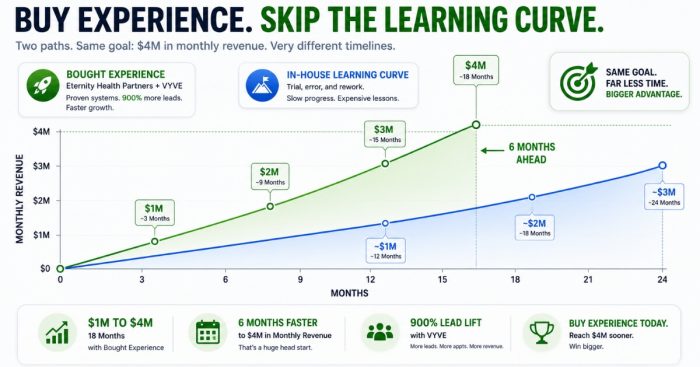
That principle is exactly what helped Eternity Health Partners, which scaled from roughly $1M to $4M in revenue with outside help.
Can a clinic run a hybrid of agency and in-house?
Yes.
In fact, the hybrid model is often the ideal long-term solution.
The simplest framework is:
- Keep proximity work in-house.
- Outsource leverage work to an agency.
In-house responsibilities typically include:
- Organic social media
- Review management
- Patient communication
- Front-desk follow-up
- Brand voice
Meanwhile, agencies often handle:
- Paid advertising
- Funnel architecture
- Offer design
- Channel strategy
- Media buying
The two functions are complementary rather than redundant.
A common progression looks like this:
- Begin fully agency-led.
- Hire an internal coordinator.
- Train the coordinator on proven systems.
- Gradually bring selected channels in-house.
- Retain the agency for strategy and specialized execution.
The objective is not agency forever.
Nor is it in-house forever.
The goal is placing every function where it produces the highest return at your current stage.
How much faster can you grow with outside help?
The acceleration is real.
More importantly, it is measurable.
Eternity Health Partners, which scaled from roughly $1M to $4M in revenue with outside help achieved a 4x increase by importing a proven playbook rather than building one internally.
Similarly, VYVE Wellness, a longevity and functional-medicine clinic, saw a 900% increase in leads in four months after experienced specialists took over key marketing channels.
Those results did not happen because agency teams worked harder.
They happened because agency teams skipped years of trial and error.
Every clinic scaling from $20K a month to $2M a month faces predictable challenges.
Teams that have solved those challenges before move through them dramatically faster.
That is what buying experience looks like in practice.
You reach the same destination sooner because somebody else already paid the tuition.
FAQ’s About Hiring a Medical Marketing Agency vs Building In-House
How much does a medical marketing agency cost compared to an in-house hire?
A single marketer may cost less than an agency retainer.
However, one marketer is not equivalent to a complete marketing department.
Replicating agency capabilities internally requires multiple specialists plus software and management overhead.
Consequently, total costs often exceed agency fees.
How long until an agency produces results for a cash-pay clinic?
Experienced agencies can often launch campaigns within days or weeks.
By contrast, in-house teams frequently spend months building infrastructure, learning the market, and refining offers before achieving similar performance.
At what revenue should a clinic start building marketing in-house?
There is no universal threshold.
However, in-house teams usually make financial sense once a clinic exceeds seven figures in annual cash collections and has proven acquisition systems that justify dedicated staff.
What is the biggest risk of building a marketing team in-house too early?
The biggest risk is paying tuition through wasted advertising spend.
An inexperienced team learns by making mistakes.
Meanwhile, the clinic loses both money and the opportunity cost of delayed growth.
Does hiring an agency really accelerate growth, or is that just sales talk?
The results are measurable.
Eternity Health Partners grew from approximately $1M to $4M in revenue.
VYVE Wellness increased leads by 900% in four months.
The acceleration comes from avoiding years of trial and error and implementing proven systems immediately.
What’s the next step?
If you run a cash-pay medical practice and are debating whether to hire an agency or build internally, the answer depends on your stage of growth.
For most clinics below seven figures, buying expertise produces better results than building it.
Once revenue, volume, and marketing complexity increase, a selective hybrid model often becomes the most efficient approach.
The right answer is not based on preference.
It is based on economics, experience, and growth goals.
If you want someone to review your numbers and determine exactly which marketing functions should be outsourced and which should remain in-house, that is the conversation to book.
We will map the agency-versus-in-house decision to your specific practice on the call.