
Why Can’t My Med Spa Scale Past $1M (and What Actually Breaks the Ceiling)?
Almost every med spa and anti-aging membership clinic figures out how to get to about a million a year with one provider. Then it stalls.
The reason is not the market and it is not your prices — it is structure.
A clinic stuck at $1M is almost always running on one provider, a thin service mix, no system that works without the owner, and a single acquisition channel.
Breaking through means fixing those four things. Moreover, the biggest one is usually the one you are most afraid of.
This is the answer-first breakdown of why clinics plateau around $1M and exactly what moves break the ceiling.
Why does almost every med spa stall right around $1M?
Because roughly $1M a year is the ceiling for what one skilled provider can personally produce while the owner simultaneously runs marketing, sales, hiring, and operations.
The number is not a coincidence.
Nor is it the market telling you demand has disappeared.
Instead, it is the limit of one person’s time, energy, and production capacity.
Most anti-aging membership clinics eventually figure out how to generate approximately $1M annually with one provider.
However, scaling to $2M, $3M, or $4M requires additional clinical capacity.
That means hiring another provider.
Unfortunately, that is exactly where many owners freeze.
The plateau is structural.
When the founder remains both the primary producer and the person running everything else, revenue eventually reaches a hard cap.
To break through, the founder must stop being the sole point of production.
Every scaling move discussed below is ultimately a version of that same shift.
The owner bottleneck: why the founder is the ceiling
The single biggest reason clinics remain stuck at $1M is fear.
More specifically, it is usually three fears stacked together.
First, owners struggle with the idea of charging the same rates for someone who is not them.
Second, they are unsure how to integrate another provider operationally while maintaining pricing and quality.
Third—and most significantly—they fear training someone only to watch that provider leave and compete in the same market.
All three concerns are legitimate.
However, all three are solvable.
Until they are solved, the founder remains the ceiling.
Every patient relationship belongs personally to the owner.
Consequently, the owner never gains enough time to build something larger.
The breakthrough comes when owners reframe the economics.
Treat a second provider as a leverage investment, not a salary.
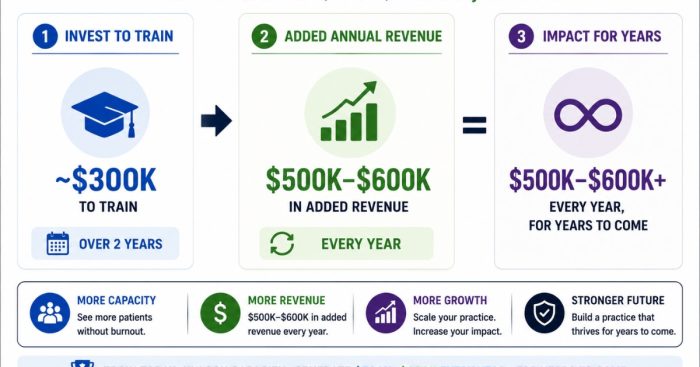
Suppose it takes two years and approximately $300K to train a provider fully.
If that provider later generates $500K–$600K in annual revenue year after year, the investment becomes obvious.
You are not buying payroll.
You are buying capacity.
The clinics that break through stop viewing provider hires as expenses and start viewing them as assets that remove the founder bottleneck.
How to make patients accept a second provider at full price
You make the brand the reason patients trust the result.
Patients willingly pay full price for a second provider when confidence lives in the clinic rather than exclusively in the founder.
That requires standardization.
Specifically, you need:
- Consistent protocols
- Consistent intake processes
- Consistent consultation experiences
- Consistent treatment outcomes
Additionally, you need visible proof.
That means reviews, testimonials, and success stories tied to the practice name rather than a single provider.
Strong brand presence also matters.
Patients should encounter your clinic through:
- Google Search
- Google Business Profile
- Social media
- Online reviews
When the clinic itself becomes the trusted entity, providers become interchangeable in the patient’s mind.
As a result, pricing remains intact.
This is the same brand-equity engine that allows practices to add capacity without discounting.
It is also the difference between a personal practice and a scalable business.
The deeper framework for building that kind of brand-led demand lives inside our med spa marketing resources.
The thin service mix: why one offer caps your revenue
Adding a second provider only works if enough demand exists to keep that provider busy.
A thin service mix makes that difficult.
Clinics that reach $1M with one or two hero offers eventually run out of room.
Each patient only has so many reasons to return.
Likewise, each patient has a spending ceiling.
The solution is depth.
Specifically, depth in the service ladder.
Examples include:
- Aesthetics and injectables
- Weight loss and GLP-1
- Hormone replacement therapy
- Anti-aging programs
- Recurring memberships
For example, a weight-loss or gynecology front-end service can naturally lead into hormone optimization.
The goal is not random expansion.
Instead, the goal is creating a ladder where one patient relationship generates multiple revenue events over multiple years.
That increases lifetime value while simultaneously creating enough demand to support additional providers.
No system: why the business cannot run without you
The clinics that break past $1M transform founder intuition into systems.
That means documenting:
- Sales scripts
- Follow-up processes
- Intake procedures
- Rebooking systems
- Team responsibilities
When everything exists only in the owner’s head, every new hire requires constant oversight.
As a result, growth remains tied directly to founder bandwidth.
The solution is simple in theory:
Document and delegate.
Create repeatable systems for:
- Consultations
- Closing patients
- Lead follow-up
- Scheduling
- Patient retention
This is exactly what scaling looks like in practice.
Eternity Health Partners grew from $1M to $4M while the owners were removed from the day-to-day.
That outcome was not accidental.
Removing the founder as the operational dependency allowed revenue to scale.
You cannot build a $4M business if every decision, appointment, and conversation depends on you.
Single channel: why one source of leads runs out
Most clinics reach $1M through a single acquisition channel.
Often that channel is:
- Word of mouth
- One paid platform
- One referral source
Eventually, that channel saturates.
When you add a second provider, you need substantially more patient flow.
One channel rarely produces enough volume safely.
Additionally, relying on one source creates concentration risk.
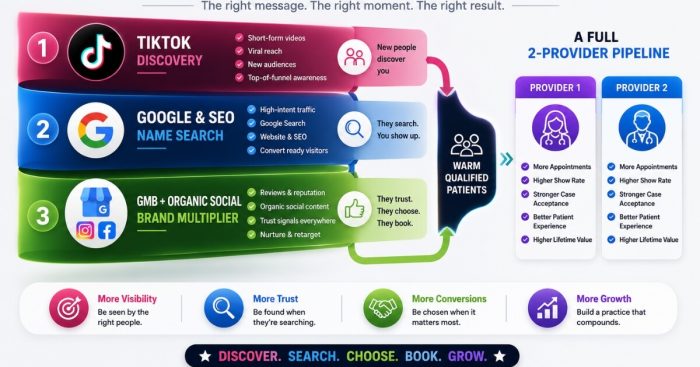
The clinics that scale stack channels strategically.
Each channel serves a different purpose:
- TikTok generates front-end awareness and demand.
- Google captures high-intent search traffic.
- SEO captures long-term discovery.
- Google Business Profile builds trust.
- Organic social reinforces brand authority.
We watched that exact channel stack compound at NuLevel Wellness Medspa, where we added $6.7M in revenue in one year across 3,727 new patients and reached a $1M-per-month run rate.
Depth on one channel can get you to $1M.
A diversified, brand-led acquisition system is what gets you beyond it.
The four moves that actually break the ceiling
Breaking past $1M is not one dramatic decision.
Instead, it is the combination of four leverage moves.
First, add a second provider and treat the hire as an investment.
Second, make the brand the reason patients buy, allowing new providers to command full pricing.
Third, deepen the service ladder so there is enough demand to support expanded capacity.
Fourth, build systems and stack acquisition channels so growth no longer depends on the founder.
Doing one of these in isolation creates limited results.
However, doing all four together creates compounding leverage.
That is the path every clinic that has moved from $1M to $4M and beyond has followed.
FAQ’s About Scaling a Med Spa Past $1M
Is $1M actually a real ceiling for med spas, or does it just feel that way?
It is a real structural ceiling.
Approximately $1M annually is what a single provider can produce while simultaneously managing marketing, sales, hiring, and operations.
The limit comes from personal capacity, not market demand.
Every clinic that breaks through transitions from a founder-dependent business into a scalable system.
Why am I scared to hire a second provider, and is that fear costing me growth?
Most owners struggle with three concerns:
- Charging full price for someone other than themselves
- Integrating another provider operationally
- Losing a trained provider to competition
While these fears are understandable, they frequently become the primary growth constraint.
Viewed properly, a second provider is not an expense.
It is a leverage investment that creates capacity beyond the founder’s own production limits.
How do I make patients accept a second provider at the same price I charge?
Build trust in the clinic rather than the individual provider.
That means:
- Standardized protocols
- Consistent patient experiences
- Reviews tied to the practice
- Strong brand visibility
When patients trust the brand, provider substitution becomes much easier and pricing remains stable.
What is the fastest single move that breaks a med spa past $1M?
Adding leverage.
Specifically, a second provider supported by a system capable of keeping them booked.
A second provider dramatically increases clinical capacity.
However, success still requires:
- A deep service mix
- Reliable systems
- Multiple lead sources
Without those supporting structures, the hire becomes an expense rather than an asset.
Can I scale past $1M on a single acquisition channel?
Rarely.
Most clinics plateau because their primary channel eventually saturates.
Supporting multiple providers requires more patient flow than one source can typically provide.
That is why successful clinics stack channels and assign each one a specific role within the acquisition system.
How long does it realistically take to break through the $1M ceiling?
Expect a meaningful ramp.
Training a provider to full productivity may take up to two years.
However, improvements to systems, branding, and acquisition channels can begin producing results much faster.
For example, NuLevel Wellness Medspa, where we added $6.7M in revenue in one year across 3,727 new patients and reached a $1M-per-month run rate achieved dramatic growth through systemization and channel expansion.
Similarly, Eternity Health Partners grew from $1M to $4M while the owners were removed from the day-to-day by eliminating founder dependency.
What’s the next step?
If your med spa is parked at $1M, the ceiling is probably not your market.
It is your structure.
The founder remains the bottleneck.
The service ladder is too shallow.
The systems are incomplete.
And patient acquisition depends too heavily on one source.
The clinics that break through solve all four problems together.
They add leverage through providers, strengthen the brand, deepen the service mix, and build systems that operate independently of the owner.
If you want someone to evaluate your providers, service mix, operations, and acquisition channels together—and identify the exact constraint holding back growth—that is the conversation to book.
We will map your specific path beyond $1M on the call.