
How Much Revenue Is Your Cash-Pay Clinic Losing to Lead Leakage?
Your front desk’s computer probably has $100,000 worth of patient contact info written on post-it notes around the edge of the monitor.
Each one is a real person who called, expressed interest, and then quietly slipped out of your follow-up loop.
This is the most expensive problem in a cash-pay medical practice that almost nobody puts a number on. Once you do the math, you stop thinking of it as a marketing problem and start treating it as the fastest revenue you will ever recover.
Here is how to quantify what lead leakage is actually costing you, where the leaks happen, and why plugging them lowers your effective cost per patient.
How do I calculate how much revenue my cash-pay clinic is losing to lead leakage?
Multiply the number of leads that never get fully worked each month by your close rate and your average patient value, then add a referral multiple.
That is the formal version.
The field version is faster, and it is the one that tends to land:
Count the post-it notes on the front-desk monitor.
In most clinics, a single post-it note stuck to the screen represents roughly $5,000 of revenue that will probably never be collected because it is a real patient contact who slipped out of the system.
Now add referrals.
Every patient you deliver a great experience for will likely refer someone. That means each note is realistically worth closer to $10,000 or more.
Three or four notes start to add up to the entire annual salary of the front-desk employee who wrote them.
Then scale it.
A month of:
- Missed callbacks
- Web leads nobody touched
- Intakes that died in a spreadsheet
adds up to far more than the four notes you can physically see.
The point of the math is not precision to the dollar.
It is to show that the cheapest patients you will ever acquire are the leads you already paid for and never worked.
For a deeper framework on the cost side of the equation, start with our patient acquisition hub.
Where do leads actually leak in a cash-pay medical practice?
Leads leak in four predictable places: the front desk, the gap between channels, the spreadsheet, and the silence after no follow-up.
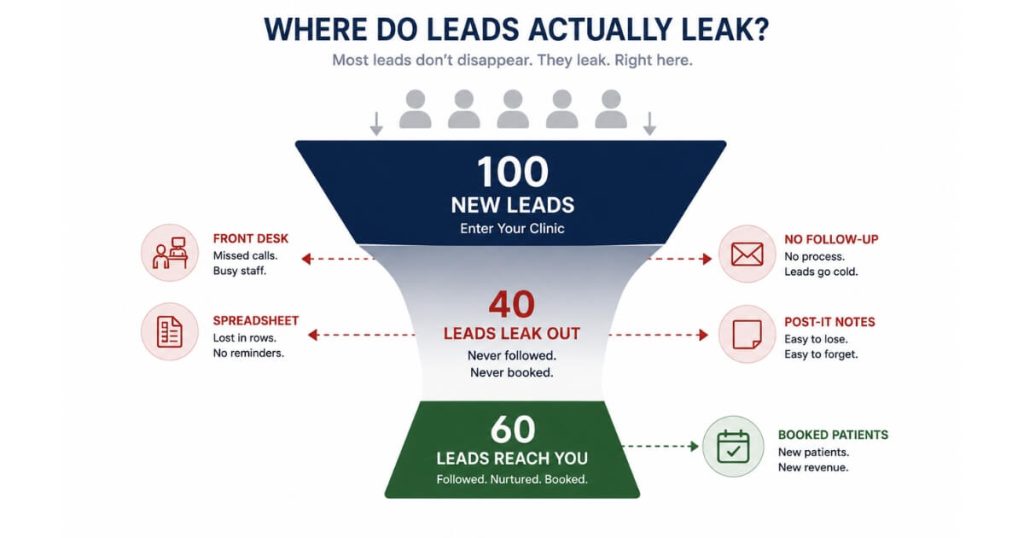
The first and most visible leak is the front desk.
A patient calls, someone writes the name and number on a post-it note, and the note never makes it into the CRM.
The second leak is disjointed systems.
Leads arrive through:
- Phone calls
- Web forms
- Ad platforms
- Booking tools
Each lands in a different place with a different vendor. As a result, no single person can see the whole pipeline at once.
The third leak is the spreadsheet that quietly becomes a graveyard.
Contacts get entered once and never followed up.
The fourth leak is the simplest and most lethal:
No follow-up at all.
A lead comes in, nobody calls back fast enough, and the patient books with whichever clinic answered first.
Every one of these is an operations leak, not a marketing problem.
That distinction matters because buying more leads to pour into a leaky funnel usually makes the economics worse, not better.
Why does lead leakage make my effective CAC so much higher?
Your effective customer acquisition cost is total acquisition spend divided by the patients you actually convert. A leaked lead is spend with zero conversion attached to it.
Picture it in numbers.
You pay to generate 100 leads but only work 60 of them.
The cost of all 100 still gets spread across the patients those 60 produced.
As a result, your real cost per acquired patient climbs even though your cost-per-lead figure looks healthy on the dashboard.
The 40 leads you never touched did not just fail to convert.
They actively inflated the price of every patient you did win.
This is why plugging the leak is one of the rare growth levers that lowers CAC and raises revenue at the same time.
You convert more patients from the exact same spend.
For most cash-pay clinics, the highest-leverage move is not a new ad channel.
It is capturing and working the leads already coming in.
The leads you already paid for are the cheapest patients you will ever acquire.
Recovering them is often a faster path to scale than any new platform.
Why won’t telling my front desk to use the CRM fix the leakage?
Because it is a systems problem wearing the costume of a discipline problem.
Every time you tell the front desk to document everything in the CRM, they do it for a little while.
Then they revert to old habits.
The reason is simple.
The post-it note is faster than a clunky, multi-vendor setup.
Under pressure, the team reaches for the fastest tool.
Unfortunately, the fastest tool leaks.
You are seeing patients all day, so you cannot babysit the behavior.
Hiring a new person does not solve it either.
You still have to train them into the same broken process with time you do not have.
The fix is to remove the decision entirely.
When every lead from every channel routes into one place automatically, capturing a lead becomes the path of least resistance instead of an extra task.
Make the system easier than the post-it note.
The post-it notes disappear on their own.
What does it actually take to plug lead leakage and recover the lost revenue?
Three moves, run inside the first 90 days.
They are the same three things we implemented in every clinic we worked with last year.
Those clinics generated a combined $92 million in revenue, and we only ran paid ads for six of them.
That number is proof that the leverage is in the funnel, not the ad spend.
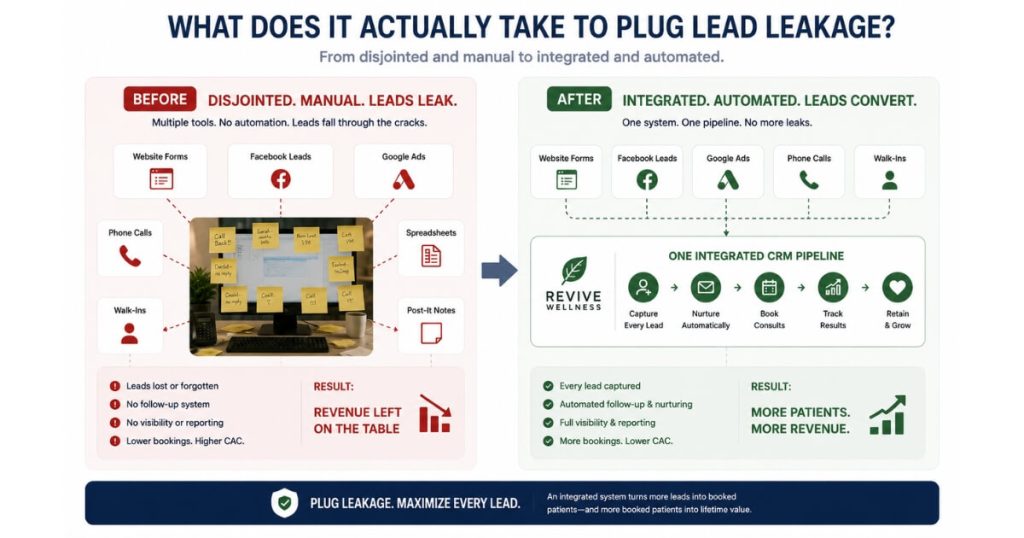
1. Build an integrated funnel
Send every lead into one place.
That means:
- No disjointed CRMs
- No multiple vendors
- No post-it notes
All leads enter one pipeline that the team can actually see and work.
2. Improve pricing presentation
Increase prices or improve how pricing is packaged and presented.
This lifts both:
- Conversion
- Profit per patient
on the leads you are finally capturing.
3. Build topical-authority SEO
Position the clinic as the go-to expert in its market.
As a result, more demand arrives:
- High-intent
- Pre-sold
- Easier to convert
Doing just these three things in the first 90 days reliably produces a minimum of 20% growth.
Most of that growth comes from leads the clinic was already generating and leaking.
Not from new spend.
You can see the compounding effect when capture and conversion are both fixed.
At Eternity Health Partners, we helped the practice grow from $1M to $4M while consistently working 60 inbound calls and 40 web leads per month.
At Orthobiologics Associates, we drove a 79.4% lead-to-booked conversion rate by making sure no qualified lead fell through the cracks.
FAQ’s About Lead Leakage at Cash-Pay Clinics
What is lead leakage in a medical practice?
Lead leakage is any interested patient who enters your world and then slips out before booking and paying.
Examples include:
- A caller written on a post-it note
- A web form nobody answered
- An intake that died in a spreadsheet
- A lead that never received a callback
It is revenue you generated and then lost to an operational gap.
How much is one unworked lead worth at a cash-pay clinic?
As a working estimate:
- Roughly $5,000 in collected revenue
- Closer to $10,000 when referrals are included
Run the math using your own close rate and average patient value.
Most owners discover the number is much larger than expected.
Is lead leakage a marketing problem or an operations problem?
It is an operations problem.
The leads are already arriving.
They are failing at capture and follow-up, not generation.
That is why spending more on ads before fixing the leak often increases effective CAC rather than lowering it.
What’s the single fastest way to stop leaking leads?
Route every lead from every channel into one CRM automatically.
When lead capture no longer depends on a busy front-desk employee remembering to do it, the leak closes by default.
You can finally see and work the entire pipeline.
How quickly can a clinic recover revenue after plugging the leak?
Most clinics see meaningful movement within 90 days.
The recovered patients come from demand that already exists.
Combining:
- An integrated funnel
- Better pricing presentation
- Topical-authority SEO
has reliably produced at least 20% growth for the clinics we work with.
What’s the next step?
If your front desk monitor is ringed with post-it notes, you are not looking at a stationery habit.
You are looking at a revenue leak with a dollar figure attached.
The cheapest patients you will ever acquire are the leads you have already paid for.
Recovering them is faster and more profitable than buying new ones on top of a funnel that loses them.
If you want someone to map exactly where your clinic is leaking leads, what it is costing you, and which fixes recover the most revenue first, that is the conversation to book.
We will audit your current sales process before the call and come prepared with actionable items you can implement right away.