
What Should a GLP-1 Weight-Loss Membership Cost at a Cash-Pay Clinic?
The question every cash-pay clinic owner asks when they launch a GLP-1 program is “what should I charge?” — and almost everyone gets the answer backwards.
They price the membership to win on the sticker number against the big-box telehealth sites, lose the margin war, and never build the part of the business that actually makes money.
The right answer flips it: price the membership to win the relationship, then let bloodwork, retention, and a real service ladder turn one GLP-1 patient into someone who spends up to 7X their original membership across a year at your clinic.
Here is the concrete pricing playbook — the anchors, what to include, how long the contract should run, and why GLP-1 is the front door and not the house.
How much should a cash-pay clinic charge for a GLP-1 weight-loss membership?
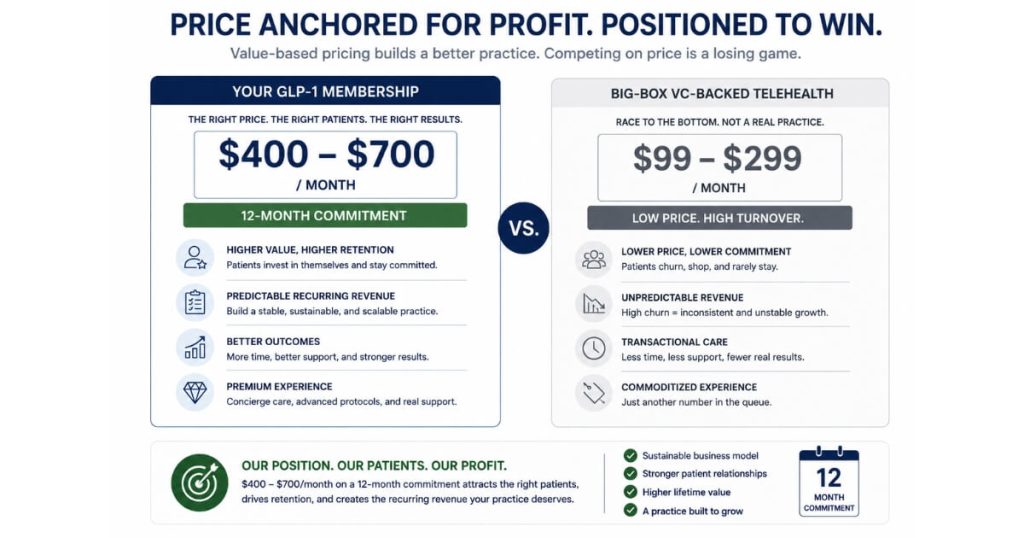
For a cash-pay clinic, the workable anchor for a GLP-1 weight-loss membership is roughly $400 to $700 per month on a 12-month commitment, with the medication, provider visits, dose titration, and ongoing coaching bundled into the monthly price.
Do not try to win on the sticker number.
The big-box, VC-backed GLP-1 websites can price below cost and go into the red for years to buy market share. That is a game an independent clinic cannot win.
Instead, price the membership to reflect a relationship that retains the patient for 12 to 16 months and opens the door to other services.
The membership price is the entry point, not the profit center.
The profit comes from:
- Retention
- Bloodwork-driven upsells
- Additional services uncovered during care
That is how patients end up spending up to 7X their initial membership.
Set the price:
- High enough to fund real care
- High enough to cover labs and provider time
- Low enough to clear the commitment hurdle
Then build the revenue on top of it.
If you want help benchmarking your number, our med spa marketing team builds these membership economics with clinics every week.
What should be included in a GLP-1 membership so the price is justified?
A GLP-1 membership should bundle:
- The medication
- The initial consultation
- Initial labs
- Dose titration
- Dosing and administration support
- Scheduled provider follow-ups
- Concierge follow-ups throughout the year
Do not simply hand over a prescription.
The single highest-leverage inclusion is bloodwork.
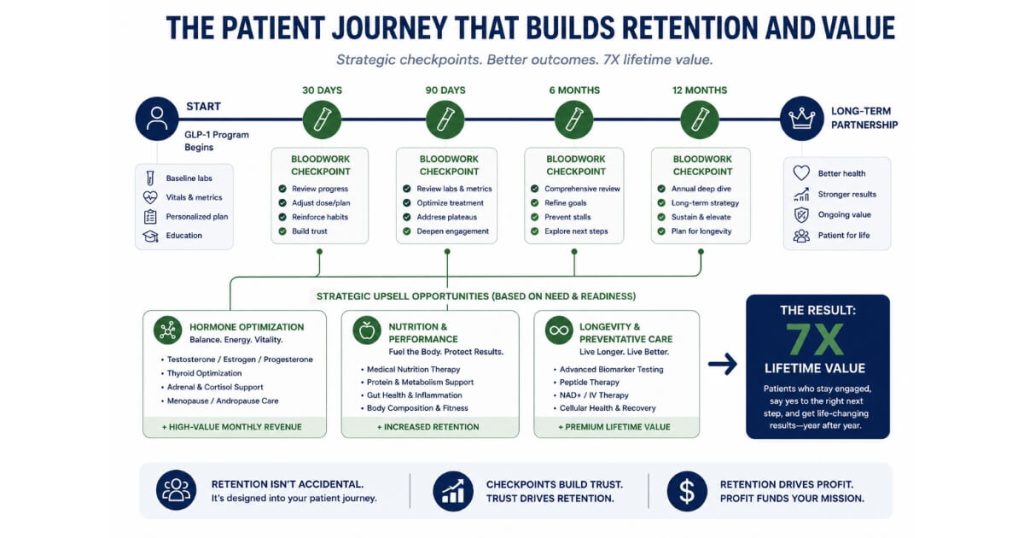
Running labs at intake and at the natural fall-off points — around:
- 30 days
- 90 days
- 6 months
- 12 months
— does three things at once:
- Shows the patient visible before-and-after progress
- Invests them in their own results so they stay longer
- Surfaces other health markers that are out of balance
Those markers may include:
- Hormones
- Energy
- Sleep
- Libido
- Stress
That last point is where the membership pays for itself.
When a patient can see a marker is off, you do not have to sell them anything.
The conversation becomes:
“Want us to help you with that?”
Build the membership around care milestones and the price stops being about a drug and starts being about outcomes.
How long should the contract or commitment be?
Anchor the commitment at 12 months.
The entire economic model of a cash-pay GLP-1 membership depends on retaining the patient for 12 to 16 months. That is the window where the upsells and continued treatment compound.
A month-to-month plan trains the patient to leave the moment the scale moves.
It also leaves the clinic competing on price with the big-box sites every 30 days.
A 12-month commitment, framed during the consultation as a health journey rather than a weight-loss sprint, assumes the close and sets the expectation that the patient will be with you for a while.
Use the intake and consultation to future-pace what life looks like after the weight comes off:
- Nutrition
- Hormones
- Energy
- Longevity
Operationally:
- A credit card secured on the new-patient form helps hold commitment.
- A proven consult script helps hold commitment.
- A strong script alone can roughly double conversion.
Why is GLP-1 a gateway service rather than the main revenue driver?
GLP-1 is the front door, not the house.
The membership fee gets the patient in and keeps them coming back.
The real revenue is everything the relationship unlocks once they are inside.
Because GLP-1 patients are:
- Already paying cash
- Already engaged in their health
- Already getting labs run
They are the warmest possible audience for:
- Hormone therapy
- Nutrition programs
- Peptides
- Aesthetics
- Longevity care
The bloodwork makes those upsells patient-led.
Nobody likes to be sold, but everyone likes to buy.
This is how a clinic gets a GLP-1 patient to spend up to 7X their original membership value over time — by becoming the last provider that patient ever needs to see.
Price the membership to win the relationship.
Then let the service ladder do the heavy lifting on lifetime value.
Should a clinic offer a membership or charge per visit?
The membership model wins for cash-pay GLP-1, and it is not close.
Per-visit billing:
- Makes revenue lumpy
- Invites patients to shop around between refills
- Gives the clinic no predictable base to build other services on
A monthly membership converts GLP-1 into recurring, predictable cash.
It also creates the standing relationship the upsell strategy depends on.
We saw exactly this at Eternity Health Partners, a clinic that scaled from $1M to $4M in revenue on a membership model with 250 members at $1,000 per month.
Recurring membership pricing — not per-visit fees — is what scales a cash-pay practice.
Membership also smooths the retention work.
Scheduled:
- Labs
- Concierge calls
- Follow-up consults
at the:
- 30-day mark
- 90-day mark
- 6-month mark
- 12-month mark
fit naturally into a recurring plan and feel like care.
Automated workflows handle the nurture so the front desk simply follows a daily task list.
How do you compete on GLP-1 price against big-box telehealth sites?
You do not compete on price — you compete on relationship and results.
The big-box GLP-1 websites are:
- VC-backed
- Running multi-million-dollar ad budgets
- Willing to lose money for years
An independent clinic that tries to match those prices simply hands away its margin.
The winning move is to play a different game:
- Bundle real care
- Run the bloodwork
- Retain the patient for a year
- Build higher-LTV services on top
We watched this compound at NuLevel Wellness, a weight-loss and medspa clinic where we added $6.7M in revenue in one year across 3,727 new patients.
Front-end weight-loss demand acquired the patients.
The relationship behind the membership turned them into long-term, high-LTV care.
The patient who wants the cheapest possible semaglutide was never your patient.
The patient who wants to actually fix their health and have one provider quarterback the whole thing is — and that patient does not choose on price.
FAQ’s About GLP-1 Membership Pricing
What is a reasonable monthly price for a GLP-1 membership in 2026?
Most cash-pay clinics land between $400 and $700 per month on a 12-month commitment.
That typically includes:
- Medication
- Provider visits
- Dose titration
- Follow-up care
The exact number depends on your medication cost and what care you include.
Treat that range as the relationship-pricing band, not the rock-bottom band occupied by the big-box sites.
Does a higher membership price hurt conversion?
Not when the price is justified by what is included.
Patients who choose a cash-pay clinic over a big-box site are choosing:
- Care
- Labs
- Accountability
- A real provider relationship
They are not choosing the lowest sticker price.
A proven consultation script that frames the membership as a health journey can roughly double conversion at any reasonable price point.
How does bloodwork increase membership value?
Bloodwork at:
- Intake
- 30 days
- 90 days
- 6 months
- 12 months
shows visible progress, deepens commitment, and surfaces out-of-balance markers such as:
- Hormones
- Sleep
- Energy
Those markers become patient-led upsells.
That is the mechanism behind GLP-1 patients spending up to 7X their original membership.
What is the average lifetime value of a GLP-1 membership patient?
It depends on your service ladder.
The goal is:
- 12 to 16 months of retention
- Upsells into hormones
- Upsells into nutrition
- Upsells into longevity care
That pushes total spend to multiples of the initial membership.
The membership fee is the floor on lifetime value, not the ceiling.
Should the membership price include the medication?
Yes.
Bundling the medication into the monthly fee makes the price:
- Simple
- Predictable
- Easy to commit to
It also prevents patients from price-shopping the medication separately every refill.
The membership should read as a complete care plan, not a prescription plus add-ons.
What’s the next step?
If you are launching or repricing a GLP-1 weight-loss membership, the number on the page matters far less than the system behind it.
Price the membership to win a 12-month relationship.
Bundle the bloodwork that drives patient-led upsells.
Build the higher-LTV service ladder that turns one weight-loss patient into 7X their original value.
That is the difference between a membership that merely sells semaglutide and one that creates long-term revenue.
If you want someone to look at your membership price, your offer, and your upsell ladder together — and tell you exactly where the leverage is — that is the conversation to book.
We will map your GLP-1 membership economics on the call.