
How Do You Market Regenerative Medicine to Chronic-Pain Patients With Fibromyalgia or Neuropathy?
Marketing regenerative medicine to chronic-pain patients is nothing like selling a same-day aesthetic offer. A fibromyalgia or neuropathy patient has usually seen multiple doctors, tried multiple drugs, and been disappointed before they ever find you — so they arrive skeptical and unwilling to commit to a $3K–$20K cash program on the first touch. Winning this category means mastering a long education-and-consideration arc: messaging that names the patient’s exact symptoms, channels that capture problem-aware search demand, proof from patients in their shoes, and an email nurture sequence that keeps the relationship warm until they book.
How long does it take to convert a fibromyalgia or neuropathy patient into a regenerative medicine program?
Plan for weeks to months, not days.
Chronic-pain patients do not buy on impulse.
Instead, they buy after they trust you, and trust takes time to build with an audience that has been let down before.
The reason the arc is so long is the patient’s history.
Someone with fibromyalgia or neuropathy has typically cycled through primary care, specialists, and a stack of medications that masked symptoms without fixing the cause.
As a result, they often arrive at your clinic feeling both hopeful and defensive.
Asking that person to commit to a multi-thousand-dollar cash program on the first interaction rarely works.
Instead, the conversion happens across a series of stages:
- A message that recognizes their symptoms
- An introduction to regenerative options
- An explanation of how treatment works
- Proof from other patients
- A low-friction first step
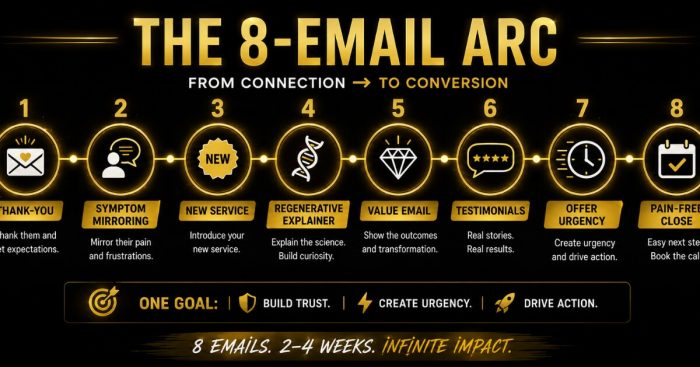
The engine that carries a patient through that arc is a multi-email nurture sequence.
For example, the fibromyalgia sequence this article is built from runs eight emails:
- A thank-you email
- Symptom mirroring
- A new-service introduction
- A regenerative-medicine explainer
- A value email on making treatment more effective
- A testimonials email
- An offer-expiry nudge
- An “imagine living pain-free” close
Meanwhile, the clinics that win this category do not chase the fast yes.
Instead, they build the relationship patiently and make the consultation effortless to book the moment the patient is ready.
What messaging actually resonates with chronic-pain patients?
Lead with their symptoms in their own words, then offer hope without overpromising.
The single highest-converting move in this category is symptom mirroring.
In other words, you name the exact sensations the patient lives with so they think:
“This clinic finally gets it.”
For fibromyalgia and neuropathy, that symptom list is specific and emotionally loaded.
Examples include:
- Constant tingling
- Pins and needles
- Numbness
- Paresthesia
- Loss of feeling
- Chronic pain
- Acute pain
- Burning sensations
- Shooting pains
- Stabbing pains
- Extreme sensitivity
- Problems with hot and cold
When a patient sees their daily reality reflected back to them, trust forms before you have made a single clinical claim.
Because of that, the second email in the source sequence opens by mirroring symptoms.
That is often the moment the patient feels understood.
From there, the message frames regenerative medicine as restoring structure and function to damaged cells and tissues rather than masking pain with drugs.
This distinction matters enormously.
After all, many chronic-pain patients are tired of pain medications and want a real solution.
One testimonial that converts particularly well captures this perfectly.
The patient explained that he was:
“glad he does not use pain meds to mask the pain”
and that the doctor:
“really looks at the problem.”
Keep the tone:
- Warm
- Plain-spoken
- Patient-centered
However, avoid hype.
Likewise, avoid jargon.
Most importantly, anchor every message around a free consultation with one clear and repeated call to action.
Which marketing channels convert regenerative medicine for chronic pain?
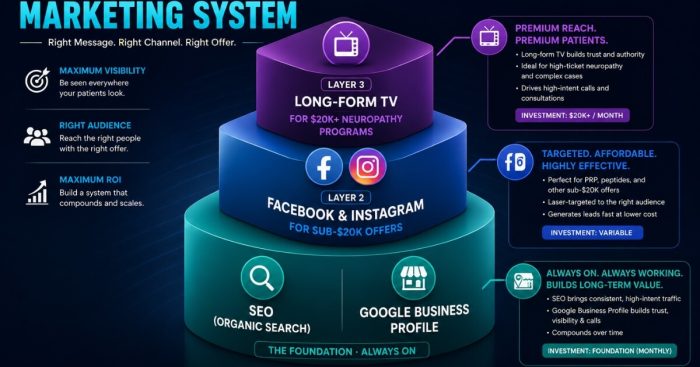
Facebook and Instagram for front-end cash offers under $20K, long-form TV for programs above $20K, and SEO plus Google Business Profile as the always-on layer underneath both.
The channel mix follows patient behavior.
More importantly, chronic-pain patients are problem-aware searchers.
Pain is a search-first behavior.
Patients routinely type symptoms, locations, and treatment names into Google.
Because of this, SEO and a keyword-accurate Google Business Profile are non-negotiable.
They capture the local intent most regenerative clinics are competing for inside a 25-mile radius.
This is the foundation.
That is also why a deep pain management marketing strategy starts with owning organic and local search before scaling paid traffic.
Facebook and Instagram remain the paid workhorses for joint pain and neuropathy.
The audience size supports high-ticket spend.
In addition, these platforms support the aggressive-offer creative this category often requires.
However, they only work when follow-up is fast.
Cash must come in as quickly as you are spending it.
For $20K-plus neuropathy programs, long-form TV can be highly effective.
Specifically, it reaches older audiences who have the time and attention to engage with a 20-minute pitch and call a 1-800 number.
The critical point most clinics miss is simple:
The channel only acquires the lead.
Afterward, the nurture sequence and sales process carry the long consideration arc.
How do you use email nurture to sell regenerative medicine for fibromyalgia?
Build a multi-email sequence that mirrors the patient’s consideration journey and re-offers the consultation at every stage.
Email is where the long arc actually gets walked.
That is because it lets you educate before you ask and keep asking gently.
The proven eight-email arc for fibromyalgia provides a blueprint any chronic-pain clinic can adapt.
Email 1
Thank the patient for reaching out and validate their decision to seek help.
Email 2
Mirror symptoms and build rapport around the shared goal of improving health.
Email 3
Introduce the new service — stem cell therapy — using social proof.
Email 4
Explain regenerative medicine in depth.
Discuss:
- Prolotherapy
- Platelet-rich plasma (PRP) injections
- Stem cell therapy
Email 5
Add value.
For example, explain how diet and supplements can make treatment more effective.
This builds trust without selling anything.
Email 6
Stack testimonials and video reviews.
Email 7
Create urgency around the free-consultation offer.
Email 8
Paint the pain-free future.
Then recap the full service ladder:
- PRP
- Prolotherapy
- Percutaneous tenotomy
- Physiotherapy
Every email repeats one clear call to action:
Book your consultation.
As a result, patients who become ready in week three already know exactly what step to take next.
The sequence works because it leads with education and proof first.
Only then does it repeatedly and gently ask for the consultation.
Why is proof so important when marketing regenerative medicine to chronic-pain patients?
Because chronic-pain patients have been let down before and will not trust a clinic’s claims about itself.
Instead, they trust other patients who were once in their shoes.
Proof is not optional in this category.
It is often the deciding factor.
Fibromyalgia and neuropathy sufferers have usually cycled through specialists and medications that failed them.
Therefore, the strongest trust signal is a real patient describing:
- The same condition
- A similar struggle
- A meaningful outcome
The most effective proof is specific and relatable.
For example:
- A patient who avoided knee surgery after PRP and stem cell treatment
- A patient who chose the doctor because of a whole-patient approach
Written testimonials work well.
Video testimonials work even better.
Likewise, reviews that mention the exact condition and treatment often carry the most weight.
That is why the source sequence dedicates an entire email to proof.
Practice-level proof matters too.
Regenerative pain marketing has produced results like $2,095,039 in 10 months and 26 organic leads per month for one pain and regenerative medicine clinic.
Similarly, a separate SGB specialist who added more than $40K per month while cutting insurance dependence in half demonstrates what focused positioning can accomplish.
Stack proof everywhere:
- Website
- Google Business Profile
- Ads
- Email nurture sequences
That way, patients encounter trust signals at every stage of the consideration journey.
What is the right offer and first step for a chronic-pain regenerative campaign?
A free consultation is the right first step because it lowers the stakes for a skeptical, fatigued patient and lets the sales conversation carry the high-ticket program.
You are not selling a $20K program from an ad.
Instead, you are selling the next small and safe step.
Chronic-pain patients rarely commit to a multi-thousand-dollar program directly from a Facebook ad or TV spot.
Therefore, the job of the marketing is to earn a low-friction first appointment.
During that consultation, the clinic can:
- Assess the patient
- Explain treatment options
- Recommend prolotherapy, PRP, or stem cell therapy when appropriate
- Begin building trust
Frame the consultation as a no-pressure conversation.
Use it to answer questions and explain which services may help.
At the same time, make booking effortless through a single repeated call to action.
After the patient has been educated, add gentle urgency.
For example, use a limited-time consultation offer like the source sequence does in its seventh email.
Finally, remember that a long consideration window requires long follow-up.
Because of that, every campaign should include:
- Fast follow-up
- Email nurture
- Consistent re-engagement
That ensures leads who do not book immediately continue moving toward a decision.
FAQ’s About Marketing Regenerative Medicine for Chronic Pain
How much does it cost to market regenerative medicine for chronic pain?
Budget for both a lead-acquisition channel and a long nurture system.
Facebook and Instagram drive front-end leads.
Meanwhile, SEO and Google Business Profile build the local foundation.
The email sequence and sales follow-up then convert leads over weeks.
Because the ticket is often $3K to $20K or more, clinics can sustain meaningful acquisition costs when follow-up systems are strong.
What regenerative treatments should I feature in my marketing?
Feature the services your clinic actually delivers and that this audience searches for.
Common examples include:
- Prolotherapy
- Platelet-rich plasma (PRP) injections
- Stem cell therapy
- Percutaneous tenotomy
- Photobiomodulation
- Physiotherapy
Frame these treatments as restoring damaged cells and tissues rather than masking pain.
Should I market to fibromyalgia and neuropathy patients differently?
The structure remains the same:
- Symptom mirroring
- Education
- Proof
- Free consultation offer
- Long nurture sequence
However, the symptom language should change.
Mirror the exact sensations each condition produces so patients feel personally understood.
How do I get more reviews and testimonials for my regenerative pain practice?
Ask satisfied patients to describe:
- Their specific condition
- Their treatment
- Their outcome
Capture both written and video testimonials whenever possible.
Reviews that mention exact treatments and conditions tend to perform best because they feel authentic and relatable.
What’s the next step?
If your fibromyalgia and neuropathy leads keep stalling out, the gap is almost never the treatment.
Instead, it is the long arc between the first click and the booked consultation.
Mirror their symptoms in your messaging.
Then stack proof throughout the journey.
Finally, build the email nurture sequence that keeps re-offering the consultation until they are ready.
If you want someone to look at your channels, offer, and follow-up together and tell you exactly where the leverage is, that is the conversation to book.