
Do Email Nurture Sequences Work for Converting High-Ticket Regenerative Medicine Leads?
A stem cell or regenerative medicine lead almost never buys on the day they first hear about you. They are weighing a $5,000 to $20,000 cash decision against surgery, against doing nothing, and against the price — and they sit in that consideration window for weeks. Email nurture is the one channel built for exactly that window. This is the answer to whether nurture sequences convert high-ticket regenerative leads, plus the exact cadence and content structure — pulled from a real, working back-pain stem cell sequence — that turns a cold lead into a booked consult.
Do email nurture sequences actually convert high-ticket regenerative medicine leads?
Yes — email nurture is one of the highest-leverage conversion tools a regenerative or stem cell clinic has, precisely because the buying decision is slow and expensive.
A $5K–$20K cash-pay stem cell or PRP decision is almost never made on the day someone first hears about it.
Instead, the lead compares the treatment against:
- Surgery
- Doing nothing
- The cost
As a result, they often remain in that consideration window for weeks.
An email sequence is the one channel that stays in front of them through that entire window without re-paying for a click each time.
In addition, it delivers the patient education your sales team does not have hours to provide one-on-one.
It also pre-handles surgery and cost objections before the consult call.
Most importantly, it keeps the clinic top-of-mind until the prospect is finally ready to book.
Meanwhile, the clinics that convert these leads do not rely on a single follow-up.
Instead, they run a structured eight-to-twelve email sequence that walks the lead from problem-aware to decision-ready.
Your stem cell clinic marketing engine generates the lead.
Ultimately, the nurture sequence is what turns it into a booked, paid consult.
Why do regenerative medicine leads need a longer nurture sequence than other cash-pay offers?
Because the decision is high-ticket, feels irreversible, and competes directly against surgery and against doing nothing.
A filler patient is product-aware and may book in a day.
By contrast, a stem cell or regenerative lead is usually problem-aware.
They know they are in pain.
In many cases, they have already been told to get surgery.
At the same time, they are often:
- Scared
- Skeptical
- Price-sensitive
Before they will book, they need to understand:
- What the treatment is
- Whether it is safe
- Whether the cells are ethically and FDA-sourced
- How the procedure actually works
- How long recovery takes
- Whether they even qualify
- Which specific condition of theirs it treats
Clearly, that is a lot of education.
And no one absorbs it in a single email.
Therefore, a longer sequence — eight to twelve emails spaced over two to four weeks — gives the lead time to move through skepticism into trust at their own pace.
At the same time, it gives the clinic repeated, low-pressure chances to invite the consult.
Compress that into three emails and you lose every lead who simply was not ready yet.
What is the right cadence and length for a regenerative medicine email nurture sequence?
Eight to twelve emails delivered every two to three days over roughly two to four weeks, front-loaded with education and back-loaded with qualification and urgency.
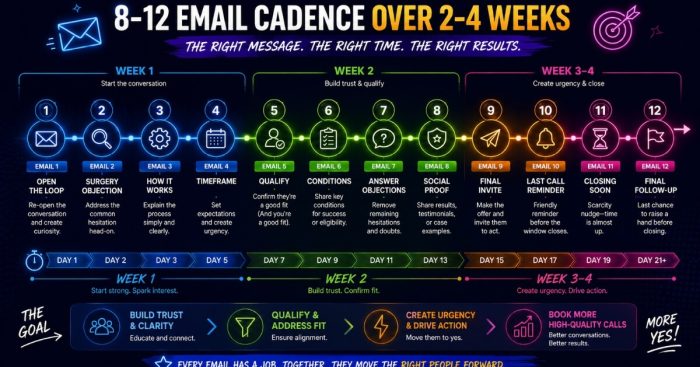
The structure below is pulled directly from a real back-pain stem cell nurture sequence.
More importantly, it maps cleanly onto how a high-ticket pain lead actually thinks.
Email 1 — Open the loop
- Name the conservative treatments that have already failed
- Mention exercise, physical therapy, chiropractic care, pain medication, and injections
- Position the clinic as the complete solution
Email 2 — Take on surgery
- Address the surgery objection directly
- Discuss infection risk
- Discuss nerve damage concerns
- Discuss lost flexibility
- Discuss lengthy recovery periods
- Position the therapy as the minimally invasive alternative
Emails 3–4 — How it works
- Explain the science
- Explain the procedure
- Explain how the cells are ethically and FDA-lab sourced
- Keep the language simple
Email 5 — How long it takes
- Answer timeframe questions
- Explain recovery expectations
Email 6 — Do you qualify?
- Review candidacy
- Discuss patient history
- Discuss physical exams
- Discuss imaging review
Emails 7–9 — Conditions treated
Cover one condition per email, such as:
- Degenerative disc disease
- Facet joint syndrome
- Other joint and soft-tissue conditions
Final Email — Bust the myths
- Address common misconceptions
- Reinforce the benefits
- Make a clear call to action
Every email should end with the same simple ask:
Book a one-on-one consultation.
In addition, most emails should preview the next email in the sequence.
That keeps the lead opening future messages.
Two to three days between sends keeps you present without becoming noise.
What content structure makes a regenerative medicine nurture email convert?
Each email should answer exactly one objection or one question, open with a curiosity hook, use short skimmable lines and lists, and close with a single consultation call to action.
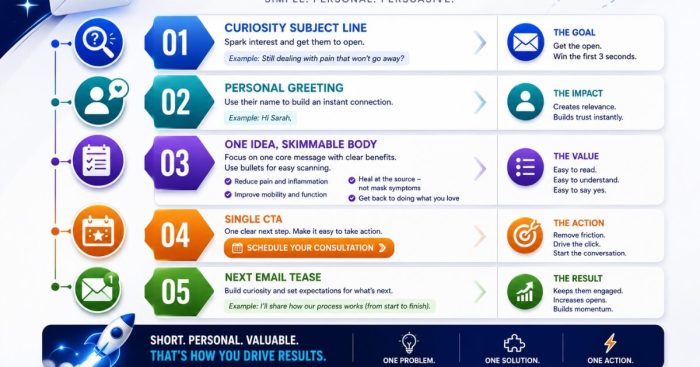
The pattern that works is remarkably consistent.
First, start with a curiosity-driven subject line.
Examples include:
- “DANGER of Mainstream Back Surgery”
- “Do YOU Qualify for Stem Cell Therapy?”
Next, use a personal greeting.
Then focus the body on a single idea.
For readability, break information into:
- Short paragraphs
- Short lines
- Bullet lists
As a rule, the entire email should take less than a minute to read.
Finally, the sign-off or P.S. should preview the next email.
That keeps the curiosity loop open.
However, avoid stacking multiple offers or multiple topics into a single email.
Remember:
One email. One job.
That job should either:
- Remove an objection
- Deepen belief
Likewise, the call to action should never change.
Every email should direct the lead to book a one-on-one consultation by phone or email.
Because of this consistency, the message compounds over eight to twelve touches.
The lead always knows the next step.
Therefore, timing becomes the only remaining variable.
How do email nurture sequences fit with the rest of a stem cell clinic’s marketing?
Nurture is the conversion layer that sits underneath lead generation — SEO and ads fill the top of the funnel, the email sequence converts what they bring in.
Regenerative and stem cell care is a search-first, high-LTV category.
As a result, SEO and Google Business Profile are often the default lead-generation engines.
However, pain leads are problem-aware and slow to decide.
Because of that, a large percentage of leads are not ready to book during the first week.
Without a nurture sequence, those leads go cold.
As a result, the clinic has to pay again to reacquire them.
By contrast, a nurture sequence helps the same lead volume produce more booked consults.
The sequence handles education and objection management at scale.
This is why clinics that pair strong lead generation with disciplined follow-up produce outsized results.
That lead-to-booked rate is what nurture done right looks like.
Likewise, Elite Pain Doctors generated more than $2 million in ten months on roughly 26 organic leads a month.
High revenue on modest lead volume is often the signature of a funnel that converts rather than simply collects leads.
What are the most common mistakes clinics make with regenerative medicine lead nurture?
Sending too few emails, leading with a hard sell instead of education, and changing the call to action every email.
The biggest mistake is a one-and-done follow-up.
For example, many clinics send a single:
Thanks for your interest. Call us.
Afterward, they abandon the lead entirely.
The problem is that the decision usually takes weeks.
The second mistake is selling before educating.
A high-ticket pain patient must first trust:
- The safety
- The sourcing
- The science
Only then does price become relevant.
The third mistake is inconsistency.
Some clinics change:
- The ask
- The cadence
- The number of topics per email
As a result, the lead never knows what action to take.
Other common mistakes include:
- Burying the consultation CTA
- Writing dense paragraphs
- Failing to mention the patient’s specific condition
- Ignoring surgery-related fears
Fix those issues and the same lead list often converts dramatically better.
Most importantly, that improvement happens without spending another dollar on traffic.
FAQ’s About Regenerative Medicine Lead Nurture Emails
Do email nurture sequences actually convert high-ticket regenerative medicine leads?
Yes — email nurture is one of the highest-leverage conversion tools a regenerative or stem cell clinic has because the buying decision is slow and expensive.
As a result, patients often spend weeks evaluating their options.
An email sequence keeps your clinic visible, educates the lead, handles objections, and creates repeated opportunities to book a consultation.
How many emails should a regenerative medicine nurture sequence have?
Eight to twelve emails delivered every two to three days over two to four weeks.
This provides enough time to build trust, answer questions, address objections, and encourage consultation bookings.
What should each nurture email contain?
Each email should focus on one question or one objection.
Specifically, include:
- A curiosity-based subject line
- Short paragraphs
- Bullet lists
- One clear CTA
The goal is simple: remove an objection or strengthen belief.
How does email nurture fit with SEO and ads for a stem cell clinic?
SEO and ads generate the lead.
Meanwhile, email nurture converts the lead.
Because regenerative patients often take weeks to decide, nurture sequences help maximize the value of every lead generated.
What is the biggest mistake clinics make with regenerative lead nurture?
The biggest mistake is relying on a single follow-up email.
High-ticket regenerative decisions take time.
Therefore, a longer educational sequence consistently outperforms one-and-done follow-up.
What’s the next step?
If your regenerative or stem cell clinic is generating leads but losing them in the weeks between first contact and the consult, the leak is almost always the same one: there is no structured email nurture sequence carrying the lead through the consideration window.
The leads are not bad.
Instead, the follow-up is missing.
A disciplined eight-to-twelve email sequence that handles the surgery objection, explains the science, qualifies the patient, and asks for the consult every time will convert leads you are currently paying to lose.
If you want someone to look at your lead flow, your follow-up, and your conversion math together — and tell you exactly where the booked consults are leaking out — that is the conversation to book.
We will map the nurture sequence to your offer and your conditions on the call.