
How Much Does It Cost to Acquire a Regenerative Medicine Patient?
Every regenerative and stem cell clinic owner eventually asks the same question: what does it actually cost to get one new patient in the door? The honest answer is that there is no single number.
Your cost-per-patient can range from almost nothing to several thousand dollars. It depends on the channel you use, the ticket size of the offer, and how compliant your advertising language is.
Regenerative medicine is different from most cash-pay medical specialties. The highest-intent keywords are often restricted on ad platforms. Search volume can be limited. And most patients spend weeks researching before making a high-ticket decision.
Here is the numbers-first breakdown of what it costs to acquire a regenerative patient — and which channels do it most efficiently.
How much does it cost to acquire a regenerative medicine or stem cell patient?
Realistically, a regenerative or stem cell patient can cost anywhere from under $100 to more than $2,000 to acquire.
The biggest factor is the channel.
Patients acquired through SEO and Google Business Profile are often the least expensive.
Patients acquired through paid advertising are usually much more expensive.
The reason is simple.
Regenerative patients are:
- High-ticket buyers
- Slow decision-makers
- Difficult to target through paid ads
In addition, many of the highest-intent keywords are restricted on advertising platforms.
As a result, clinics often have to attract patients through broader and more expensive top-of-funnel campaigns.
Organic search is usually the cheapest source of new patients.
Once content ranks, the effective acquisition cost per patient becomes extremely low.
Paid acquisition works very differently.
Consider these numbers:
- Hair-restoration clicks often cost $15–$25 each.
- Four clicks can cost more than $100.
- Competitive campaigns often start around $1,200 per month.
Because clinics cannot advertise directly on many regenerative keywords, costs rise quickly.
Why is regenerative medicine so expensive to advertise compared to other cash-pay treatments?
Three factors drive costs higher:
- Keyword restrictions
- Limited search volume
- Long buying cycles
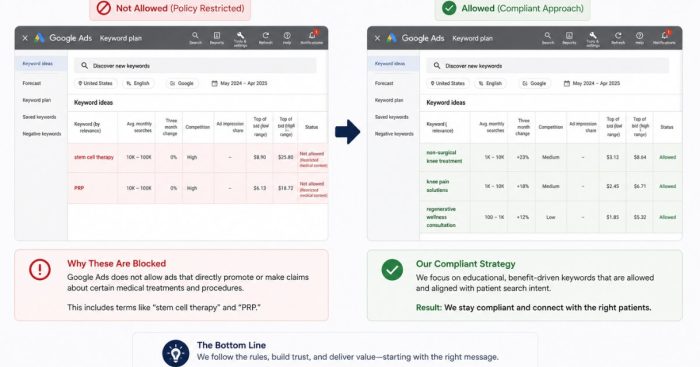
Google Ads restricts many regenerative medicine terms.
Keywords such as:
- Stem cell therapy
- PRP
- Treatment-related phrases
are often flagged as FDA-sensitive.
In many cases, Google simply will not serve ads for these terms.
As a result, clinics must advertise around the problem rather than the treatment.
Instead of targeting regenerative procedures directly, they target phrases such as:
- Non-surgical knee treatment
- Alternatives to knee surgery
- Knee replacement alternatives
These audiences are larger.
However, they are also less qualified.
That increases acquisition costs.
Search volume creates another challenge.
For example, Google Keyword Planner may show only about 10 monthly searches for “peptides for joint pain” in smaller markets.
That creates a supply problem.
There simply are not enough high-intent searches available.
Finally, regenerative patients rarely make immediate decisions.
Most patients:
- Research for weeks
- Compare providers
- Read reviews
- Ask friends and family
- Evaluate costs
Because of this, one click rarely becomes one patient.
Advertising compliance creates another layer of risk.
The wrong language can trigger account suspensions or ad disapprovals.
That makes regenerative advertising both expensive and fragile.
Which channel has the lowest cost to acquire a stem cell patient?
SEO and Google Business Profile consistently deliver the lowest acquisition costs.
The reason is straightforward.
Organic search allows clinics to appear when patients search for regenerative treatments directly.
Paid platforms often block those same searches.
For example, someone searching:
- Stem cell therapy near me
- PRP near me
is already showing strong buying intent.
Organic rankings capture that intent naturally.
Once rankings are established, additional patients arrive without additional click costs.
We see this repeatedly.
One Fargo clinic ranks:
- #1 for PRP
- #2 in the map pack for stem cell therapy
- #3 organically for stem cell therapy
The clinic achieved this without paid advertising.
That visibility creates a steady stream of low-cost patients.
The results scale.
Orthobiologics Associates generated more than $309,000 in cash-pay revenue through SEO.
When SEO becomes the primary lead source, the marginal cost of the next patient approaches zero.
That is why organic visibility sits at the center of any serious stem cell clinic marketing strategy.
What is a good front-end offer to lower regenerative patient acquisition cost?
A PRP offer often provides the lowest-risk entry point.
Many clinics use:
- Discounted PRP injections
- Buy-one-get-one PRP offers
- Introductory regenerative consultations
These offers lower the barrier to entry.
Instead of asking a patient to commit to a $5,000–$20,000 treatment plan immediately, the clinic offers a smaller first step.
PRP is especially attractive because the hard material cost is relatively low.
In many cases, materials cost roughly $150.
Once the patient’s blood is processed and the patient is already in the chair, additional treatment opportunities become easier to introduce.
The strategy looks like this:
- Acquire the patient through a low-risk PRP offer.
- Deliver a positive experience.
- Build trust.
- Introduce higher-ticket regenerative services when appropriate.
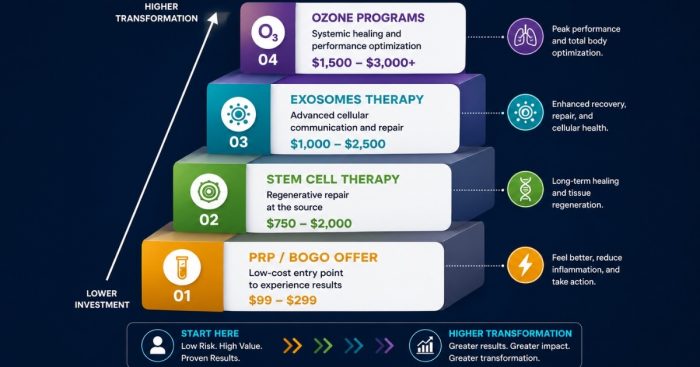
This approach lowers acquisition costs while increasing average patient value.
More importantly, it helps solve a common problem.
Many clinics increase patient volume while revenue stays flat.
The issue is not patient count.
The issue is revenue per patient.
A structured treatment ladder helps solve that problem.
How does ticket size change the cost-per-patient math in regenerative medicine?
Ticket size determines whether an acquisition cost is profitable.
Consider two examples:
- A $2,000 acquisition cost for a $400 service is a disaster.
- A $2,000 acquisition cost for a $20,000 program can be extremely profitable.
That is why regenerative medicine operates differently from low-ticket aesthetics.
The lifetime value is much higher.
One patient may purchase:
- Stem cell procedures
- Exosome therapies
- Hormone optimization
- Additional regenerative services
Over time, that patient can generate significant revenue.
Because of this, clinics should match each offer to the appropriate acquisition channel.
For example:
| Offer Type | Best Channel |
|---|---|
| Stem Cells | SEO |
| PRP | SEO + Paid Ads |
| HRT | SEO |
| Longevity Programs | SEO |
| Body Contouring | Paid Ads |
When the channel matches the offer, acquisition costs remain manageable.
When it does not, profitability disappears quickly.
Do paid ads or SEO acquire regenerative patients cheaper?
SEO acquires regenerative patients more cheaply than paid advertising over almost any meaningful timeframe.
Paid advertising faces several challenges:
- Restricted keywords
- Rising CPCs
- Longer buying cycles
- Compliance risks
Depending on the campaign, clicks can range from:
- $4
- $10
- $15
- $25+
Yet many of the highest-intent keywords cannot be advertised directly.
That forces clinics into broader campaigns with lower intent.
SEO works differently.
It captures the patient at the exact moment they search.
Once rankings are established, traffic continues without per-click costs.
The long-term economics are difficult to ignore.
Consider the case-study data:
- $309,590 generated through SEO with zero ad spend
- More than $2 million generated through approximately 26 organic leads per month
Paid ads still have a role.
They work well for compliant gateway offers and top-of-funnel awareness.
However, if the goal is the lowest cost per regenerative patient, SEO wins almost every time.
FAQ’s About Regenerative Medicine Patient Acquisition Cost
How much does it cost to acquire a regenerative medicine or stem cell patient?
Acquisition costs typically range from under $100 to more than $2,000 per patient.
SEO and Google Business Profile usually generate the lowest costs.
Paid advertising is often more expensive because regenerative buyers take longer to decide and many high-intent keywords are restricted.
Why is regenerative medicine so expensive to advertise?
Three factors drive costs higher:
- Restricted keywords
- Low search volume
- Long buying cycles
In addition, compliance rules limit what clinics can say in advertisements.
Which channel has the lowest cost to acquire a stem cell patient?
SEO and Google Business Profile generally provide the lowest acquisition costs.
Organic rankings allow clinics to appear when patients search for regenerative treatments directly.
Once rankings are established, each additional patient becomes extremely inexpensive to acquire.
What is a good front-end offer to lower acquisition costs?
PRP offers often work well.
Examples include discounted injections, buy-one-get-one offers, and introductory regenerative consultations.
These offers reduce risk for the patient and create opportunities for higher-ticket care later.
How does ticket size affect acquisition costs?
Ticket size determines profitability.
A $2,000 acquisition cost may be unacceptable for a low-ticket procedure but highly profitable for a $20,000 regenerative program.
That is why offer-to-channel alignment matters.
Do paid ads or SEO acquire regenerative patients cheaper?
SEO almost always wins on cost efficiency over time.
Paid ads can generate leads quickly.
However, SEO continues producing patients without ongoing click costs, making it the more efficient long-term channel.
What’s the next step?
Most clinics focus on cost-per-click.
The better question is cost-per-patient.
More importantly, the best clinics focus on patient value, not just patient volume.
A strong acquisition strategy combines:
- SEO
- Google Business Profile
- Conversion optimization
- Strategic front-end offers
Together, those systems lower acquisition costs while increasing patient value.
If you want help calculating your true cost-per-patient and building a regenerative marketing system that scales profitably, that is the conversation to book.
We will break down the numbers and identify the fastest path to growth.