
What Does the Regenerative Medicine Patient Journey Look Like? (From Google Search to a High-Ticket Stem Cell Decision)
A regenerative patient does not wake up one morning and book a $10,000 stem cell program. They take a long, winding path — from the first late-night symptom search, through weeks of research and second-guessing, to the consult where they finally decide. If you only market to the very end of that path, you are competing for the tiny slice of patients who are already ready to buy and ignoring the much larger pool still forming their decision. The clinics that dominate this category understand the whole journey and show up at every stage. Here is what that journey actually looks like, and how to market to each step so you are the clinic the patient finds, trusts, and chooses.
What does the regenerative medicine patient journey look like?
It is a five-stage path — symptom search, research and education, clinic evaluation, consultation, and treatment decision plus follow-up — and it usually unfolds over weeks because it is a high-cost, high-uncertainty cash decision driven by trust.
Unlike a quick aesthetic purchase, the regenerative journey is long and deliberative.
It starts when a person in pain begins searching for answers.
Then it moves into a research phase where they educate themselves and form opinions.
Next, it narrows to evaluating specific clinics on trust signals.
From there, it advances to a consultation where the real decision is made.
Finally, it ends with the treatment commitment and the follow-up relationship that drives lifetime value.
The defining feature of the entire path is uncertainty.
The patient is spending serious cash, often on something insurance will not cover, frequently after being told by another doctor that surgery is their only option.
As a result, every stage is really about reducing that uncertainty.
The clinic that shows up helpfully at each step, rather than only shouting “book now” at the end, is the one that earns the patient.
This is the backbone of a real patient acquisition system: meet the patient where they are, not only where you wish they were.
How does a regenerative patient first start looking for help?
They start problem-aware, not product-aware — typing symptoms, conditions, and “alternatives to surgery” into Google long before they ever search for “stem cell clinic near me.”
The journey begins in pain and frustration, not with your treatment name.
The patient searches things like:
- “knee pain when I walk”
- “alternatives to knee replacement”
- “why does my shoulder still hurt after PT”
- “non-surgical options for a torn rotator cuff”
At this stage they may not even know regenerative medicine is an option for them.
This is the single biggest opportunity most clinics miss.
They only buy ads on high-intent terms like “PRP near me” and ignore the enormous volume of problem-aware searchers who do not yet know your category exists.
Educational content that answers those early questions honestly — explaining the condition, the conventional options, and where regenerative approaches may fit — captures the patient at the exact moment they are forming their understanding.
Just as importantly, it positions you as the source that taught them.
Pain is a search-first behavior, which is why a strong SEO and content foundation is the highest-leverage investment at the top of this journey.
What happens during the research phase, and why does it take weeks?
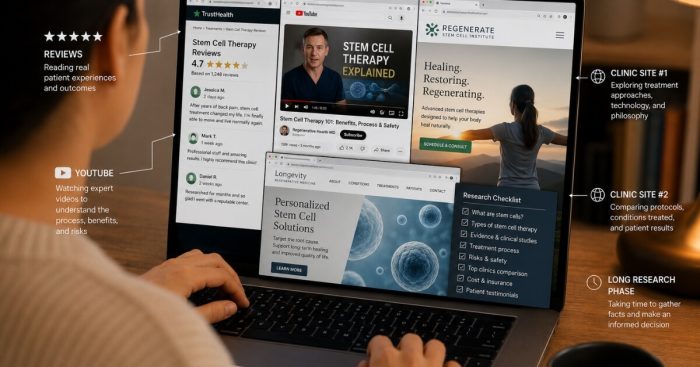
The patient becomes a researcher — reading, comparing, and watching — because a multi-thousand-dollar cash decision with no insurance backstop demands confidence, and confidence takes time to build.
Once a patient knows regenerative medicine is a possibility, they do not call immediately.
Instead, they go deep.
They:
- Watch YouTube videos.
- Read reviews.
- Compare clinics.
- Ask in forums.
- Try to figure out whether this is legitimate.
- Determine whether it will work for them specifically.
This phase can stretch for weeks.
More importantly, it is where most of the real decision actually happens.
The clinic that produces honest, educational content — videos explaining the science and the limits, blog posts answering the exact questions patients are asking, and visible proof — stays present throughout this phase.
As a result, it becomes the trusted front-runner before the patient ever makes contact.
This is exactly how authority compounds: when we helped Dr. Joy Kong become the number one stem cell expert on YouTube, patients across the country were effectively completing their research phase by watching her.
So by the time they reached out, the decision was already leaning her way.
Win the research phase and you win the patient before the competition even knows they exist.
How does a patient choose which clinic to actually contact?
They choose on trust signals — reviews, educational content, the doctor’s visible expertise, and a website that answers their questions — far more than on price or proximity.
By the time a regenerative patient is ready to reach out, they have usually narrowed to two or three clinics.
At that point, the deciding factors are almost entirely about credibility.
Key trust signals include:
- Strong, specific Google reviews that mention the treatments and outcomes.
- A doctor who clearly knows the science and has taught it publicly.
- A website that addresses their fears honestly, including the FDA and safety questions.
- Real proof of results, framed truthfully.
The clinic that has invested in these trust assets gets the call.
Meanwhile, the clinic with a thin website and a handful of generic reviews gets skipped, even if it is closer or cheaper.
This is why brand and reputation are not vanity projects in regenerative medicine — they are the literal selection criteria.
A clinic that built this kind of credibility, like the regenerative practice where we generated $309,590 in cash-pay revenue in 10 months from SEO and trust assets alone with a 79.4% conversion rate, wins the contact because the patient already feels safe before the phone rings.
What does the decision moment look like, from consult to treatment?
The consultation is where the decision is truly made — the patient arrives wanting to say yes and needing the clinic to confirm candidacy, frame the investment, and make the path forward feel safe and clear.
The consult is not where you start selling.
It is where you finish what your marketing began.
A patient who has searched, researched, and chosen you is arriving warm.
They want this to be the answer.
Your job at the consult is to:
- Evaluate candidacy honestly.
- Explain the plan in plain language.
- Frame the investment against the alternative they are trying to avoid.
- Remove practical friction through clear next steps, financing options, and scheduling.
This is also where lifetime value begins.
Regenerative patients who get a good outcome and a great experience refer others and return for additional areas over time.
The clinics that convert consults at a high rate are the ones whose front desk and patient coordinators are trained for this exact moment.
And a practice like the pain clinic where we helped add more than two million dollars in revenue in ten months shows what happens when the whole journey, from first search to signed treatment plan, is engineered to work together rather than left to chance.
How do you market to each stage of the regenerative patient journey?
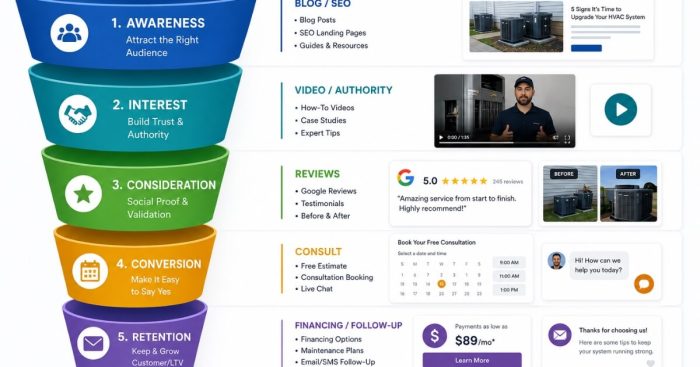
You match an asset to each stage — educational SEO for symptom search, video and proof for research, reviews and credibility for evaluation, a trained consult process for the decision, and a follow-up system for lifetime value.
The mistake is treating marketing as one thing aimed at one moment.
The journey demands a stack.
For the symptom-search stage:
- Build educational blog content.
- Create SEO content that answers problem-aware questions.
For the research stage:
- Invest in video.
- Develop thought leadership.
- Share honest proof that a patient can consume over weeks.
For the evaluation stage:
- Systematically grow specific reviews.
- Make your website answer every fear, including FDA and safety concerns.
For the decision stage:
- Train your phone process.
- Train your consultation process so warm patients convert.
For the post-treatment stage:
- Build a follow-up system.
- Build a recall system that turns one outcome into referrals and repeat care.
When every stage is covered, the journey becomes a machine.
You capture patients earlier.
You nurture them while competitors ignore them.
And you convert them when they are ready.
That is exactly how the strongest stem cell clinic marketing turns a long, uncertain buyer journey into a predictable flow of high-ticket patients.
FAQ’s About the Regenerative Medicine Patient Journey
What are the stages of the regenerative medicine patient journey?
There are five:
- Symptom search.
- Research and education.
- Clinic evaluation.
- Consultation.
- Treatment decision plus follow-up.
It unfolds over weeks because it is a high-cost, high-uncertainty cash decision driven by trust.
The patient starts in pain searching for answers, educates themselves and forms opinions, narrows to specific clinics on trust signals, makes the real decision at a consultation, and then enters a follow-up relationship that drives lifetime value.
Every stage is fundamentally about reducing the patient’s uncertainty.
How do regenerative patients first search for help?
They start problem-aware, not product-aware, typing symptoms and conditions like “knee pain when I walk,” “alternatives to knee replacement,” or “non-surgical options” long before searching for a stem cell clinic.
Many do not yet know regenerative medicine is an option for them.
Most clinics miss this by only bidding on high-intent terms, ignoring the large volume of problem-aware searchers.
Educational content that answers these early questions captures the patient as they form their understanding and positions the clinic as the source that taught them.
Why does the regenerative research phase take so long?
Because a multi-thousand-dollar cash decision with no insurance backstop demands confidence, and confidence takes time to build.
After a patient learns regenerative medicine is a possibility, they watch videos, read reviews, compare clinics, and try to determine whether it is legitimate and will work for them.
This phase can stretch for weeks and is where most of the decision actually happens.
The clinic that produces honest, educational content stays present throughout and becomes the trusted front-runner before the patient ever makes contact.
How do patients choose which regenerative clinic to contact?
On trust signals far more than price or proximity: strong, specific reviews, a doctor with visible expertise, a website that honestly answers their fears including FDA and safety, and real proof of results.
By the time they reach out, patients have usually narrowed to two or three clinics, and credibility is the deciding factor.
The clinic that invested in these trust assets gets the call; the clinic with a thin website and generic reviews gets skipped even if it is closer or cheaper.
How do you market to each stage of the journey?
Match an asset to each stage: educational SEO for symptom search, video and proof for the research phase, reviews and credibility for evaluation, a trained consult process for the decision, and a follow-up and recall system for lifetime value.
The mistake is aiming one message at one moment.
When every stage is covered, you capture patients earlier, nurture them while competitors ignore them, and convert them when they are ready — turning a long, uncertain journey into a predictable flow of high-ticket patients.
What’s the next step?
The regenerative patient journey is long, deliberate, and driven by trust — which means the clinic that shows up helpfully at every stage, not just at the moment of purchase, is the one that wins.
Map your marketing to the journey:
- Capture the symptom searcher.
- Nurture the researcher.
- Earn the evaluator’s trust.
- Convert the consult.
- Keep the patient for life.
Do that and you stop fighting over the small pool of ready-to-buy patients and start owning the much larger pool still deciding.
If you want help mapping your marketing to the full regenerative patient journey — and finding the stages where you are currently invisible — that is the conversation to book.
We will build your stage-by-stage plan on the call.