
Should a Regenerative Medicine Clinic Put Its Stem Cell Prices on the Website?
Every regenerative and pain practice owner eventually has the same argument with their marketing person. One side says “patients keep asking the price, just put it on the site and stop wasting everyone’s time.” The other says “if we post a $6,000 number with no context, every price-shopper bounces and we never get the consult.” Both are partly right, and the answer is not a coin flip — it depends on the treatment, the ticket size, and what job you need the website to do. This is the straight version of how to think about price transparency at a high-ticket regenerative clinic, and what to put on the page when a bare number would cost you the patient.
Should a regenerative medicine clinic put its stem cell prices on the website?
Usually not a full price for high-ticket stem cell and regenerative programs — but you should give the visitor a sense of investment level, because total silence reads as evasive and a naked number reads as expensive.
The instinct to either dump the full price list or hide everything are both wrong for this category.
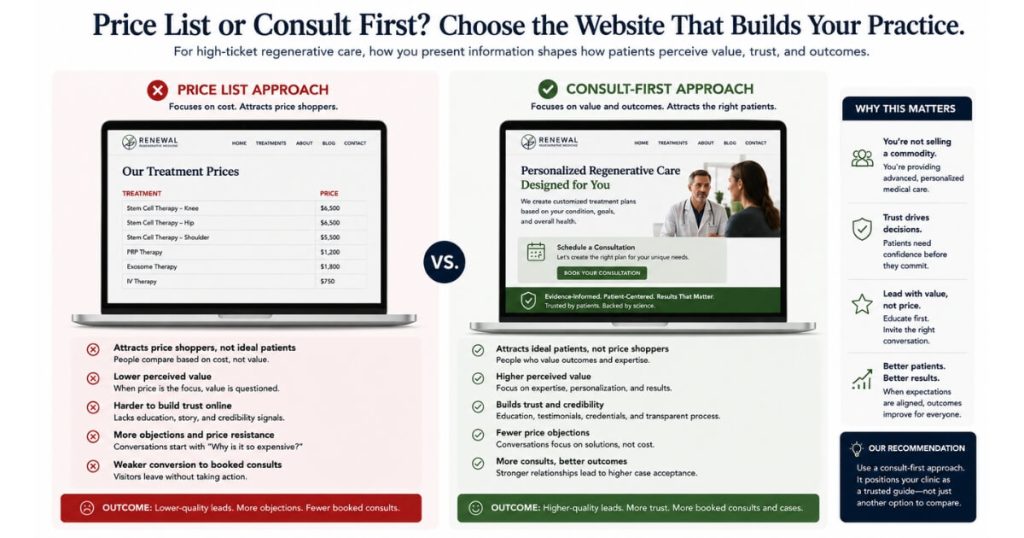
A high-ticket regenerative program is a considered, consultative purchase — the patient needs to understand candidacy, the process, and the realistic outcome before a number means anything.
Post “$6,000” with no context and you have framed yourself as a price, not a solution, and the price-shopper leaves before you ever get to explain why you are worth it.
But go completely silent and the modern patient, who has been burned by clinics that hide bad value, gets suspicious and bounces to a competitor who at least gave them a range.
The winning middle path for most clinics is a “starting from” anchor or an honest range for entry-level procedures, paired with a clear explanation that comprehensive programs are quoted after a consultation.
You qualify out the bargain-hunters without looking like you are hiding something.
For a lower-ticket, well-understood procedure like PRP for a single joint — which a clinic might run around $750 per joint — showing a clear price can actually build trust and book the appointment.
The rule scales with the ticket: the bigger and more customized the program, the more the price belongs in a conversation, not a footer.
Why do most high-ticket regenerative clinics keep full prices off the page?
Because a five-figure cash number with no value built around it filters for the wrong patient and kills the consult that actually closes the case.
High-ticket regenerative care is sold in a relationship, not a checkout.
The patient who is going to pay $8,000 or $15,000 in cash for a regenerative program is buying confidence — in the diagnosis, the provider, and the plan — and that confidence is built in a consultation, not on a pricing grid.
When you post the full number cold, you let the most price-sensitive, least-committed visitor self-select out before anyone has had the chance to establish value, and you train your whole funnel to compete on price instead of outcome.
That is the exact trap premium positioning is supposed to avoid.
The clinics that grow fastest in this category route the price question into a consult where a human can frame the investment against the alternative — surgery, a lifetime of injections, or simply staying in pain.
We have seen this play out at clinics like Orthobiologics Associates, where a consultative, education-first funnel produced a 79.4% conversion rate from lead to booked appointment and $309,590 in cash-pay revenue in 10 months.
That number does not happen when the website does the quoting; it happens when the consult does.
When does showing prices actually help a regenerative practice?
When the procedure is lower-ticket and well-understood, when you are trying to filter for serious buyers in a price-sensitive local market, or when transparency is your deliberate brand position.
There are real situations where putting a price on the page is the right call.
Entry-level, commoditized procedures — a single-joint PRP injection, a basic prolotherapy visit, an IV — are things patients comfortably price-compare, and a clear number removes friction and books the appointment.
If your market is saturated with cheap competitors and your phone is clogged with people who could never afford a program, a published “programs start at” figure can pre-qualify and protect your team’s time.
And some practices choose radical transparency as their whole differentiation — “no surprise pricing, no pressure” — which can be a powerful trust play in a category full of high-pressure sales rooms.
The key is that showing a price should be a strategic choice you made on purpose, not a default you fell into because patients kept asking.
If you decide to show numbers, anchor them: lead with the value and the outcome, then present the price as the investment to get there, never as a bare line item.
How do you handle the “how much does it cost?” question without scaring patients off?
Acknowledge it immediately, give an honest range or starting point, and then pivot to candidacy — because dodging the question destroys trust faster than any number does.
The mistake clinics make is treating the price question like a threat.
A patient asking “how much” is showing interest, not hostility, and stonewalling them (“we can’t discuss that until you come in”) makes you sound like you are hiding a bad number.
The better script names a real starting point or range, then immediately reframes:
“Programs typically start around X, but the honest answer is that the right number depends on what we find in your evaluation — some patients need one area treated, some need more, and a few aren’t good candidates at all, which we’ll tell you up front.”
That answer respects the patient, gives them something concrete, and moves them toward the consult where value gets built.
Train your front desk and patient coordinators on it, because the way the price question gets handled on the phone is often the difference between a booked high-ticket consult and a lead that ghosts.
If your team is losing patients on this exact moment, it is usually a script-and-training problem, not a price problem — and it is fixable.

Does hiding prices hurt your SEO or visibility in AI search?
It can — search engines and AI answer engines increasingly favor pages that give a real answer, so a page that says nothing about cost may simply not get surfaced for “how much does stem cell therapy cost” queries.
This is the part most clinics overlook.
A growing share of patients now research price by asking Google’s AI Overview, ChatGPT, or Perplexity “how much does PRP or stem cell therapy cost,” and those engines cite pages that actually address the question.
A treatment page with zero pricing context gives the AI nothing to quote, so a competitor’s transparent page gets the citation and the click.
You do not have to publish your full quote to win here — an honest, well-structured explanation of what drives the cost, a starting range for entry procedures, and a clear “why it varies” section give the answer engines something to cite while still routing the real number into a consult.
That is how you get found by the patient who is price-researching without surrendering your premium positioning.
A clinic that pairs this kind of transparent, intent-matching content with a strong consultative funnel — the same approach behind effective pain management marketing — captures the high-ticket searcher instead of repelling them.
Done right, you answer the question well enough to get cited and clicked, and you still hold the close for the consult.
FAQ’s About Showing Stem Cell Prices on a Regenerative Clinic Website
Should a stem cell clinic show prices on its website?
For high-ticket, customized stem cell or regenerative programs, usually not the full price — but you should not go completely silent either.
A naked five-figure number with no value built around it filters for the most price-sensitive patient and kills the consult that closes the case, while total silence reads as evasive to a skeptical modern patient.
The winning approach for most clinics is a “starting from” anchor or honest range for entry procedures, plus a clear note that comprehensive programs are quoted after a consultation.
For a lower-ticket, well-understood procedure like single-joint PRP, showing a clear price can build trust and book the appointment.
Why do high-ticket regenerative clinics keep prices off the page?
Because high-ticket regenerative care is sold in a consultative relationship, not a checkout.
The patient paying five figures in cash is buying confidence in the diagnosis, the provider, and the plan, and that confidence is built in a consultation.
Posting the full number cold lets the least-committed visitor self-select out before value is established and trains the whole funnel to compete on price instead of outcome.
Routing the price question into a consult, where a human frames the investment against the alternative, is what produces high conversion rates on high-ticket cases.
When should a regenerative practice show its prices?
When the procedure is lower-ticket and well-understood (single-joint PRP, prolotherapy, IVs), when you want to pre-qualify serious buyers in a price-sensitive market, or when radical transparency is your deliberate brand position.
Showing a price should be a strategic choice made on purpose, not a default you fell into because patients kept asking.
If you do show numbers, anchor them: lead with the value and outcome, then present the price as the investment to get there, never as a bare line item.
How should a clinic answer “how much does it cost?” on the phone?
Acknowledge the question immediately, give an honest starting point or range, then pivot to candidacy.
Dodging the question (“we can’t discuss that until you come in”) makes you sound like you are hiding a bad number and destroys trust faster than any price does.
A script like “programs typically start around X, but the right number depends on your evaluation” respects the patient, gives them something concrete, and moves them toward the consult.
How this moment is handled is often the difference between a booked high-ticket consult and a lead that ghosts.
Does hiding prices hurt SEO and AI search visibility?
It can.
Patients increasingly research cost through Google’s AI Overview, ChatGPT, and Perplexity, and those engines cite pages that actually address the question.
A treatment page with no pricing context gives the AI nothing to quote, so a transparent competitor page earns the citation and the click.
You do not need to publish your full quote — an honest explanation of what drives cost, a starting range for entry procedures, and a clear “why it varies” section give answer engines something to cite while still routing the real number into a consult.
What’s the next step?
Whether to show your prices is not a philosophy question — it is a positioning and funnel question.
The right answer depends on your ticket size, your market, and what you need each page to do: filter, build trust, get cited, or close.
Most regenerative clinics land on a hybrid — transparent on entry procedures and “why it varies,” consultative on the high-ticket programs — and the ones that get it right convert more of the patients they were quietly repelling.
If you want a second set of eyes on your pricing pages, your phone scripts, and how the two work together to convert high-ticket regenerative patients, that is the conversation to book.
We will map your transparency strategy and your funnel on the call.