
What Can a Regenerative Medicine Clinic Legally Say in Its Marketing? (Stem Cell and PRP Advertising Rules for 2026)
If you run a cash-pay stem cell, PRP, or regenerative pain practice, the scariest question in your marketing is not “how do we get more patients” — it is “are we allowed to say this?” The honest answer for 2026 is that you have far more room than the nervous clinic owner thinks and far less than the hype merchant down the street is using. The FDA regulates the products, the FTC regulates the promotion, and both have made regenerative medicine an enforcement priority. But the line is not mysterious. You can market the experience of care, your credentials, your process, and honestly-framed outcomes all day long. You just cannot promise to cure a disease with a product that is not approved to cure it. Here is the plain-English version of where the line sits and how to build marketing that converts on the right side of it.
What can a regenerative medicine clinic legally say in its marketing?
You can market your credentials, your process, the patient experience, honestly-framed functional outcomes, and education about conditions and options.
What you cannot do is claim an unapproved product cures, reverses, or treats a specific disease.
The cleanest way to think about it is that you are allowed to describe what you do and who does it, and you are allowed to educate.
- You can say a board-certified physician performs the procedure.
- You can explain how PRP or a regenerative injection works.
- You can describe what a typical visit looks like.
- You can share that many patients pursue these options to stay active and avoid more invasive routes.
- You can talk about pain, function, mobility, and quality of life in measured language.
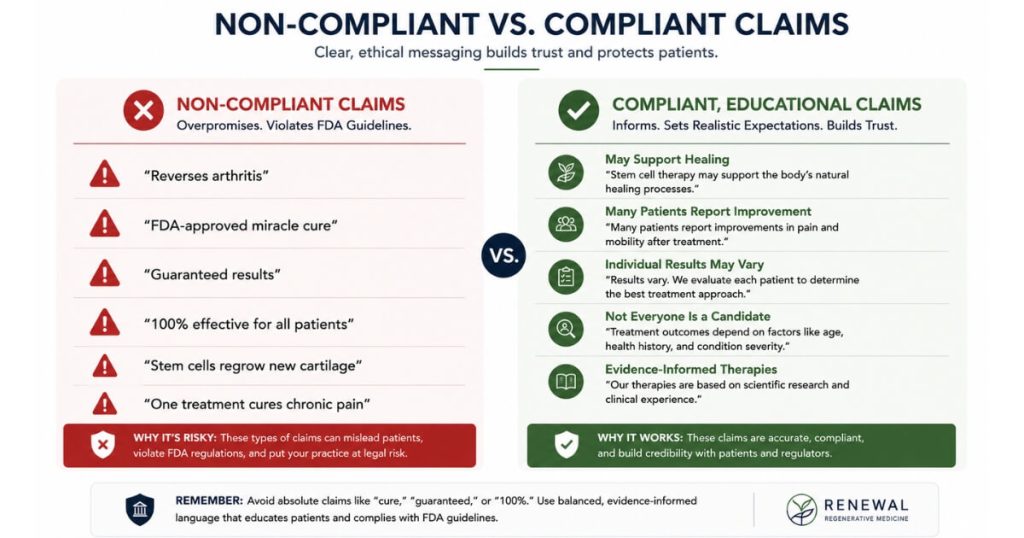
What trips clinics up is crossing from education into a guarantee — language like “reverses arthritis,” “regenerates cartilage,” or “FDA-approved stem cell cure.”
Those are exactly the phrases regulators point to.
The fix is almost never to go silent.
It is to swap absolute promises for honest, candidate-based framing:
- “may support”
- “many patients report”
- “candidates are evaluated individually”
- “results vary”
That is not weak marketing.
In a skeptical category, it is the marketing that earns trust.
What stem cell and PRP marketing claims get clinics in trouble with the FDA and FTC?
The claims that draw enforcement are disease-cure claims for unapproved products, implying a therapy is FDA-approved when it is not, and testimonials that imply ordinary patients should expect extraordinary results.
This is not theoretical.
In January 2025 the FTC and the Georgia Attorney General secured orders banning stem cell clinic operators from marketing stem cell treatments and requiring more than $5.1 million in refunds and penalties — and the case turned on the promotional claims, not the science.
The FDA, separately, has kept unapproved stem cell and exosome therapies as a top enforcement priority and has put companies on notice for marketing unapproved products for serious conditions.
The pattern across both agencies is consistent: the trigger is the claim.
Saying or implying that an unapproved injection “treats” arthritis, neuropathy, autism, or any named disease is the fast lane to a warning letter.
So is leaning on dramatic testimonials that suggest a typical patient will get a dramatic result.
Exosome marketing draws extra scrutiny because most exosome products do not meet the regulatory bar.
The takeaway for your marketing team is simple:
Never let the website, the ad, or the salesperson promise a cure.
Never let a testimonial do the overclaiming the clinic knows it cannot do directly.
Can I use patient testimonials and before-and-after results in regenerative marketing?
Yes, but they must be truthful, represent typical results or clearly disclose that they do not, and never imply a cure — because the FTC treats a testimonial as your claim.
Patient stories are some of the most persuasive assets a regenerative clinic has, and you are not banned from using them.
The rule is that a testimonial cannot say something the clinic itself could not legally say.
If a patient on camera declares the treatment “cured my arthritis,” that becomes your disease-cure claim the moment you publish it.
Use stories that describe the experience and honestly-framed functional change — “I can get back on the golf course,” “I’m sleeping through the night again” — rather than diagnostic cures.
If a result is not typical, the FTC expects you to disclose that clearly and conspicuously, not bury it.
Document your outcomes so the stories you tell are real and defensible.
Handled this way, social proof becomes a trust asset instead of a liability, which matters enormously in a market where the patient is already screening you for credibility.
A clinic like Orthobiologics Associates, where we generated $309,590 in cash-pay revenue in 10 months from SEO alone with a 79.4% conversion rate from lead to booked appointment, did it on honest, education-first content — proof that you do not need to overclaim to convert.
The transparency is the conversion mechanism.
This is the foundation of compliant stem cell clinic marketing that still produces patients.
How do I market a treatment that isn’t FDA-approved without overclaiming?
Market the problem you help with, the process, and the candidacy evaluation — not a promised outcome — and let education do the selling.
Most regenerative procedures are offered under the practice of medicine rather than as FDA-approved therapies, and patients increasingly know that.
So stop fighting it and build your marketing around it.
Lead with the patient’s problem in their own words:
- Joint pain
- A torn-up knee
- Neuropathy that keeps them up at night
Explain the options honestly, including when a patient may not be a good candidate.
That single move builds more trust than any superlative.
Describe your process:
- The consult
- The imaging or workup
- The decision
- The procedure
- The follow-up
Be transparent that outcomes vary and that you evaluate every patient individually.
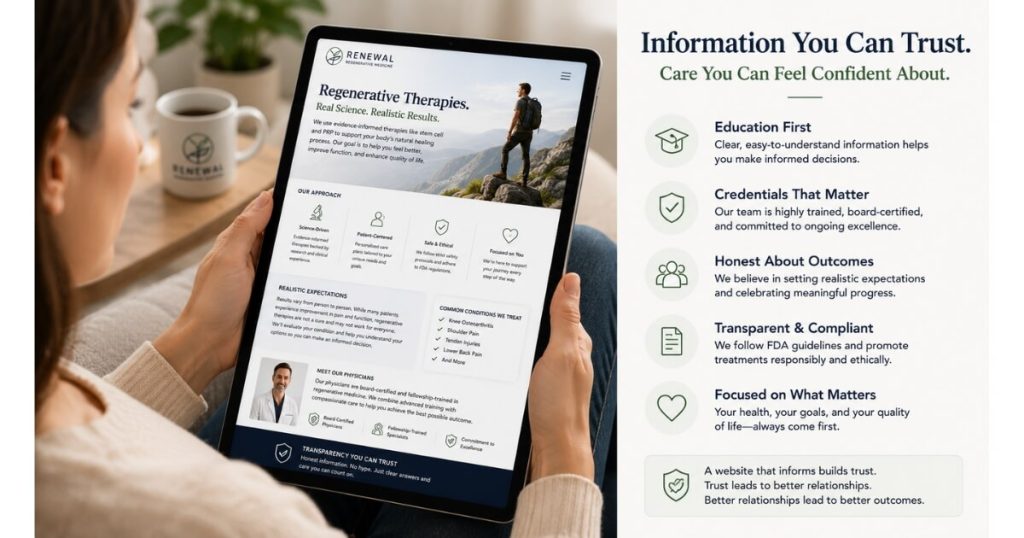
This “education-first, candidacy-based” frame is both the compliant approach and the high-converting one, because the modern regenerative patient is specifically looking for a clinic that is not overselling.
If you want a patient-acquisition system built on this kind of credible, compliant foundation, that is exactly what a strong approach to stem cell clinic marketing is supposed to deliver — authority and trust, not hype.
Why does compliant marketing actually convert better for a cash-pay regenerative clinic?
Because the buyer is making a high-cost, high-uncertainty cash decision, and credibility is how people resolve uncertainty — the honest clinic wins the patient the hype clinic scares off.
Here is the part most owners miss:
Compliance and conversion are not in tension.
They are the same strategy.
A patient about to spend thousands of dollars in cash, with no insurance backstop, on a treatment they have read warnings about, is in a heightened state of skepticism.
Miracle language raises their guard.
Honest, educational, candidacy-based language lowers it.
The clinics that market on credibility do not just stay out of trouble.
They capture the patients their over-promising competitors repel, and they do it while the regulators thin out the hype merchants for them.
We watched authority compound this way when we helped Dr. Joy Kong become the number one stem cell expert on YouTube, which let her hire four more doctors and scale herself out of the day-to-day.
In a trust-driven category, the most compliant voice is usually the most credible one — and the most credible one wins.
FAQ’s About Regenerative Medicine Advertising Compliance
What can a stem cell or PRP clinic legally say in its marketing?
A regenerative clinic can market its providers’ credentials, its process, the patient experience, education about conditions and options, and honestly-framed functional outcomes such as improved mobility or reduced pain.
What it cannot do is claim that an unapproved product cures, reverses, or treats a specific disease, or imply the therapy is FDA-approved when it is not.
The practical move is to replace absolute promises (“reverses arthritis”) with candidacy-based, measured language:
“candidates are evaluated individually; many patients report improved function; results vary.”
That framing is both compliant and, in a skeptical market, higher-converting.
What marketing claims get regenerative clinics in trouble with the FDA and FTC?
Disease-cure claims for unapproved products, implying a treatment is FDA-approved when it is not, and testimonials that suggest ordinary patients should expect extraordinary results.
In January 2025 the FTC and the Georgia Attorney General banned stem cell clinic operators from marketing stem cell treatments and ordered more than $5.1 million in refunds and penalties, with the case hinging on the promotional claims.
The FDA continues to treat unapproved stem cell and exosome therapies as a top enforcement priority.
The common trigger across agencies is the claim — phrases like “regenerates cartilage” or “reverses arthritis” applied to unapproved products.
Can a regenerative clinic use patient testimonials and before-and-after photos?
Yes, but a testimonial is treated as the clinic’s own claim, so it must be truthful, avoid implying a cure, and either represent typical results or clearly disclose that it does not.
Use stories that describe the experience and honestly-framed functional change rather than diagnostic cures.
Document your outcomes so they are defensible.
Disclose clearly when a result is not typical.
Handled correctly, patient stories are a powerful trust asset rather than a compliance risk.
How do you market a treatment that isn’t FDA-approved?
Market the problem you help with, your process, and your candidacy evaluation rather than a promised outcome.
Lead with the patient’s problem in their own words.
Explain the options honestly, including when someone is not a good candidate.
Describe your consult-to-follow-up process.
Be transparent that outcomes vary.
This education-first, candidacy-based approach is both the compliant path and the high-converting one, because the modern regenerative patient is actively screening for a clinic that is not overselling.
Does compliant marketing hurt a regenerative clinic’s conversion rate?
No — it usually improves it.
A patient spending thousands in cash on a treatment they have read warnings about is highly skeptical.
Miracle language raises their guard while honest, educational language lowers it.
Compliant clinics capture the patients their over-promising competitors scare off, and they do it while regulators thin out the hype merchants.
Credibility is how buyers resolve uncertainty, so the most compliant voice is frequently the most persuasive one.
What’s the next step?
The regulatory environment around regenerative medicine is not a reason to market timidly — it is a reason to market credibly.
The clinics that win in 2026 are the ones whose every ad, page, and sales conversation describes honest process and realistic outcomes instead of cures.
That is the marketing that stays clear of FDA and FTC enforcement and converts the skeptical, high-value cash patient at the same time.
If you run a stem cell, PRP, or regenerative pain practice and you want your website, ads, and sales scripts audited for both compliance and conversion — so you are saying everything you are allowed to say and nothing you are not — that is the conversation to book.
We will map your claims, your proof assets, and your messaging on the call.