
Should a Cash-Pay HRT Clinic Offer a Free Trial or Intro Offer to Win New Members?
A competitor down the street runs “free labs, free first pellet, try it a month, $121 if you feel better” and pulls 15 to 20 new members a month. Tempting, right? Intro offers can absolutely flood a calendar — or quietly bleed a clinic dry. The offer itself isn’t good or bad; whether it works depends entirely on what’s built behind it. Here’s the FAQ on whether a cash-pay HRT clinic should run a free trial or intro offer, and how to make one that actually pays.
Should a cash-pay HRT clinic offer a free trial or intro offer?
Maybe — but only if you have the retention and backend in place to turn trial-takers into long-term members.
An intro offer is an acquisition tool, not a strategy, and it only profits when something good happens after the trial.
A low-friction front-end offer — free or cheap labs, a free or discounted first treatment, a low first-month price — works by removing the patient’s risk.
Done right, it pulls in volume.
The competitor running “free labs, free first pellet, $121/month if you feel better” was adding 15 to 20 net new members a month with it.
That’s real.
And for a clinic that needs to fill a calendar, an intro offer can be a fast way to do it.
The catch is that the offer only makes money on the back end.
The trial itself is usually a loss leader, recouped only if those patients stay.
So the honest answer is conditional.
If you have:
- A strong consult
- A clear path from trial to membership
- Fast follow-up
- Real retention
An intro offer can be a powerful growth lever.
If you don’t, it’s an expensive way to acquire patients who try you once and vanish.
Whether to run one is really a question about the rest of your patient acquisition system, not about the offer itself.
Do free-trial hormone offers actually work?
They work for acquisition volume — they’re proven to fill calendars — but “work” depends on conversion to membership, not on how many trials you give away.
There’s no question that aggressive trial offers generate front-end response.
Hormones are a high-intent, high-LTV category.
Removing the cost barrier to trying gets people in the door who would otherwise hesitate.
The competitor example proves the top of the funnel:
- Free labs
- Free first pellet
- 15 to 20 new members signing on monthly
People will try almost anything that’s free and low-risk, especially something they’re already curious about.
However, trial volume is a vanity metric until those patients convert and stay.
A clinic that gives away 20 trials and keeps 4 has a very different business than one that gives away 20 and keeps 15.
Same offer.
Opposite outcome.
The variable isn’t the offer’s pulling power.
It’s everything that happens after the patient walks in.
That’s why the right question is never “do free trials work” but “does my clinic convert and retain trial patients well enough to make a free trial profitable.”
What makes an intro offer profitable instead of a money-loser?
The backend: a membership to convert into, a retention system to keep members, and the margin and follow-up to make the lifetime value dwarf the cost of the giveaway.
An intro offer is profitable when the math on the back end works.
For example:
- Give away a $300 lab and a first treatment.
- Convert that patient into a $300–$1,000-a-month membership.
- Keep them for a year or more.
The giveaway becomes one of the best marketing dollars you’ll ever spend.
However, give away the same trial with:
- No membership to step into
- Weak follow-up
- High churn
And you’ve simply paid to treat strangers for free.
The offer didn’t fail.
The backend did.
This is exactly why the deepest-discount clinics are often the most fragile.
Cheap acquisition with no retention engine burns cash fast.
The durable HRT businesses are built on lifetime value, not front-end gimmicks.
A clinic with that kind of retention can afford an aggressive intro offer because each converted patient is worth thousands.
A clinic without it can’t.

How do I structure an intro offer that converts to membership?
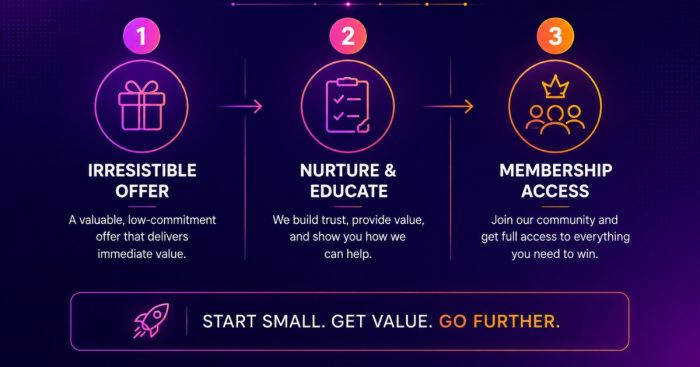
Make the trial a clear on-ramp to the membership, not a destination — credit the entry cost toward joining, present the membership during the trial, and follow up fast and relentlessly.
A converting intro offer is engineered backward from the membership.
First, the trial should naturally lead somewhere.
The patient finishes the free or low-cost first step and there’s an obvious, pre-framed next move into the membership.
For example:
“If you feel great, here’s how we keep it going.”
Second, credit the entry.
If they paid anything to start, apply it to the first month so joining feels like the smart, frictionless choice.
Third, present the membership while motivation is highest.
Do it at or right after the first positive experience, not weeks later.
Fourth, follow up fast.
A trial patient who isn’t contacted quickly cools off, and a cooled-off trial is a wasted acquisition cost.
Strong offers paired with a strong backend are how fast-scaling clinics grow.
For example, NuLevel Wellness Medspa added $6.7M in revenue in a year across 3,727 new patients on the back of compelling front-end offers.
However, those offers worked because the conversion and follow-up operation behind them turned responders into paying patients.
Build the on-ramp before you turn on the offer.
As a result, the trial becomes a membership machine instead of a charity.
When should I NOT run an intro offer?
When your retention is weak, your follow-up is slow, your margins are thin, or you have no membership to convert trial patients into — in those cases an intro offer just accelerates losses.
Skip the intro offer if any of the foundations are missing.
If patients who join don’t stay, a trial offer simply increases the number of people who leave.
If your front desk doesn’t follow up within minutes and persist for days, trial responders will go cold before they ever convert.
If your margins are already tight, a loss-leader offer can push the unit economics underwater.
And if you don’t have a membership or clear backend for the trial to lead into, you’re giving away care with nothing to convert into — the worst version of the play.
There’s also a positioning reason to be cautious.
As covered in our piece on responding when a competitor undercuts on price, racing to out-discount a price-cutter can train your market to shop on price and erode the premium positioning that high-LTV HRT patients actually want.
Sometimes the better move is to:
- Fix retention first.
- Differentiate on value.
- Layer in a smart intro offer once the backend can support it.
The discipline of knowing when an offer helps versus hurts is central to real medical practice marketing.
FAQ’s About HRT Intro Offers and Free Trials
Will a free trial just attract freebie-seekers who never pay?
It can, if there’s nothing behind it.
A free trial with:
- A strong consult
- A clear membership on-ramp
- Fast follow-up
Filters and converts.
A free trial with none of that mostly attracts people who take the free thing and leave.
The backend determines who you keep.
How much can an intro offer realistically generate?
On the front end, a lot.
A competitor example added 15 to 20 net new members a month with a free-labs, free-pellet, $121 trial.
However, the revenue that matters comes from how many of those convert to membership and stay.
Judge the offer by converted, retained members, not by trial sign-ups.
Should the trial be free or low-cost?
Either can work.
The key is removing enough risk to get a yes while keeping a path to revenue.
A small credited entry fee, applied to the first month, often converts better than fully free because it filters for intent without becoming a barrier.
Test both against your conversion data.
What’s the single biggest reason intro offers lose money?
No backend.
Clinics run the offer to fill the calendar but haven’t built:
- The membership
- The retention system
- The fast follow-up
The offer works at the top of the funnel and fails at the bottom.
That’s a business problem, not an offer problem.
Is an intro offer better than just lowering my prices?
Usually, yes.
An intro offer is a temporary, controllable acquisition tool.
A price cut permanently lowers revenue on every member and trains the market to shop on price.
A trial brings people in without devaluing your ongoing membership.
What’s the next step?
If you’re tempted to run a free trial because a competitor’s is working, the real question isn’t the offer — it’s whether your retention, follow-up, and membership can turn trial patients into long-term revenue.
Get those right and an intro offer becomes a growth engine.
Skip them and it becomes an expensive giveaway.
On a 60-minute strategy call we’ll assess your backend — membership, retention, and follow-up — and design an intro offer that actually converts to members, or tell you honestly if you should fix retention first.