
How Do I Market a Cash-Pay Clinic in a Small or Rural Market?
The marketing advice clinics read online assumes a big city — plenty of search volume, deep ad budgets, a dense population to draw from. In a small or rural market, that playbook quietly fails: there simply aren’t enough people searching for your treatment to make paid search work. But small-market clinics grow all the time. They just use a different strategy — one built on creating demand, owning local search, and widening their reach. Here’s the FAQ on marketing a cash-pay clinic in a small or rural market.
How do I market a cash-pay clinic in a small or rural market?
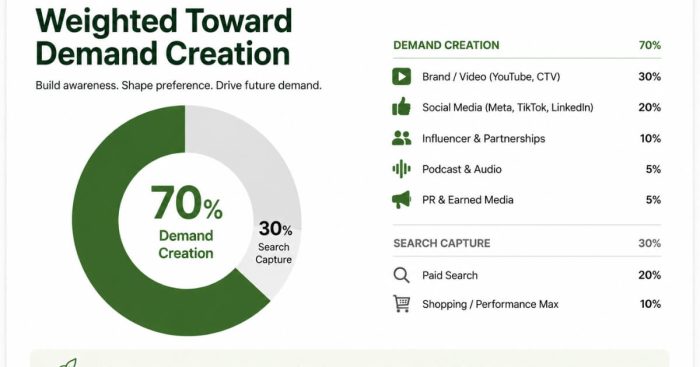
Lead with demand creation and local authority, not search capture — because in a thin market there isn’t enough existing search to feed a paid-search-first strategy.
The defining feature of a small market is that demand is shallow.
At one regenerative clinic we work with in a small North Dakota market, a high-value search term like “peptides for joint pain” had only about 10 searches a month — nowhere near enough to build a paid Google search campaign on, regardless of the click price.
In a city you capture demand that already exists.
In a rural market you often have to create the demand first, then capture the small amount of search that does exist.
That reversal is the whole strategy.
So the small-market mix flips the usual order.
Instead of pouring budget into paid search, you:
- Put treatments in front of people who aren’t searching yet
- Build the local authority that wins the search that does happen
- Widen your geographic net so you’re drawing from more than one small town
Specifically, that means focusing on:
- Social media
- Community outreach
- SEO
- Google Business Profile
Matching the channel to how patients actually find you in a thin market is the core of building a patient acquisition system that fits your geography instead of fighting it.
Why don’t paid search ads work well in low-population areas?
Because paid search only captures demand that already exists — and in a small market, that demand is too thin to sustain a campaign.
Google search ads are a capture channel.
They put you in front of people at the moment they search.
That’s powerful when thousands of people search your treatment monthly.
However, it’s nearly useless when ten do.
With volume that low, you’re paying premium click prices to fight a handful of competitors over a tiny pool of clicks.
As a result, the math almost never works, and the campaign starves for impressions no matter how much you’re willing to spend.
The problem isn’t your ads.
It’s that the audience isn’t searching in the first place.
This is the single most common small-market mistake:
Copying a big-city clinic’s paid-search-heavy strategy and concluding “marketing doesn’t work here” when it underperforms.
Marketing works fine in small markets.
Search-capture as the lead channel doesn’t.
Once you stop trying to force paid search to carry a thin market and shift budget to channels that create and own demand, growth becomes very achievable.
How do I find patients when almost no one is searching for my treatment?
Create the demand: use social media, community presence, and education to introduce the treatment to people who don’t yet know they want it.
When patients aren’t searching, you have to reach them before they search.
Facebook and Instagram are the workhorses here because they’re interruption channels.
You can put a compelling treatment story, offer, or patient testimonial in front of the right local audience whether or not they’ve ever heard of the service.
Community presence does the same job offline.
For example:
- Local events
- Educational talks
- Gym partnerships
- Wellness partnerships
In small markets, reputation and familiarity compound faster than anywhere else because the community is tight.
Education is the multiplier.
A provider who consistently explains the treatment — what it is, who it helps, what to expect — creates demand that didn’t exist, then becomes the obvious place to get it.
This is also where a strong content presence pays off.
The same videos and posts that build trust create awareness of treatments your small market wasn’t searching for yet.
You’re not capturing a market.
You’re building one, and then owning it.
How important is local SEO and Google Business Profile in a small market?
Critical — because while total search volume is low, you can realistically own nearly all of it, and a small market has far less competition to beat.
The flip side of thin search volume is that the search that does exist is winnable.
In a major metro, ranking #1 for a treatment means out-competing dozens of well-funded clinics.
In a small market, it can mean out-competing two or three — or none.
That makes local SEO and a fully optimized Google Business Profile some of the highest-ROI work a rural clinic can do.
Focus on:
- Accurate services
- A keyword-rich description
- A steady flow of reviews mentioning the treatments you want to be found for
- Regular Google Business Profile posts
These can let you dominate local search for very little spend.
Because you can capture essentially all the local intent, organic becomes the durable backbone of a small-market clinic.
Organic-first growth is proven even in high-ticket care.
In a small market, where you can realistically own the top of local search, that organic backbone is even more decisive.
Should I expand my radius or draw patients from a wider area?
Yes — widen your geographic net.
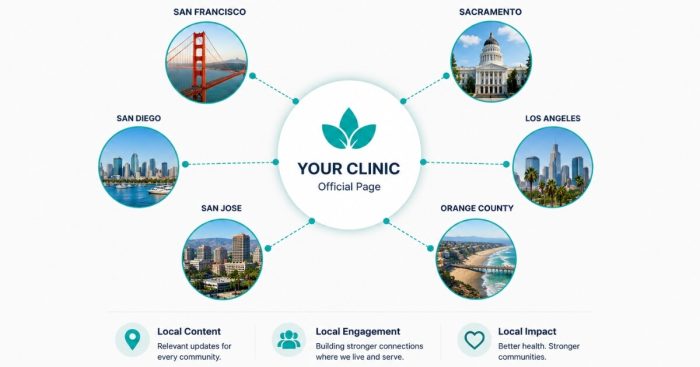
A rural clinic should market to its whole drawable region, not just its home town, and build local pages for each nearby community it can realistically serve.
One small town often can’t supply enough patients on its own.
However, the surrounding region can.
Cash-pay patients — especially for higher-ticket regenerative, hormone, and specialty care — will drive a meaningful distance for the right provider.
Therefore, define your real service radius, often a one-to-two-hour drive, and market to all of it.
Practically, that means:
- Building dedicated landing pages for each meaningful nearby town
- Creating location pages for surrounding communities
- Running social ads across the wider region
- Ensuring your reviews and Google Business Profile presence reach beyond your immediate ZIP code
Niching down helps here too.
In a smaller market, being the clear specialist in one high-value treatment can pull patients from a wide area precisely because you’re the only real option for miles.
That’s exactly the kind of distinctive, authority-driven approach that lets a clinic draw patients from across a region rather than competing for a single town’s thin demand.
Building that regional authority is the heart of medical practice marketing that works outside the big cities.
FAQ’s About Marketing a Cash-Pay Clinic in a Small or Rural Market
Does this mean I should never run paid ads in a small market?
Not never — just not paid search as your lead channel.
Paid social, especially Facebook and Instagram, works well in small markets because it creates demand rather than capturing it.
Paid search can play a small supporting role for the limited high-intent terms that do have volume.
However, it shouldn’t carry the strategy.
How far will cash-pay patients really travel?
Often surprisingly far for the right provider.
A one-to-two-hour drive is common for higher-ticket regenerative, hormone, and specialty care, especially when you’re the clear local authority or the only option in the region.
Define your true service radius and market to all of it.
Is local SEO worth it if my town is tiny?
Yes — arguably more than in a big city.
Total volume is low, but competition is low too.
Therefore, you can own nearly all the local search for very little spend.
Combined with a strong Google Business Profile and reviews, it becomes the durable backbone of a small-market clinic.
How do I create demand for a treatment people don’t know about?
Through social media, community presence, and consistent provider-led education.
Explain the treatment:
- What it is
- Who it helps
- What to expect
Do this repeatedly across video and local channels.
As a result, you create awareness and then become the obvious place to get it.
You’re building the market, not just serving it.
Should I niche down or offer everything in a small market?
Niching into one high-value treatment often works better.
Being the clear regional specialist pulls patients from a wide area and makes your marketing distinctive.
A specialist is worth driving to.
A generalist competing on a thin local market is not.
What’s the next step?
If you’ve concluded that “marketing doesn’t work here,” the real issue is almost certainly a big-city playbook applied to a small market.
The clinics that grow in rural areas create demand, own local search, and widen their radius.
And that approach is very learnable.
On a 60-minute strategy call we’ll map your real service region, identify which channels create demand in your market, and build the local-SEO and outreach plan that grows a cash-pay clinic outside the big cities.