
How Should a Cash-Pay HRT Clinic Respond When a Competitor Undercuts on Price?
A new hormone clinic opens nearby with a louder, cheaper offer — free labs, a free first month, a $121 membership — and starts pulling 15 to 20 new members a month. Your instinct is to cut your price to match. Don’t. Matching a price-cutter is how you trade your margin for their growth problem. Here’s the FAQ on how a cash-pay HRT clinic competes when someone undercuts you — without starting a race to the bottom you can’t win.
How should a cash-pay HRT clinic respond when a competitor undercuts on price?
Compete on value, retention, and trust — not on being the cheapest.
The clinic that wins the long game is rarely the one with the lowest price.
When a competitor shows up with an aggressive offer — say $300 labs, a $300 consult, and a $350-a-month membership ($500 for a couple), or a “free labs, free first pellet, try it a month, $121/month if you feel better” trial — it’s tempting to read it as proof you’re overpriced.
It usually isn’t.
Aggressive front-end offers are a customer-acquisition tactic, often run by a newer clinic that needs volume fast and hasn’t yet learned what those patients cost to keep.
Your job isn’t to copy their acquisition gimmick.
Instead, it’s to be the clinic those patients wish they’d chosen — and, increasingly, to be the one they switch to.
The durable response is to sharpen what makes you worth more:
- Provider quality
- Results
- The experience
- The relationship
Price is only the deciding factor when nothing else is differentiated.
Differentiation is the entire point of serious medical practice marketing — give the patient a reason to choose you that a coupon can’t beat.
Should I lower my prices to match a competitor’s cheaper membership?
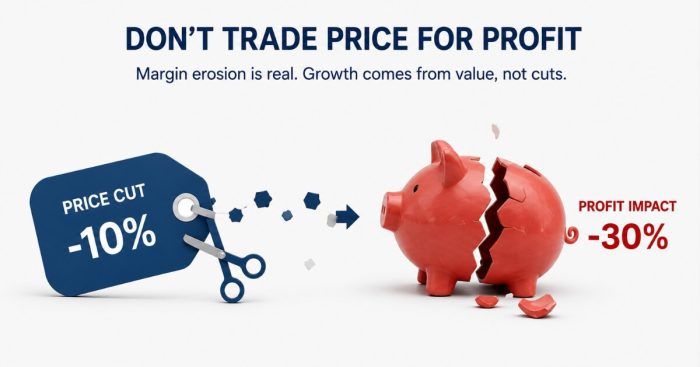
No — matching a price-cutter shrinks your margin without buying you loyalty, and it trains your market to shop on price.
Run the math on what a price cut actually does.
Drop a $400 membership to $300 to “stay competitive” and you’ve given up 25% of the revenue on every existing member, not just the new ones.
Meanwhile, the patient who joined for the lowest price is the same patient who’ll leave for the next lowest price.
You didn’t win a loyal member.
You rented a price-shopper and discounted your whole book to do it.
Meanwhile, the deepest-discount clinic is often the most fragile, because cheap acquisition brings high churn and thin margins that can’t absorb a slow month.
There’s a quieter point here, too.
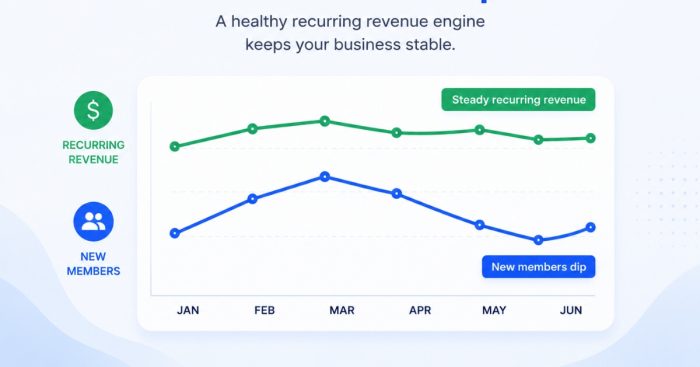
A well-run membership clinic can be at its lowest member count in a while and still be highly profitable.
One HRT practice we work with was at its lowest active membership in some time and still throwing off around $1M a year, with the owners paying themselves comfortably.
That resilience comes from margin and retention, not from being the cheapest.
Cut your price and you trade away the very thing that makes you durable.
How do I compete with a clinic offering free labs and a free trial?
Counter a free-trial offer with proof, guarantees of experience, and a stronger overall value — not with a free trial of your own.
A “free labs and free first month” offer works because it removes risk for the patient.
You neutralize it not by giving your service away, but by removing risk a different way:
- Overwhelming social proof (reviews, testimonials, before-and-afters)
- A clear description of the superior experience and results they’ll get
- Confidence in your provider’s expertise
When a patient can see that your clinic gets better outcomes and treats them better, “free for a month somewhere else” stops looking like a deal and starts looking like a gamble.
You can also out-position the gimmick.
The free-pellet, $121-if-you-feel-better offer is built for the patient who’s never tried hormones and wants a cheap first step.
Let the discounter educate that cold market and spend to acquire those patients.
Then be the obvious upgrade when they want real, consistent care.
Authority beats discounting over time.
For example, Dr. Joy Kong became the #1 stem cell expert on YouTube and scaled out of the day-to-day by building authority and trust, not by being the cheapest option in her category.
How do I keep my clinic profitable when membership numbers drop?
Protect margin and retention so recurring revenue carries you through slow stretches — the membership model is built to absorb exactly this.
The reason a competitor’s growth spurt doesn’t have to scare you is that recurring revenue is sticky in a way that one-off sales never are.
A membership base keeps paying month after month even when net-new enrollment slows.
Therefore, a clinic can be at its lowest member count in a while and still be solidly profitable.
The lever that keeps you safe isn’t acquisition speed — it’s retention and margin.
Keep your members happy and your pricing healthy, and a quiet month for new sign-ups is a manageable dip, not a crisis.
That’s also the argument for not panicking and slashing prices the moment a competitor appears.
The clinic with strong retention and real margin can wait out a discounter’s land-grab.
Meanwhile, the clinic that already cut to the bone to compete has no cushion when the discounter’s churn catches up to them.
Eternity Health Partners grew from $1M to $4M a year and built $1.7M in annual membership revenue from SEO alone, running about 250 members at roughly $1,000 a month — proof that durable HRT revenue comes from value and retention, not from winning a price war.
How do I differentiate an HRT clinic without competing on price?
Win on the things a discount can’t copy:
- Results
- Provider trust
- The patient experience
- A recurring relationship the patient doesn’t want to leave
Concretely, that means investing in the parts of the business the price-cutter skips.
- Make the consult genuinely valuable and unhurried.
- Build a follow-up and check-in cadence so patients feel cared for between visits.
- Collect and showcase results and testimonials relentlessly.
- Train the front desk to be warm and fast.
- Give patients a reason to refer their friends.
Each of these raises the value of your membership and the cost — emotional and practical — of leaving for a cheaper clinic.
That’s how you keep members while a competitor churns through theirs.
The patients worth keeping aren’t shopping on price anyway.
The high-LTV HRT patient wants to feel great, trust their provider, and not think about it.
Likewise, they’ll happily pay more for that certainty.
Build the clinic that delivers it, market the difference clearly through a patient acquisition system that attracts value buyers, and let the discounter fight over the customers who were always going to leave.
FAQ’s About Competing on Price at a Cash-Pay HRT Clinic
A competitor is offering free labs and a free month — am I overpriced?
Almost certainly not.
Aggressive front-end offers are an acquisition tactic, usually from a newer clinic that needs volume and hasn’t yet felt what those patients cost to retain.
Your price isn’t the problem.
Your job is to be the clinic patients wish they’d chosen on quality and results.
Won’t I lose patients if I don’t match the cheaper price?
You’ll lose the price-shoppers — and those were never loyal.
You keep the patients who value results, trust, and experience, who happen to also be your highest-LTV members.
Matching the price would have discounted your entire book to chase the least loyal segment of the market.
How can my clinic be at its lowest member count and still be profitable?
Because recurring revenue and healthy margin carry you.
A membership base keeps paying through slow enrollment months, so a well-run clinic can dip in new sign-ups and still throw off strong profit.
That resilience is exactly what a price cut would erode.
When does it make sense to adjust my pricing at all?
When your costs, your value, or your market genuinely change — not as a reflex to a competitor’s launch offer.
Repricing should be a deliberate decision about your own economics, reviewed against your à la carte menu and membership structure, never a panic move.
How do I market against a cheaper competitor?
Lead with proof and differentiation:
- Reviews
- Results
- Provider authority
- The experience
Let the discounter spend to educate cold patients.
Then position yourself as the upgrade for anyone who wants consistent, high-quality care.
Ultimately, authority and trust beat discounting over the long run.
What’s the next step?
If a cheaper competitor has you wondering whether to slash your prices, the answer is almost certainly to sharpen your value instead.
The clinics that win the HRT market long-term compete on results, trust, and retention — and protect the margin that lets them outlast every discounter.
On a 60-minute strategy call we’ll pressure-test your pricing against your competition, map how to differentiate without cutting, and build the retention engine that keeps members through any price war.