
How Do I Keep My Regenerative or Pain Clinic Busy During Slow Months?
Every regenerative and pain practice has slow stretches — the post-holiday lull, the summer dip, the weeks the schedule mysteriously thins. Most owners treat these as bad luck and wait them out. They’re not luck; they’re a pipeline problem, and they’re fixable. This is the FAQ on smoothing out seasonality and keeping a regenerative or pain clinic’s schedule full year-round.
Why does my regenerative or pain clinic have slow months?
Usually because marketing is reactive — it ramps up when the schedule is full and goes quiet when things slow down, creating a lagging cycle of feast and famine.
Slow months are a pipeline gap, not bad luck.
The classic pattern is simple.
When the clinic is busy, no one worries about marketing, so the pipeline empties.
Weeks later the schedule thins, panic sets in, marketing ramps up, and demand returns — just in time to get complacent again.
The result is a self-inflicted cycle of slow months.
Some genuine seasonality exists, but most of the dip is a marketing rhythm problem.
An always-on pipeline that runs regardless of how full the schedule looks today is what smooths it out, and it’s the heart of reliable patient acquisition.
How do I keep my regenerative pipeline full year-round?
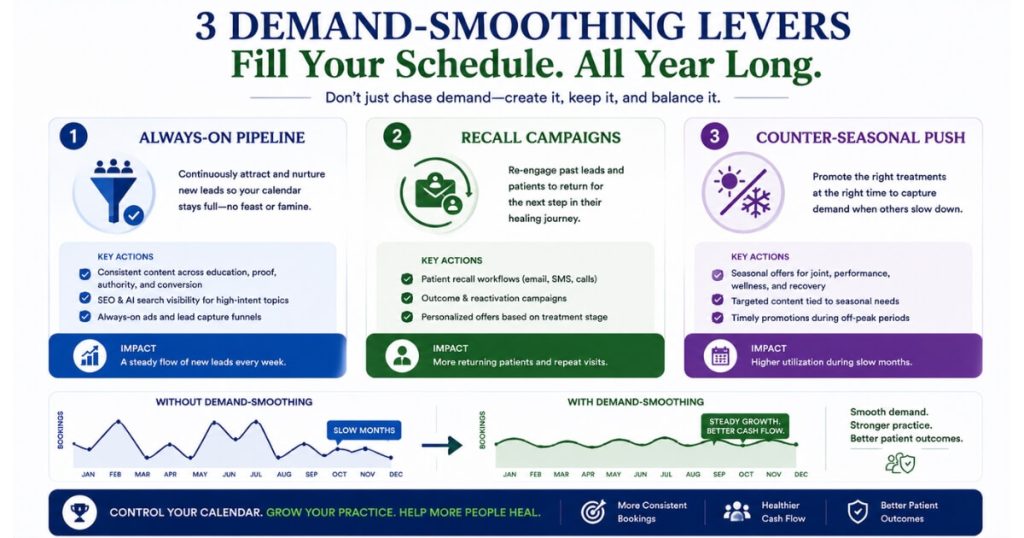
Run marketing as an always-on system rather than a panic response.
Keep generating leads and nurturing the pipeline even when the schedule is full, so demand keeps arriving when the busy period ends.
The fix for feast-and-famine is to never turn the pipeline off.
Because there’s a lag between marketing effort and booked treatment — especially for high-ticket regenerative care with its long decision cycle — the work you do during a busy month is what fills the following slow one.
Clinics that keep SEO, content, and lead generation running continuously, and keep nurturing the leads who aren’t ready yet, find the slow months shrink because there’s always demand in the pipeline maturing toward a booking.
How does patient recall help fill slow months?
Your past-patient list is a demand reserve you can activate during a slow stretch.
Recall campaigns for the other joint, maintenance, and check-ins fill the schedule with warm patients who convert fast.
When new-lead flow dips, the fastest way to fill the schedule is to turn to the patients you already have.
A recall push to patients due for the other knee, for maintenance, or simply overdue for a check-in produces booked appointments quickly because the trust is already there.
This is why a clinic with an organized patient list is far more resilient to slow months — it can generate near-term demand on command.
It’s also why the recall systems behind long-term value, like the revenue we built at Elite Pain Doctors over 10 months for $2,095,039, double as a seasonality buffer.
Should I run promotions during slow months for regenerative treatment?
Be careful.
Discounting a premium regenerative treatment can erode the value positioning you’ve built.
If you promote, lead with added value or access rather than price cuts, and protect the perception of the treatment.
Slashing prices to fill a slow month trains patients to wait for deals and signals that your treatment is worth less than you claim.
That’s a dangerous move for a premium practice.
Better levers are:
- Value-adds
- Education-driven offers
- Candidacy evaluations
- More outreach
None of these cheapen the treatment.
If you do create a time-bound reason to act, frame it around access or a bonus, not a markdown, so you fill the schedule without undermining the premium positioning that makes high-ticket regenerative care work.
How far ahead do I need to market to avoid a slow stretch?
Months ahead, because high-ticket regenerative decisions have a long lead time.
The patient who fills your schedule in the slow season often entered your pipeline well before it.
Regenerative patients research and deliberate for weeks or months before booking.
That means the marketing that prevents a slow period has to happen well in advance of it.
This is exactly why reactive marketing fails.
By the time you notice the dip, the window to feed the pipeline that would have filled it has already passed.
Planning marketing around the lag — keeping the top of the funnel full continuously so there’s always demand maturing toward a booking — is what turns predictable slow seasons into ordinary months.
How do I make slow months predictable instead of a panic?
Track your pipeline and bookings over time so you can see slow periods coming.
Then run a continuous, planned marketing system so the dips are anticipated and pre-empted rather than reacted to.
Once you’re tracking leads, consults, and bookings month over month, the slow periods stop being surprises.
You can see the seasonal patterns and the pipeline gaps forming in advance.
Combined with an always-on marketing engine and a recall list you can activate, that visibility lets you smooth demand deliberately:
- Front-load marketing before known slow seasons
- Lean on recall when new flow dips
- Keep the pipeline full year-round
Predictable demand is a system, not luck.
Building it is what separates a clinic that rides the waves from one that controls them — the goal of any serious pain management marketing effort.
FAQ’s About Filling Slow Months at a Regenerative Clinic
Why does my regenerative or pain clinic have slow months?
Usually because marketing is reactive — it ramps up when the schedule is full and goes quiet when things slow, creating a lagging feast-and-famine cycle.
When the clinic is busy no one markets, so the pipeline empties.
Weeks later the schedule thins.
Some genuine seasonality exists, but most of the dip is a self-inflicted marketing rhythm problem, not bad luck.
How do I keep my regenerative pipeline full year-round?
Run marketing as an always-on system rather than a panic response.
Keep generating leads and nurturing the pipeline even when the schedule is full.
Because there’s a lag between marketing effort and booked treatment, the work you do during a busy month fills the following slow one.
Continuous SEO, content, and lead generation shrink the slow months.
How does patient recall help fill slow months?
Your past-patient list is a demand reserve you can activate during a slow stretch.
A recall push to patients due for the other joint, for maintenance, or for a check-in produces booked appointments quickly because the trust is already there.
An organized patient list makes a clinic far more resilient to slow months because it can generate near-term demand on command.
Should I run discounts during slow months for regenerative treatment?
Be careful.
Discounting a premium regenerative treatment erodes the value positioning you’ve built and trains patients to wait for deals.
If you promote, lead with added value, access, or education-driven offers rather than price cuts.
Frame any time-bound reason to act around a bonus or access, not a markdown, so you fill the schedule without cheapening the treatment.
How far ahead do I need to market to avoid a slow stretch?
Months ahead, because high-ticket regenerative decisions have a long lead time.
The patient who fills your slow-season schedule often entered your pipeline well before it.
Reactive marketing fails because by the time you notice the dip, the window to feed the pipeline that would have filled it has passed.
Plan marketing around the lag and keep the funnel full continuously.
What’s the next step?
Slow months at a regenerative or pain clinic aren’t bad luck — they’re a pipeline gap, and they’re fixable.
Run marketing as an always-on system instead of a panic response.
Keep a recall list you can activate on demand.
Protect your premium positioning instead of discounting.
Plan around the long decision lag.
Do that and the predictable dips become ordinary months.
On a strategy call we’ll build the always-on pipeline and recall system that smooths out your slow seasons — the same demand engine behind $2,095,039 in revenue at Elite Pain Doctors over 10 months.