
How Do I Open a Second Location for My Regenerative or Stem Cell Practice?
Opening a second location is how a successful regenerative practice scales — but most owners treat it as a real estate and hiring decision and forget the part that actually determines success: demand. A beautiful new clinic with no patient pipeline is an expensive way to lose money. This is the FAQ on expanding a regenerative or stem cell practice to a new market, the marketing way.
What’s the biggest mistake regenerative clinics make opening a second location?
Building the location before building the demand.
Owners focus on the lease, the buildout, and the hires, then open the doors and discover the new market has never heard of them and the schedule is empty.
A second location doesn’t inherit the first one’s patient pipeline — the new market is, marketing-wise, a fresh start, and the brand recognition you built over years in your first city is near zero in the new one.
Therefore, the clinics that expand successfully build demand in the new market before the doors open, so the location launches into a pipeline instead of into silence.
Treating expansion as a marketing project first and a real estate project second is the difference between a profitable second location and an expensive one.
It’s core to scalable medical practice marketing.
How do I build demand in a new market before opening?
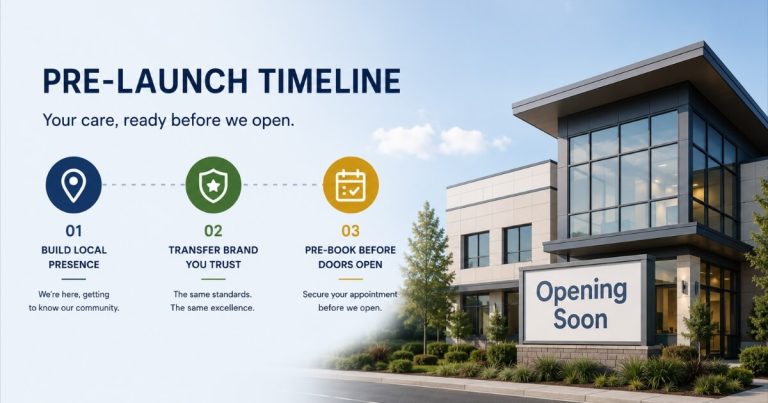
Start the local SEO, content, reputation, and pre-booking work months ahead, so by launch day the new market can find you, trusts you, and some patients are already on the schedule.
Demand-building has a lead time, especially for search authority, so it has to start well before opening.
That means:
- Establishing the new location’s local search presence and Google profile
- Producing content targeted to the new market
- Beginning to gather local proof
- Opening pre-booking before launch
Ideally, the first weeks aren’t empty.
A location that opens with a waiting list was marketed for months before the lease was even signed.
The goal is to launch into demand, not to launch and then go looking for it.
How much of my brand transfers to a new market?
Some, but less than you think — your reputation and authority help, but the new market needs its own local presence, local proof, and local search visibility to convert.
If you’ve built real authority — a recognized physician, strong content, a credible brand — that reputation does travel and gives you a head start a brand-new clinic wouldn’t have.
However, patients choose local for local care.
Therefore, the new location still needs:
- Its own Google presence
- Local reviews
- Market-specific content
- Local trust signals
The smart approach leverages the parent brand’s authority while deliberately building the new location’s local footprint.
As a result, it benefits from your reputation and stands on its own in the new market.
Should I replicate my first location’s marketing or start fresh?
Replicate what worked as a proven system, but localize the execution — same playbook, new market specifics.
You’re duplicating a process, not copy-pasting a campaign.
Your first location taught you which channels, offers, and messages convert your patients.
That hard-won knowledge is exactly what de-risks the second location.
Therefore, you should absolutely run the proven playbook again.
However, the targeting, the local SEO, the reviews, and the community presence all have to be built fresh for the new market.
The win of a second location is that you’re no longer guessing.
Instead, you’re deploying a known system into new territory, which is far faster than building from zero the way you did the first time.
When is a regenerative practice ready to open a second location?
When the first location runs on systems rather than the owner, demand reliably exceeds one location’s capacity, and you have the operational and marketing engine to replicate — not just the ambition.
Expanding before the first location is systematized just multiplies the owner’s problems across two cities.
The practices ready to expand have:
- Documented operations
- A marketing engine that reliably produces patients
- A provider model that doesn’t depend solely on the founder
As a result, the second location inherits a working machine.
If the first location only runs because the owner is in it every day, the answer isn’t a second location yet.
Instead, it’s systematizing the first one.
This is the same readiness that lets founders scale beyond themselves, the way the most scalable regenerative practices build authority into the brand rather than the person.
How do I market a regenerative practice across multiple locations?
With a unifying brand and authority at the top and dedicated local presence underneath each location — one recognizable name, multiple local footprints.
Multi-location regenerative marketing works best as a hub-and-spoke:
- The overarching brand and the physician’s authority give every location credibility and reach.
- Each location maintains its own local SEO, Google profile, reviews, and market-specific content so it competes locally.
Patients get the trust of a recognized brand and the relevance of a local clinic.
Managing this well is a real operational discipline.
Ultimately, it’s how a regenerative practice grows from one successful clinic into a recognized multi-location group — the kind of scaling that strong stem cell clinic marketing is built to support.
FAQ’s About Expanding a Regenerative Practice
What’s the biggest mistake when opening a second regenerative location?
Building the location before building the demand.
Owners focus on the lease, buildout, and hires, then open to an empty schedule because the new market has never heard of them.
A second location doesn’t inherit the first’s pipeline — the new market is a marketing fresh start, so demand has to be built before the doors open.
How do I build demand in a new market before opening?
Start the local SEO, content, reputation, and pre-booking work months ahead, since search authority has a lead time.
Establish the new location’s local search presence and Google profile, produce market-specific content, gather local proof, and open pre-booking so the first weeks aren’t empty.
A location that opens with a waiting list was marketed for months beforehand.
How much of my brand transfers to a new market?
Some, but less than you think.
Real authority — a recognized physician, strong content, a credible brand — does travel and gives you a head start.
However, patients choose local for local care.
Therefore, the new location still needs its own Google presence, local reviews, and market-specific content.
Leverage the parent brand while deliberately building local footprint.
Should I replicate my first location’s marketing or start fresh?
Replicate what worked as a proven system, but localize the execution.
Your first location taught you which channels, offers, and messages convert — that knowledge de-risks the second.
However, targeting, local SEO, reviews, and community presence must be built fresh for the new market.
You’re duplicating a process, not copy-pasting a campaign.
When is a regenerative practice ready for a second location?
When the first runs on systems rather than the owner, demand reliably exceeds one location’s capacity, and you have the operational and marketing engine to replicate.
Expanding before the first is systematized just multiplies the owner’s problems across two cities.
If the first only runs because the owner is in it daily, systematize that first.
What’s the next step?
A second regenerative location lives or dies on demand, not on the buildout.
The owners who expand successfully treat it as a marketing project first — building local search, brand transfer, and pre-booking in the new market months before the doors open.
Likewise, they expand only once the first location runs on systems instead of on them.
On a strategy call we’ll build the expansion and demand-generation plan for your new market — the systematized, multi-location approach that lets a regenerative practice scale without scaling its problems.
See how we help practices grow at Orthobiologics Associates, $309,590 in cash-pay revenue in 10 months.