
How Should a Regenerative Clinic Structure Its Offer Ladder From Diagnostic to Maintenance?
Most regenerative clinics have one offer: an expensive treatment the patient either buys or doesn’t. That all-or-nothing structure leaves two kinds of money on the table — the patient who isn’t ready for the big commitment yet, and the patient who finishes treatment and is never sold anything again. This is the FAQ on building a regenerative offer ladder, from an entry diagnostic to core treatment to ongoing maintenance, that meets patients where they are and maximizes lifetime value.
What is an offer ladder for a regenerative clinic?
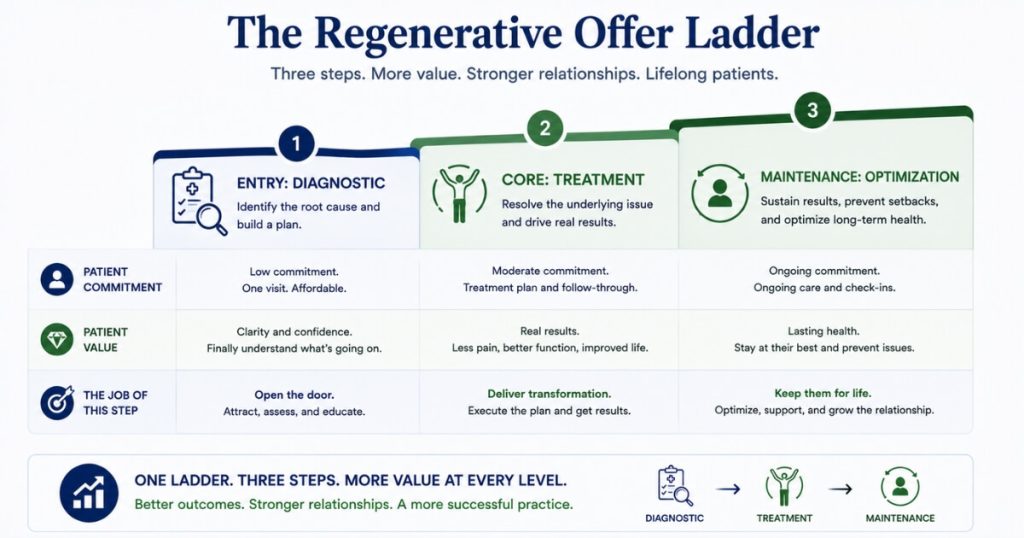
It’s a structured sequence of offers — an accessible entry point, a core treatment, and ongoing maintenance — that lets a patient start with a small commitment and ascend to the full value of your care over time.
Instead of forcing every patient to say yes or no to one big treatment, an offer ladder gives them a way in and a way forward.
The entry offer lowers the barrier to becoming a patient.
The core offer is your primary treatment.
The maintenance offer keeps the relationship and the revenue going after the core treatment ends.
Each rung makes the next one natural.
This structure is what turns a regenerative practice from a series of one-off transactions into a compounding lifetime-value business, which is the economic backbone of durable pain management marketing.
What should the entry offer on a regenerative ladder be?
A low-commitment first step that delivers real value and establishes candidacy.
Typically, that means a thorough evaluation, diagnostic, or assessment that helps the patient understand their problem and your approach without committing to the full treatment.
The entry offer’s job is to convert a hesitant prospect into a paying, engaged patient with a small, sensible first step.
A diagnostic or candidacy evaluation works because it’s genuinely useful to the patient and naturally leads to the core treatment if they’re a candidate.
It also filters for serious patients and gives your team a chance to build trust before the big decision.
The entry rung isn’t about making money on its own.
It’s about starting the relationship that the core and maintenance rungs monetize.
How does maintenance fit into a regenerative offer ladder?
Maintenance is the rung most clinics skip.
It’s also the one that quietly drives the most lifetime value.
Maintenance means periodic follow-up treatment or a membership that keeps the patient in your care after the core treatment series ends.
When a patient finishes a regenerative treatment, the relationship shouldn’t end.
Many protocols benefit from periodic maintenance, and a patient who’s had a good outcome is happy to continue care that protects their result.
A maintenance offer, whether a recurring visit cadence or a membership, converts a one-time treatment into an ongoing relationship and recurring revenue.
This is exactly the kind of back-end value that lets high-ticket practices grow, the way long-term patient value contributed to the $2,095,039 in revenue we added at Elite Pain Doctors in 10 months.
Why is a single big regenerative offer leaving money on the table?
Because it forces a binary decision that loses the not-yet-ready patient entirely and abandons the finished patient completely.
Those are two large groups a ladder would capture.
A one-offer practice converts only the patients ready to commit to the full treatment today and earns nothing from them afterward.
The patient who needs a smaller first step walks away.
The patient who completed treatment is never offered anything again.
A ladder captures both:
- The entry offer brings in the hesitant.
- Maintenance retains the finished.
The result is more patients started and far more value per patient.
That is the difference between a transactional clinic and a relationship-driven one.
How do I move patients up the regenerative offer ladder without being pushy?
Make each rung the natural, clinically appropriate next step, presented as part of caring for the patient’s outcome.
Ascension should feel like guidance, not upselling.
Patients ascend willingly when each step genuinely serves them.
The diagnostic reveals they’re a candidate, so the core treatment is the obvious answer.
The core treatment succeeds, so maintenance is how they protect it.
When the ladder maps to the patient’s real clinical journey, moving up feels like good care, not a sales funnel.
The key is that every rung delivers real value, so the next one is earned, not pushed.
That’s the same consultative principle that underpins a trustworthy stem cell clinic marketing approach.
How do I design the right offer ladder for my regenerative practice?
Map your patient’s real clinical journey.
Then build an offer at each meaningful stage — the first useful step, the core treatment, and the ongoing care that protects the result.
Price and position each one to lead naturally to the next.
Start from how patients actually move through your care, not from a generic template.
Identify the lowest-friction valuable entry point.
Define your core treatment clearly.
Create a maintenance path that fits your protocols.
Then make sure each rung is priced and framed to make the next one the obvious choice.
Designed well, the ladder increases:
- The number of patients who start
- The percentage who complete core treatment
- The value each one delivers over their lifetime
Those are the three levers that actually grow a regenerative practice.
FAQ’s About the Regenerative Offer Ladder
What is an offer ladder for a regenerative clinic?
A structured sequence of offers — an accessible entry diagnostic, a core treatment, and ongoing maintenance — that lets a patient start with a small commitment and ascend to the full value of your care over time.
Instead of forcing a yes-or-no on one big treatment, it gives patients a way in and a way forward.
It turns one-off transactions into a compounding lifetime-value business.
What should the entry offer be?
A low-commitment first step that delivers real value and establishes candidacy.
Typically, that means a thorough evaluation, diagnostic, or assessment.
Its job isn’t to make money on its own.
It’s to convert a hesitant prospect into an engaged paying patient, filter for seriousness, and lead naturally into the core treatment if they’re a candidate.
How does maintenance fit into the ladder?
Maintenance is the rung most clinics skip.
It is also the one that quietly drives the most lifetime value.
This can be periodic follow-up treatment or a membership that keeps the patient in your care after the core treatment ends.
A patient with a good outcome is happy to continue care that protects their result.
That converts a one-time treatment into recurring revenue and an ongoing relationship.
Why is a single big regenerative offer a mistake?
Because it forces a binary decision that loses the not-yet-ready patient entirely and abandons the finished patient completely.
A one-offer practice converts only patients ready to commit today and earns nothing afterward.
A ladder captures both groups:
- The entry offer brings in the hesitant.
- Maintenance retains the finished.
That yields more patients and far more value per patient.
How do I move patients up the ladder without being pushy?
Make each rung the natural, clinically appropriate next step presented as part of caring for the patient’s outcome.
When the ladder maps to the patient’s real clinical journey — diagnostic reveals candidacy, core treatment succeeds, maintenance protects it — ascension feels like good care, not upselling.
Every rung must deliver real value so the next is earned, not pushed.
What’s the next step?
A single all-or-nothing regenerative offer loses the patient who isn’t ready yet and abandons the one who just finished.
An offer ladder — an accessible entry diagnostic, a clear core treatment, and ongoing maintenance — captures both, meets patients where they are, and turns one-time treatments into lifetime value.
On a strategy call we’ll map your patient journey and build the offer ladder that fits it — the kind of back-end value that helped drive $2,095,039 in revenue at Elite Pain Doctors in 10 months.