
How Do I Bring Past Regenerative Patients Back for Repeat Treatment?
The cheapest new revenue in a regenerative practice isn’t a new patient — it’s a past one.
The patient who treated one knee almost always needs the other treated, plus maintenance, plus the shoulder they mentioned in passing.
Yet most regenerative clinics let those patients go cold the moment the treatment series ends.
This is the FAQ on building a recall campaign that brings past regenerative and stem cell patients back for repeat treatment, maintenance, and referrals.
Why should a regenerative clinic focus on past patients instead of new ones?
Because a past regenerative patient has already paid you thousands, trusts you, and has a high chance of needing more treatment.
As a result, they’re dramatically cheaper to convert than a cold lead.
Reactivation is the highest-return marketing a regenerative practice can run.
A patient who came in for a knee has already revealed three important things:
- They have the money for cash-pay regenerative care.
- They believe in the treatment enough to have done it.
- They likely have other joints, the contralateral knee, or a maintenance need on the horizon.
More importantly, re-engaging them costs a fraction of acquiring a stranger.
There’s no skepticism to overcome.
Likewise, there’s no trust to build.
The trust is already there.
That’s why the practices with the best economics treat their patient list as an asset rather than a filing cabinet.
Instead, they build pain management marketing systems that work the existing patient base as hard as they work new leads.
What does a regenerative patient recall campaign actually look like?
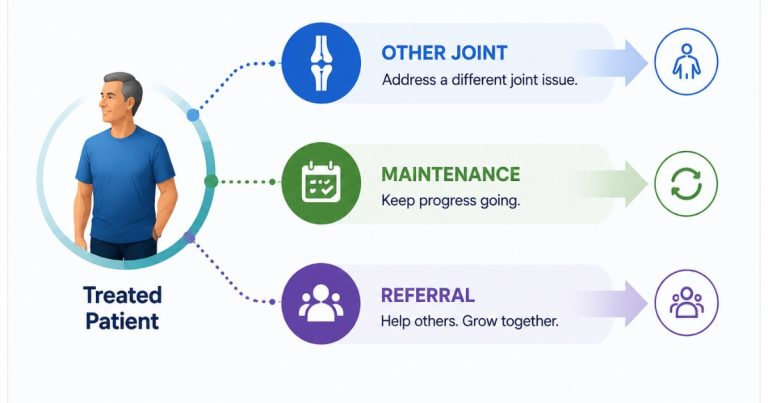
A successful recall campaign runs on three parallel tracks:
- Other-joint and contralateral outreach
- Maintenance reminders
- Referral requests
Each track should be triggered at the right point after treatment.
At the same time, each track should run on a calendar rather than memory.
Track one targets the patient’s known additional needs.
For example, if they treated one knee, the other knee, hips, or shoulder mentioned during intake become warm opportunities.
A personal check-in a few months later can reopen that conversation.
Meanwhile, track two focuses on maintenance.
Many regenerative protocols benefit from periodic follow-up care.
Therefore, a scheduled reminder helps keep the patient in a long-term relationship instead of a one-and-done transaction.
Track three focuses on referrals.
Specifically, the referral ask should happen when the patient is happiest and has already felt the result.
Ultimately, all three tracks should run on an automated calendar.
That way, no patient slips through the cracks.
As a result, the recall engine compounds quietly underneath your new-patient marketing.
When should I reach out to a regenerative patient after their treatment?
Reach out at the outcome peak for referrals and reviews.
Then reach out again at the clinically appropriate interval for maintenance and additional treatment opportunities.
Timing is everything.
Unfortunately, most clinics either reach out too late or never reach out at all.
The referral and review ask lands best when the patient is actively feeling the improvement.
At that point, their enthusiasm is highest and their story is freshest.
Meanwhile, other-joint and maintenance outreach should happen when it’s clinically sensible to consider the next treatment.
The exact timing depends on your protocols.
However, the most important point is that the outreach is scheduled.
It should never depend on whether someone happens to remember the patient.
A patient who hears nothing for a year assumes you’ve forgotten them.
By contrast, a patient who receives a thoughtful and well-timed check-in feels cared for.
Consequently, they’re far more likely to return.
How do I run recall without it feeling like a sales pitch?
Lead with care, not the cash register.
Check on the patient’s outcome first.
Then let the next treatment come up naturally as part of looking after them.
Recall that feels like genuine follow-up converts.
By comparison, recall that feels like a coupon repels.
The framing is everything.
A message that opens with “how’s the knee feeling?” and a real interest in progress earns the right to mention the other joint or a maintenance visit.
As a result, the recommendation feels helpful rather than transactional.
On the other hand, a message that opens with a discount on a second treatment sends a very different signal.
It reads as a clinic that sees the patient as a wallet.
High-ticket regenerative patients are sophisticated buyers.
Because of that, they can tell the difference.
The care-first approach converts better.
In addition, it’s simply the right way to treat people who trusted you with both their bodies and their money.
What’s a past regenerative patient actually worth over time?
Often several multiples of their first treatment.
That value comes from additional joints, maintenance care, and referrals.
That’s exactly why reactivation deserves real attention rather than being treated as an afterthought.
A patient who treats one knee and later returns for the other creates additional value.
Likewise, a patient who enters a maintenance cadence creates even more value.
Add a referred friend or family member, and the lifetime value grows again.
As a result, the patient becomes worth far more than the original transaction.
This compounding lifetime value is the economic engine that allows high-ticket regenerative practices to afford strong patient acquisition costs.
It’s also the same dynamic behind the long-term revenue we’ve helped build at Elite Pain Doctors, where we added $2,095,039 in revenue over 10 months.
Unfortunately, the clinics that ignore the back end leave much of that value on the table.
How do I keep my regenerative patient list organized enough to recall from?
Use a CRM that tags every patient by:
- What they treated
- What they didn’t treat
- When their next outreach is due
That way, recall runs on triggers rather than someone scrolling through old charts.
Simply put, you can’t recall patients you can’t easily identify.
The patients who need the other knee, maintenance treatment, a referral request, or a review request should each exist in clearly defined segments.
Your system should surface those segments automatically.
With that structure in place, the recall campaign becomes a set of scheduled and repeatable touches.
As a result, it no longer depends on heroic manual effort.
This is the same backbone behind any durable patient acquisition operation.
The difference is that you’re pointing it at the goldmine you already own.
FAQ’s About Reactivating Past Regenerative Patients
Why are past patients the best source of regenerative revenue?
Because they’ve already paid you, already trust the treatment, and often need additional care.
That may include the other joint, maintenance treatment, or a related condition.
As a result, re-engaging them eliminates much of the skepticism and trust-building required with cold leads.
Therefore, patient reactivation delivers one of the highest returns available in regenerative marketing.
What should a regenerative recall campaign include?
A recall campaign should include three parallel tracks:
- Outreach for other or additional joints
- Maintenance reminders
- Referral and review requests
Each track should run on a calendar.
Whenever possible, those touches should be automated.
That ensures no patient falls through the cracks.
When is the best time to ask a regenerative patient for a referral?
Ask at the outcome peak.
That’s when the patient is feeling the improvement most strongly.
Consequently, their enthusiasm is highest and their story is freshest.
That timing increases both referral rates and review completion rates.
How do I recall patients without sounding salesy?
Lead with care instead of an offer.
Begin by checking on their outcome and showing genuine interest in their progress.
Then allow the discussion about maintenance or additional treatment to emerge naturally.
Patients can tell the difference between a caring follow-up and a sales message.
Because of that, the care-first approach converts better and builds trust.
What tools do I need to run regenerative patient recall?
You need a CRM that tags patients by treatments completed, untreated conditions, referral status, review status, and future outreach dates.
With those segments in place, recall becomes an automated system rather than a manual process.
As a result, your existing patient list becomes a predictable source of repeat revenue.
What’s the next step?
Your past regenerative patients are the cheapest and warmest revenue source you have.
They’ve already paid you.
More importantly, they already trust you.
In many cases, they still need the other knee, maintenance treatment, or know someone with the same condition.
A recall campaign that leads with care and runs on a calendar transforms that patient list from a filing cabinet into a growth engine.
On a strategy call we’ll build the recall system for your practice.
That includes the timing, the segments, and the outreach tracks.
We’ll also show you how it compounds the lifetime value behind results like the $2,095,039 in revenue we added at Elite Pain Doctors in 10 months.