
Should a Regenerative Medicine Clinic Invest in Paid Ads or SEO First?
Paid ads or SEO — it’s the question almost every regenerative and stem cell clinic owner wrestles with when they decide to get serious about marketing.
The framing makes it sound like a fork in the road where you pick one path, but that framing is exactly what keeps clinics stuck either renting all their patients forever or waiting half a year for rankings with no revenue coming in.
The honest answer is a sequence, not a choice.
Here’s when to start with ads, when to prioritize SEO, and why the regenerative practices that grow fastest run both as one compounding system.
Should a regenerative medicine clinic invest in paid ads or SEO first?
Most regenerative clinics should start with paid ads for immediate cash flow and begin building SEO at the same time so it compounds underneath.
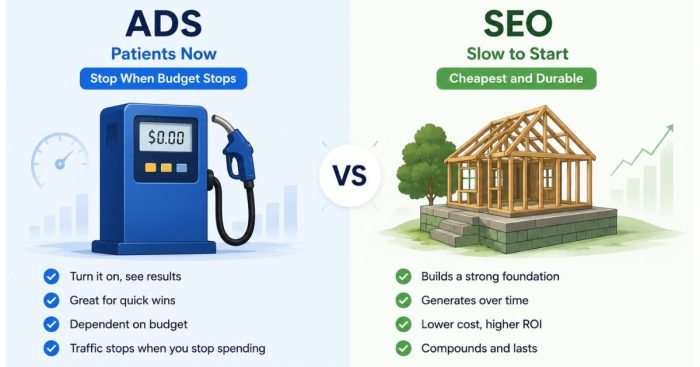
Ads buy patients now.
SEO buys the cheapest patients later.
Paid ads put you in front of joint-pain, neuropathy, and orthopedic patients the day the campaign goes live.
Because regenerative case values are high, a few closed cases can pay back the spend quickly.
SEO is slower to mature.
However, it produces the highest-intent, lowest-cost patients once it ranks.
It also keeps compounding for years.
The strategic answer is not either/or.
Instead:
- Lead with ads for speed.
- Start SEO immediately because it takes months to mature.
- Let the two reinforce each other.
If you can only fund one, choose ads when you need revenue this quarter.
Choose SEO when you’re playing a longer, lower-cost game and can wait.
This sequencing is the backbone of effective stem cell clinic marketing.
Speed comes first to fund the practice.
Durability is built underneath so the cost per patient keeps falling.
The clinics that treat it as a permanent either/or decision are the ones that stay stuck.
When should a regenerative clinic start with paid ads instead of SEO?
Start with paid ads when:
- You need patients quickly
- You need cash flow quickly
- You’re launching a new offer
- You’re launching a new location
- You want to test demand fast
- You want to test messaging fast
Ads are the fastest path to a booked consult.
You can be in front of the right patient the day you turn the campaign on.
The high case values in regenerative medicine mean the spend can pay for itself within the first one to three months.
Ads also double as the quickest way to learn what offer, audience, and message actually convert.
You get data in days instead of months.
The trade-off is that patient flow stops the moment you stop paying.
The cost per patient also never gets cheaper on its own.
That’s why ads are the right starting engine but a poor long-term-only strategy.
Ads buy speed, not durability.
The proof of how fast dialed-in paid can move in high-ticket care:
An orthopedic surgical practice added $2 million in revenue from Facebook ads alone.
That’s what paid looks like when the offer, the creative, and the follow-up are all in place.
When should a regenerative clinic prioritize SEO over paid ads?
Prioritize SEO when:
- You’re playing a long game
- You want the lowest cost per patient
- You can wait months for it to mature
SEO produces the highest-intent, cheapest, most durable patient flow a regenerative clinic can build.
Patients researching stem cell, PRP, or neuropathy treatment spend weeks comparing options.
The clinic that shows up across search, Google Business Profile, and review signals at the same time wins the most-ready buyers.
Once your pages rank, those patients keep arriving without per-click cost.
That’s why SEO is the long-term moat for high-LTV regenerative care.
The proof:
That happened with zero ad spend.
The catch is patience.
SEO takes months to compound.
That’s why it should almost always be started early and run alongside ads rather than waited on by itself.
A clinic that “does SEO instead of ads” and then waits in silence for six months is making the same mistake as one that never builds SEO at all.
Why is running both paid ads and SEO together the strongest play for a regenerative practice?
Because ads cover the gap while SEO matures.
SEO eventually lowers your blended cost per patient.
Ads continue scaling volume.
Together, they give you both speed and durability.
If you only run ads, you’re renting your patient flow forever.
It stops when the budget stops.
If you only run SEO, you wait months with no new revenue while it ranks.
Running both means:
- Ads carry the cash flow from day one
- SEO compounds underneath
- SEO becomes your cheapest channel
- Your blended cost per acquired patient drops over time
For a high-ticket, high-LTV category like regenerative medicine, patients often research for weeks before booking.
Being present in both paid and organic results wins more of those patients.
The two aren’t competitors for your budget.
They’re a system.
Building that system is the heart of a durable patient acquisition engine that doesn’t collapse the day you pause your ad account.
How do paid ads and SEO actually help each other at a regenerative clinic?
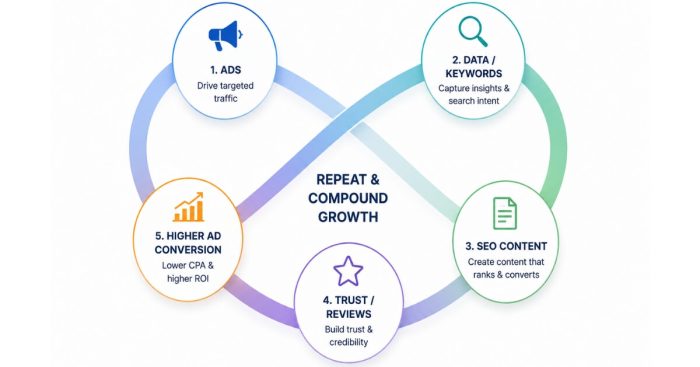
They reinforce each other in both directions.
Ads generate fast data and conversions that tell you which keywords, offers, and messages to build SEO content around.
Strong SEO and reviews make your ads convert better because patients who click already trust the brand they keep seeing.
When a researching patient sees your clinic:
- In paid results
- In organic rankings
- In Google reviews
Trust compounds.
Conversion rates improve across every channel.
Ads also let you dominate the top of the page for terms you haven’t ranked for yet.
That allows you to capture demand while SEO catches up.
The content you build for SEO also strengthens paid performance.
Examples include:
- Treatment pages
- FAQs
- Patient education content
Those assets become better landing pages and ad destinations.
Run together, each channel makes the other cheaper and more effective.
Run in isolation, both leave money on the table.
This compounding effect is exactly why the strongest regenerative practices stop asking which channel to pick.
Instead, they ask how fast they can get both working in concert.
What’s the most common mistake regenerative clinics make choosing between ads and SEO?
Treating it as a one-or-the-other decision.
Most often, that means delaying SEO until “later.”
Then later never comes.
The clinic stays permanently dependent on paid ads.
Because SEO takes months to compound, every month you wait pushes your durable patient channel further into the future.
The mirror-image mistake is betting everything on SEO and starving the practice of revenue while waiting for rankings.
The clinics that get this right do three things:
- Start ads for cash flow.
- Start SEO for durability.
- Let them compound together.
The error isn’t picking the wrong one first.
It’s picking only one and never building the other.
That leaves the practice either:
- Renting all its patients
- Waiting forever for them
Speed and durability aren’t a trade-off you have to make.
They’re two channels you sequence and stack.
FAQ’s About Paid Ads vs SEO for a Regenerative Medicine Clinic
Should a regenerative medicine clinic invest in paid ads or SEO first?
Most regenerative clinics should start with paid ads for immediate cash flow and begin building SEO at the same time so it compounds underneath.
Ads buy patients now.
SEO buys the cheapest patients later.
Paid ads put you in front of joint-pain, neuropathy, and orthopedic patients immediately.
SEO takes longer to mature but produces the highest-intent, lowest-cost patients once it ranks.
The strategic answer is not either/or.
Lead with ads for speed, start SEO immediately, and let the two reinforce each other.
When should a regenerative clinic start with paid ads instead of SEO?
Start with paid ads when you need patients and cash flow quickly, when you’re launching a new offer or location, or when you want to test demand and messaging fast.
Ads are the fastest path to a booked consult.
The high case values in regenerative medicine mean the spend can often pay for itself within the first one to three months.
The trade-off is that patient flow stops when you stop paying.
That’s why ads are the right starting engine but a poor long-term-only strategy.
When should a regenerative clinic prioritize SEO over paid ads?
Prioritize SEO when you’re playing a long game, want the lowest cost per patient, and can wait months for it to mature.
SEO produces the highest-intent, cheapest, and most durable patient flow a regenerative clinic can build.
Once pages rank, patients continue arriving without per-click cost.
The trade-off is patience.
SEO takes months to compound, which is why it should usually run alongside ads.
Why is running both paid ads and SEO together the strongest play for a regenerative practice?
Because ads cover the gap while SEO matures.
SEO lowers your blended cost per patient over time.
Ads continue driving volume.
Running both creates a system that delivers speed and durability.
Ads provide immediate cash flow.
SEO becomes the lowest-cost channel later.
Together they reduce dependence on any single source of patients.
How do paid ads and SEO actually help each other at a regenerative clinic?
Ads generate fast data and conversions that reveal which keywords, offers, and messages work best.
SEO and strong reviews increase trust and improve ad conversion rates.
SEO content also becomes stronger landing-page content for paid campaigns.
Each channel makes the other more effective.
What’s the most common mistake regenerative clinics make choosing between ads and SEO?
Treating it as an either/or decision.
Many clinics delay SEO until later and stay dependent on paid ads.
Others rely only on SEO and wait months for revenue.
The strongest clinics start ads for cash flow and SEO for durability at the same time.
Then they let both channels compound together.
What’s the next step?
The paid-ads-versus-SEO question isn’t really a choice.
It’s a sequence.
Lead with paid ads to put cash-paying regenerative patients in the door now.
Start SEO at the same time because it takes months to compound.
Let the two reinforce each other until your blended cost per patient falls and your patient flow no longer depends on an ad account you have to keep funding.
Ads buy speed.
SEO buys durability.
Together they’re a system that gives you both.
Real ADvice builds that system for regenerative and stem cell clinics.
It’s fast paid acquisition stacked on compounding SEO.
That’s the combination behind $309,590 in 10 months from SEO alone at a 79.4% conversion rate and seven-figure paid results in adjacent high-ticket care.
If you want help sequencing ads and SEO for your clinic’s stage and budget, that’s the conversation to book.