
How Long Does Marketing Take to Produce ROI for a Regenerative or Pain Management Practice?
“How long until this pays off?” is the first question every regenerative and pain practice owner asks before investing in marketing — and it’s the right question, because unrealistic expectations are what kill good campaigns before they ever compound.
The honest answer is that high-ticket regenerative marketing tends to show a faster return than most owners fear and a bigger long-term return than most owners expect — but only if you know what to watch and when.
Here’s the realistic timeline: what to expect in the first 30, 60, and 90 days, why SEO lags paid ads, when you break even, and how to tell it’s working before the revenue fully lands.
How long does marketing take to produce ROI for a regenerative or pain management practice?
For a high-ticket regenerative or pain practice, paid advertising can produce a positive return within the first 30 to 90 days.
SEO and organic authority typically take 6 to 12 months to compound.
The biggest results usually land around the 10-month mark.
Because regenerative cases carry large cash tickets, even a handful of closed cases can pay back a month of ad spend quickly.
As a result, paid channels show ROI fastest.
SEO is slower to start.
However, it produces the cheapest, highest-intent patients once it ranks, and it keeps compounding for years.
The honest answer is that you should expect:
- Early signal in the first quarter
- A clear trend by month three to six
- Your strongest numbers somewhere between months six and twelve
Don’t expect a flip-the-switch return in week two.
The 10-month pattern shows up again and again in this niche.
Elite Pain Doctors added $2,095,039 in revenue in 10 months and a separate regenerative practice generated $309,590 in cash-pay revenue over the same 10-month window from SEO alone.
Those aren’t week-two numbers.
They’re what disciplined pain management marketing compounds into when you give the system time to work and don’t pull the plug in month two.
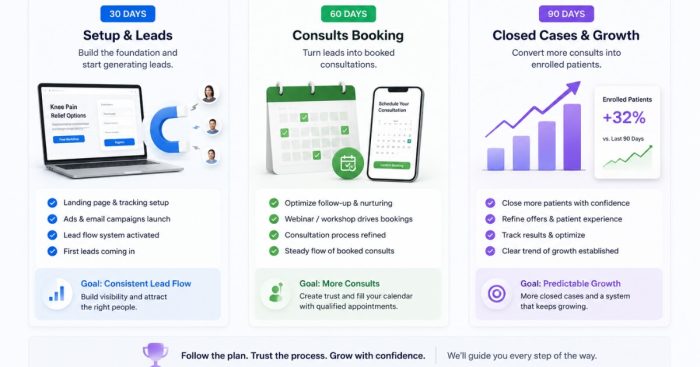
What should a regenerative clinic expect in the first 30, 60, and 90 days of marketing?
In the first 30 days, expect setup and early leads, not peak performance.
Tracking, offers, landing pages, and campaigns get built and launched.
The first inquiries start arriving.
By 60 days, you should see leads becoming booked consults as the follow-up system and consult process get tuned.
You can also start reading real cost-per-lead and conversion data.
By 90 days, a well-run campaign should show a clear, improving trend.
That includes:
- Consistent lead flow
- A measurable booking rate
- The first closed high-ticket cases
This can happen even if you haven’t hit full ROI yet.
The first 90 days is about proving the machine works and finding the levers.
The compounding return comes after.
The mistake owners make is expecting peak revenue in month one.
Many then panic in month two when it isn’t there.
The right read of the first quarter is directional:
- Are leads flowing?
- Are consults booking?
- Is the close rate climbing?
If you’re still getting zero qualified leads at 90 days, that’s a signal something is broken.
It’s not evidence that marketing simply “takes time.”
Why does SEO take longer to pay off than paid ads for a regenerative practice?
Because paid ads buy attention instantly while SEO has to earn it.
Search engines and AI assistants need time to crawl, trust, and rank your content before it sends patients.
With paid ads, you can be in front of a joint-pain or neuropathy patient the day the campaign goes live.
The cash register can ring in week one.
SEO requires building pages, authority, reviews, and topical depth that search and AI reward.
That is a months-long process.
The payoff is worth the wait.
SEO patients are the highest-intent and lowest-cost you’ll ever get.
They keep coming long after the work is done.
The right move for most regenerative practices is to run paid ads for immediate cash flow while SEO compounds underneath.
Fast return now.
Cheaper return later.
The proof that SEO is worth the patience:
One regenerative practice produced $309,590 in cash-pay revenue in 10 months from SEO alone at a 79.4% conversion rate with zero ad spend.
That result was slow to start and then became the cheapest patient flow the clinic had.
That’s exactly the SEO trade-off.
When should a regenerative practice expect to break even on its marketing spend?
On paid channels, a dialed-in regenerative or pain campaign often breaks even within the first one to three months.
A single closed high-ticket case can cover weeks of ad spend.
The math is favorable in this niche precisely because the tickets are large and the patients are motivated.
You don’t need volume to break even.
You need a few right-fit cases closing at full value.
Blended across paid and SEO, most practices reach a clear, sustained positive return by months three to six.
Their strongest ROI typically arrives by months six to twelve.
The variable that moves break-even most is not the ad platform.
It’s your conversion.
A clinic that closes 70%-plus of its consults breaks even far faster than one leaking leads at the front desk, regardless of how good the marketing is.
This is why the practices that hit profitability fastest obsess over:
- Speed-to-lead
- Consult close rate
Not just the cost per click.
Buying more attention is easy.
Converting the attention you already pay for is where break-even is actually won or lost.
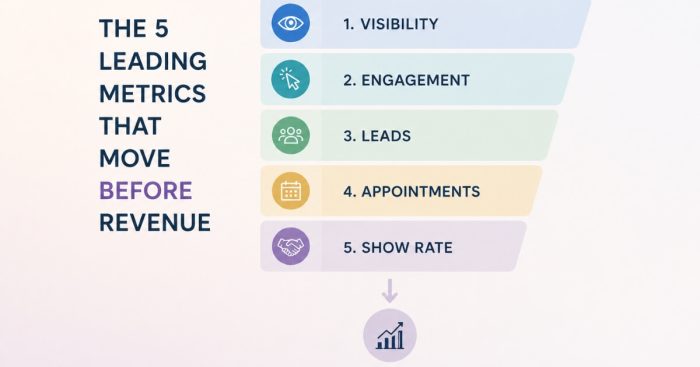
How can you tell your regenerative clinic’s marketing is working before the revenue fully shows up?
Watch the leading indicators, not just the bank account.
Key indicators include:
- Qualified lead volume
- Cost per lead
- Consult-booking rate
- Consult show rate
- Consult-to-case close rate
All of these move before revenue does.
If those numbers are trending the right way, revenue is coming even if this month’s deposits don’t show it yet.
High-ticket patients take time to decide.
A growing pipeline of booked consults is the single best early sign that the money is on its way.
Conversely, if leads are flowing but consults aren’t booking or closing, the problem is conversion, not marketing.
More ad spend won’t fix it.
Track the funnel weekly.
Doing so helps you tell the difference between:
- Marketing needs more time
- Something is broken
On the revenue line, those two situations look identical for the first couple of months.
In the funnel metrics, they look completely different.
This is exactly the kind of read that good medical practice marketing consultants bring.
They can look at a 60-day funnel and tell you whether to stay the course or fix a specific broken step instead of guessing.
What makes marketing take longer than it should at a regenerative clinic?
The most common reasons marketing “takes too long” have nothing to do with the channel.
Common causes include:
- Slow or no lead follow-up
- A weak consult and offer
- No financing option on high-ticket cases
- Untracked numbers
- Constantly changing the strategy before it has time to work
Regenerative patients are high-intent but high-consideration.
If no one calls the lead back within minutes, the case cools.
If the consult doesn’t present financing, motivated patients stall at the price.
Without visibility into cost-per-lead and close rate, you optimize blind.
If you scrap the plan every 30 days, nothing ever compounds.
Fixing the follow-up, the consult, and the tracking usually shortens time-to-ROI more than any change to the ad platform itself.
The clinics that feel like marketing “never works” are almost always losing the patients they already paid to attract somewhere between the click and the closed case.
Plug those leaks first.
Then give the strategy a full quarter to read.
The timeline compresses dramatically.
FAQ’s About Marketing ROI Timelines for Regenerative and Pain Practices
How long does marketing take to produce ROI for a regenerative or pain management practice?
For a high-ticket regenerative or pain practice, paid advertising can produce a positive return within the first 30 to 90 days, while SEO and organic authority typically take 6 to 12 months to compound.
The biggest results usually land around the 10-month mark.
Because regenerative cases carry large cash tickets, even a handful of closed cases can pay back a month of ad spend quickly.
Paid channels therefore show ROI fastest.
SEO is slower to start but produces the cheapest, highest-intent patients once it ranks.
It also keeps compounding for years.
You should expect early signal in the first quarter, a clear trend by month three to six, and your strongest numbers somewhere between months six and twelve.
What should a regenerative clinic expect in the first 30, 60, and 90 days of marketing?
In the first 30 days, expect setup and early leads, not peak performance.
Tracking, offers, landing pages, and campaigns get built and launched.
The first inquiries start arriving.
By 60 days, you should see leads becoming booked consults as the follow-up system and consult process get tuned.
You can begin reading real cost-per-lead and conversion data.
By 90 days, a well-run campaign should show a clear, improving trend that includes consistent lead flow, a measurable booking rate, and the first closed high-ticket cases.
The first 90 days is about proving the machine works and finding the levers.
The compounding return comes after.
If you’re still getting zero qualified leads at 90 days, that’s a signal something is broken, not that marketing “takes time.”
Why does SEO take longer to pay off than paid ads for a regenerative practice?
Because paid ads buy attention instantly while SEO has to earn it.
Search engines and AI assistants need time to crawl, trust, and rank your content before it sends patients.
With paid ads, you can be in front of a joint-pain or neuropathy patient the day the campaign goes live.
SEO requires building pages, authority, reviews, and topical depth that search and AI reward.
That process takes months.
The payoff is worth the wait because SEO patients are the highest-intent and lowest-cost you’ll ever get.
Most regenerative practices benefit from running paid ads for immediate cash flow while SEO compounds underneath.
When should a regenerative practice expect to break even on its marketing spend?
On paid channels, a dialed-in regenerative or pain campaign often breaks even within the first one to three months because a single closed high-ticket case can cover weeks of ad spend.
The math is favorable because the tickets are large and the patients are motivated.
Most practices reach a clear, sustained positive return by months three to six.
Their strongest ROI usually arrives by months six to twelve.
The variable that moves break-even most is not the ad platform.
It’s conversion.
A clinic that closes 70%-plus of its consults breaks even far faster than one leaking leads at the front desk.
How can you tell your regenerative clinic’s marketing is working before the revenue fully shows up?
Watch the leading indicators, not just the bank account.
Qualified lead volume, cost per lead, consult-booking rate, consult show rate, and consult-to-case close rate all move before revenue does.
If those numbers are trending the right way, revenue is coming even if this month’s deposits don’t show it yet.
A growing pipeline of booked consults is the single best early sign.
If leads are flowing but consults aren’t booking or closing, the problem is conversion, not marketing.
Track the funnel weekly so you can tell the difference between “marketing needs more time” and “something is broken.”
What makes marketing take longer than it should at a regenerative clinic?
The most common reasons marketing “takes too long” have nothing to do with the channel.
They include slow follow-up, a weak consult and offer, no financing option on high-ticket cases, untracked numbers, and constantly changing the strategy before it has time to work.
Regenerative patients are high-intent but high-consideration.
If no one calls the lead back quickly, the case cools.
If the consult doesn’t present financing, motivated patients stall at the price.
Fixing the follow-up, the consult, and the tracking usually shortens time-to-ROI more than any change to the ad platform itself.
What’s the next step?
If you’re weighing an investment in marketing for your regenerative or pain practice, set your expectations to the real timeline.
Expect early signal in the first 30 to 90 days.
Look for a clear trend by month three to six.
Plan for your strongest ROI between months six and twelve.
Paid ads can carry the early cash flow while SEO compounds underneath.
Protect that timeline by fixing the things that actually slow it down:
- Fast lead follow-up
- A strong consult with financing
- Weekly funnel tracking
That way, you always know whether to stay the course or fix a broken step.
Real ADvice builds and runs that system for regenerative and pain practices.
It’s the same discipline behind $2,095,039 in 10 months at Elite Pain Doctors.
If you want a realistic ROI timeline mapped to your specific market, ticket size, and capacity, that’s the conversation to book.