
How Should a Regenerative Medicine Clinic Offer Patient Financing for High-Ticket Stem Cell Treatments?
Regenerative medicine is one of the highest-ticket, least price-sensitive niches in cash-pay healthcare — and also one where the most common reason a great-fit patient walks away has nothing to do with whether they believe in the treatment.
They believe.
They want it.
They just can’t write a $15,000 check this week.
Patient financing is the bridge between a patient who wants stem cell or PRP therapy and one who actually starts it.
Done right, it lifts case acceptance on your biggest recommendations without lowering your prices.
Done wrong — mentioned only as a last resort after someone flinches — it does almost nothing.
Here’s the FAQ on offering financing the way the practices that close high-ticket cases actually do it.
How should a regenerative medicine clinic offer patient financing for high-ticket stem cell treatments?
Offer financing as a standard part of every high-ticket case presentation, not as a fallback you reach for only when a patient flinches at the price.
Get approved with at least one third-party medical lender.
Examples include CareCredit, Cherry, or similar providers.
Present a monthly payment alongside the full-pay price on every $5,000-plus recommendation.
Train your coordinator to introduce it before the patient has to ask.
When financing is only mentioned after someone says they can’t afford it, the treatment has already been framed as out of reach for that person.
Presenting financing as a normal way responsible people pay for important care changes that perception.
It removes the single biggest reason high-ticket regenerative cases stall: the patient wants the treatment but can’t move that much cash this week.
This is a conversion lever, not a price lever.
It belongs inside a deliberate patient acquisition system that carries the patient from inquiry all the way to a funded, started case.
The clinics that grow fastest in regenerative medicine don’t win by being cheaper.
Instead, they win by removing friction at the exact moment a motivated patient is ready to say yes.
Why does offering financing increase case acceptance for $15,000+ regenerative treatments?
Because most patients who say no to a high-ticket regenerative program are not rejecting the treatment.
They’re rejecting the lump sum.
A patient choosing between living with chronic knee pain and a $15,000 stem cell program rarely has that amount sitting idle.
That remains true even when they can comfortably afford $300 a month.
Financing reframes the decision.
The question changes from “can I pay $15,000 today” to “is getting my life back worth a monthly payment.”
That’s a far easier yes.
It also lets the clinic recommend the clinically ideal protocol, including:
- Multiple joints
- A full regenerative series
- The follow-up care that actually produces the outcome
Without financing, patients often self-select the cheapest single option because that’s all the cash on hand allows.
This is exactly the dynamic behind results like Elite Pain Doctors, where we added $2,095,039 in revenue in 10 months for a cash-pay pain and regenerative practice.
High-ticket regenerative demand is real.
The patients are motivated.
The job of the offer and the consult is to make it easy for that demand to convert into a started, paid case rather than a “let me think about it.”
What financing options work best for stem cell and PRP patients?
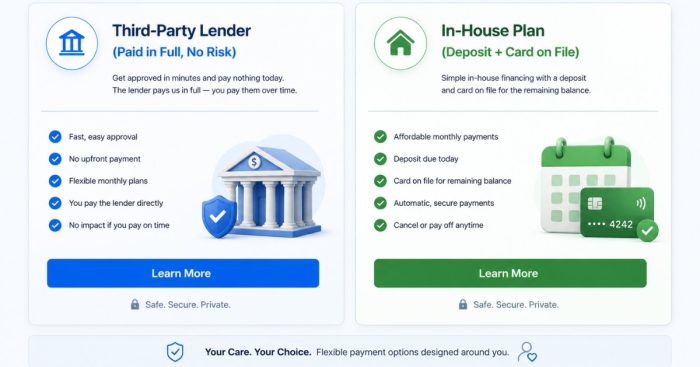
A two-tier setup works best:
- A third-party medical lender as the default
- A simple in-house payment plan for patients the lender declines or who prefer to pay the clinic directly
Third-party lenders like CareCredit and Cherry:
- Approve the patient
- Pay the clinic in full upfront
- Carry the collection risk
That protects your cash flow while still giving the patient a monthly option.
Run a soft-credit pre-qualification.
Patients can see their likely terms without a hard pull or a hit to their credit score.
That removes one more reason to hesitate.
For declines or for tickets above what a lender will approve, a structured in-house plan captures patients a lender won’t.
That plan should include:
- A meaningful deposit
- A defined number of monthly payments
- A card on file
What you want to avoid is the open-ended, undocumented “pay us when you can” arrangement.
Those arrangements:
- Erode collections
- Create awkward money conversations
- Quietly train people to treat the balance as optional
Financing should always be structured, documented, and backed by a card on file.
That’s what keeps it a growth tool instead of an accounts-receivable problem.
How do you present financing on a consult without making it feel like a “loan”?
Lead with the monthly number and the outcome.
Do not lead with the lender’s name.
Do not lead with the word “loan.”
The strongest language sounds like:
“Most patients invest about $300 a month to get back to walking without pain.”
Present it as the normal way to move forward rather than a special accommodation.
Offer financing on every case.
Doing so prevents the patient from feeling you’ve decided they can’t afford the treatment.
Once financing feels like charity or a last resort, it stops working.
Anchor the full-pay price first.
Then introduce the monthly option as the convenient alternative.
That way, financing reads as flexibility rather than a discount.
Never editorialize about a patient’s money.
Your coordinator’s job is simple:
- Present the pay-in-full option
- Present the monthly-payment option
- Let the patient choose
The clinics that convert the most high-ticket regenerative cases treat financing as a default lane on the road, not an emergency exit.
If your front desk only brings it up after a patient says “that’s a lot of money,” the framing has already cost you the case.
Should a regenerative clinic offer in-house payment plans or use a third-party lender?
Use a third-party lender as your default.
Keep a disciplined in-house plan as the backup.
Most clinics need both, in that order.
Third-party lenders are the better default because they pay you the full ticket within days.
They also absorb the risk that a patient stops paying.
That’s enormous for a clinic carrying real per-case costs in biologics and provider time.
You don’t want $15,000 of regenerative care sitting in receivables for a year.
The merchant fee the lender charges is simply the cost of converting a case that would otherwise walk out the door.
An in-house plan earns its place as the catch for everyone the lender declines or who’d rather not finance through a third party.
However, it only works if it’s structured like a real agreement.
Require:
- A meaningful deposit
- A card on file
- Fixed auto-pay dates
- Written terms
Whether you build the plan in-house or lean on a lender, this is the kind of revenue-operations decision good medical practice marketing consultants help you get right.
The financing setup quietly determines how much of your demand actually converts to collected cash.
How does offering financing affect a regenerative clinic’s cash flow and revenue?
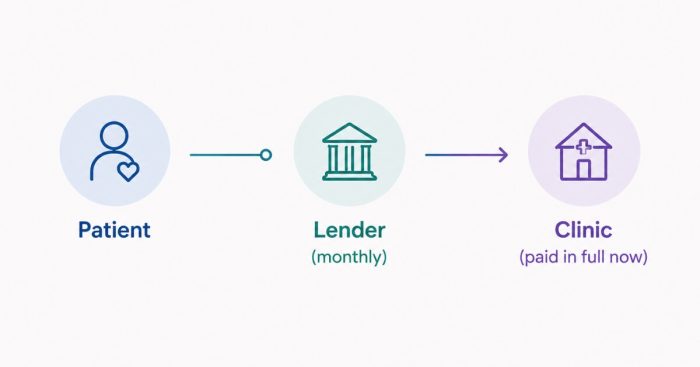
With third-party lenders, financing actually improves cash flow.
The lender pays you in full within days.
The patient repays the lender over time.
As a result, you collect the whole ticket now and carry none of the collection risk.
The lender’s merchant fee per transaction is best understood as a closing cost on cases that would otherwise be lost.
It is not a discount on your price.
In-house plans trade some immediate cash for reach.
That’s why you protect them with:
- A real deposit
- An auto-charged card on file
The compounding effect is bigger than any fee.
Financing lets you confidently recommend the full clinical protocol and the higher-value program.
That prevents patients from choosing a stripped-down version simply because of cash constraints.
The result is higher average revenue per patient.
It also feeds the lifetime value that makes regenerative practices so profitable in the first place.
That LTV-and-conversion engine is what produced outcomes like $309,590 in cash-pay revenue in 10 months at a 79.4% conversion rate for a regenerative practice.
Converting more of the patients you already attract, at the full clinical value, is almost always cheaper than buying more leads.
A merchant fee on a closed $15,000 case will always beat a free “no.”
FAQ’s About Offering Patient Financing for High-Ticket Regenerative Treatments
How should a regenerative medicine clinic offer patient financing for high-ticket stem cell treatments?
Offer financing as a standard part of every high-ticket case presentation, not as a fallback you reach for only when a patient flinches at the price.
Get approved with at least one third-party medical lender such as CareCredit or Cherry.
Present a monthly payment alongside the full-pay price on every $5,000-plus recommendation.
Train your coordinator to introduce it before the patient has to ask.
When financing is only mentioned after someone says they can’t afford it, the treatment has already been framed as out of reach.
Presenting financing as a normal way responsible people pay for important care removes the biggest reason high-ticket regenerative cases stall.
The patient wants the treatment but can’t write a $15,000 check this week.
Why does offering financing increase case acceptance for $15,000+ regenerative treatments?
Because most patients who say no to a high-ticket regenerative program are not rejecting the treatment.
They’re rejecting the lump sum.
A patient deciding between living with knee pain and a $15,000 stem cell program rarely has that amount sitting idle.
Many can comfortably afford $300 a month.
Financing reframes the decision.
The question becomes whether relief is worth a monthly payment.
That is a far easier yes.
It also lets the clinic recommend the clinically ideal protocol instead of allowing the patient to self-select the cheapest option because that’s all the cash on hand allows.
Clinics that present financing on every case routinely lift acceptance on their largest recommendations without touching the price.
What financing options work best for stem cell and PRP patients?
A two-tier setup works best.
Use a third-party medical lender as the default.
Offer a simple in-house payment plan for patients the lender declines or who prefer to pay the clinic directly.
Third-party lenders like CareCredit and Cherry approve the patient, pay the clinic in full upfront, and carry the collection risk.
That protects cash flow.
Run a soft-credit pre-qualification so patients can see likely terms without a hard pull or a hit to their score.
For declines or higher tickets, use a structured in-house plan with a meaningful deposit and defined monthly payments tied to a card on file.
Avoid open-ended, undocumented “pay when you can” arrangements.
They erode collections and train patients to treat the balance as optional.
How do you present financing on a consult without making it feel like a loan?
Lead with the monthly number and the outcome.
Avoid leading with the lender’s name or the word “loan.”
The strongest language sounds like “most patients invest about $300 a month to get back to walking without pain.”
Present financing on every case so it never signals that you think a particular patient can’t afford treatment.
Anchor the full-pay price first.
After that, offer the monthly option as the convenient alternative.
That makes financing feel like flexibility rather than a discount.
Never editorialize about a patient’s finances.
Present both paths clearly and let the patient choose.
When financing feels like a standard way responsible people pay for major care, case acceptance climbs.
How does offering financing affect a regenerative clinic’s cash flow and revenue?
With third-party lenders, financing improves cash flow because the lender pays the clinic in full within days while the patient pays the lender over time.
You receive the whole ticket now and carry none of the collection risk.
The merchant fee is best viewed as the cost of closing cases that would otherwise walk.
In-house plans trade some immediate cash for reach, so protect them with a real deposit and an auto-charged card on file.
The bigger impact comes from increased case acceptance and higher average revenue per patient.
Financing makes it easier to recommend the full clinical protocol and the higher-value program.
A merchant fee on a closed $15,000 case beats a free no.
What’s the next step?
If you run a regenerative or stem cell practice and you’re losing motivated patients at the price conversation, financing is usually the fastest lever you can pull.
The demand is already there.
The patient already wants the treatment.
Get approved with a third-party medical lender.
Build a disciplined in-house backup plan.
Train your coordinator to present a monthly option on every high-ticket case.
Anchor that option to the full-pay price and lead with the outcome.
You’ll convert more of the patients you already attract at the full clinical value without ever discounting your work.
Real ADvice helps regenerative and pain practices build the offer, the consult, and the conversion system that turns high-ticket demand into collected cash.
It’s the same engine behind $2,095,039 added in 10 months at Elite Pain Doctors.
If you want help dialing in how you present and finance your high-ticket cases, that’s the conversation to book.