
How Do Regenerative Clinics Use Educational Seminars and Webinars to Sell High-Ticket Stem Cell and Neuropathy Programs?
You can’t sell a $15,000 neuropathy or stem cell program with a 30-second ad. The patient is skeptical, has often tried everything else, and needs real education and trust before committing that kind of cash. That’s exactly the gap an educational seminar or webinar fills — it’s the trust-building middle step that turns a cold prospect into a warm, qualified consult. Here’s how regenerative clinics use the seminar funnel to sell their highest-ticket programs, and how to fill, run, and convert these events the right way.
How do regenerative clinics use educational seminars and webinars to sell high-ticket stem cell and neuropathy programs?
They use a seminar or webinar as the trust-building middle step between an ad and a high-ticket consult — educate a room of qualified prospects, establish the provider’s authority, then invite attendees to a one-on-one evaluation.
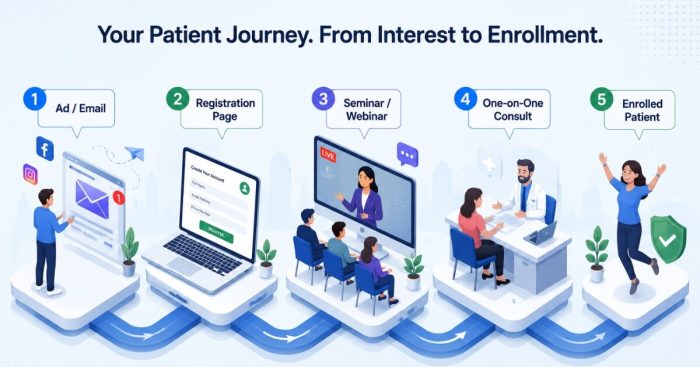
The funnel is simple and repeatable:
- A targeted ad or email drives registrations for a free educational event on a specific condition (neuropathy, knee pain, joint pain).
- The seminar or webinar teaches the audience what’s actually going on with their condition and how a regenerative approach works.
- A clear call to action moves interested attendees into a paid or complimentary consultation where the actual case is evaluated and the program is presented.
This works for $10K–$25K+ programs precisely because a single ad can’t carry that much trust on its own.
The patient needs:
- Time
- Education
- A credible expert
Before they’ll commit that kind of cash.
The seminar compresses weeks of patient research into one high-trust session and pre-qualifies the room.
It’s a core play in stem cell clinic marketing: TV long-form infomercials work on the same principle for the highest-ticket neuropathy and knee-pain programs, and the live or virtual seminar is the local clinic’s version of that same trust-at-scale mechanism.
Why do seminars and webinars work so well for high-ticket regenerative and neuropathy offers?
Because high-ticket regenerative offers are sold on trust and education, and a seminar delivers both at scale to a pre-interested audience.
A $15,000 neuropathy or stem cell program is not an impulse purchase.
The patient:
- Is skeptical
- Has often tried other things
- Needs to understand the treatment before spending that much cash
A seminar gives you 45 to 60 minutes to do what a 30-second ad never can:
- Explain the condition
- Establish the provider as a credible authority
- Show real patient outcomes
- Handle the common objections in advance
- Let the prospect feel the difference between your clinic and the alternatives
It also concentrates your sales effort.
Instead of one-on-one educating every lead from scratch, you educate a whole room at once and then have far warmer, shorter consults afterward.
The format naturally filters for intent, too:
Someone who registers for and attends a neuropathy seminar is self-identifying as a motivated, in-market buyer.
Trust at scale plus built-in qualification is exactly why this format outperforms cold lead-gen for premium regenerative programs.
What should a regenerative medicine seminar or webinar actually cover?
It should educate first and sell second: explain the condition, present the regenerative approach honestly, prove it with real patient stories, address the skepticism, and end with a clear, low-pressure next step.
A strong structure opens by:
- Connecting with the audience’s pain and frustration (“you’ve been told to just live with it or get a replacement”).
- Teaching what’s actually happening with their condition so they feel understood and informed.
- Explaining how the regenerative approach works in plain language.
- Explaining who it tends to help and who it doesn’t.
- Explaining what realistic expectations look like.
Honesty here builds more trust than hype and keeps you compliant.
Weave in real patient stories and outcomes, because in a trust-first category the proof is what converts.
Pre-handle the big objections:
- Does it work?
- Is it safe?
- How does the cost map to the value?
So the consult isn’t where those land cold.
Close by inviting attendees to a personal evaluation to find out if they’re a candidate, framed as the logical next step rather than a hard pitch.
Educate, prove, set expectations, invite — that is the arc that turns attendees into consults.
Is an in-person seminar or an online webinar better for a regenerative clinic?
Both work, and the best programs run both — in-person seminars convert at a higher rate per attendee, while webinars scale reach and cost less to fill, so the right choice depends on your goals and your patient demographic.
| In-Person Seminar | Webinar |
|---|---|
| Higher conversion per attendee | Greater scale |
| Stronger trust | Lower cost to fill |
| Team interaction | Weekly repeatability |
| Environment experience | Join from home |
| Strong fit for older demographics | On-demand replay potential |
In-person events:
- A dinner seminar
- A workshop at the clinic
- A hotel conference room
Create the strongest trust and the highest conversion because the prospect physically shows up, meets the team, and experiences the environment.
For an older neuropathy or joint-pain demographic, the in-person format often fits how they prefer to make a big health decision.
Webinars trade a little conversion for a lot of efficiency:
- They’re cheaper to fill.
- You can run them weekly.
- Attendees can join from home.
- You can re-use the recording for on-demand registrations and nurture.
A smart approach uses webinars to cast a wide, low-cost net and qualify interest, and in-person events for the highest-intent prospects in your local market.
Match the format to who your patients are and how they like to buy:
- In-person for maximum trust and conversion
- Webinar for scale, reach, and repeatability
How do you fill a regenerative seminar or webinar with the right prospects?
You fill it by promoting a specific condition to a specific audience across the channels that match that demographic, then confirming registrations aggressively so attendance holds.
Lead with the condition, not the treatment.
Example:
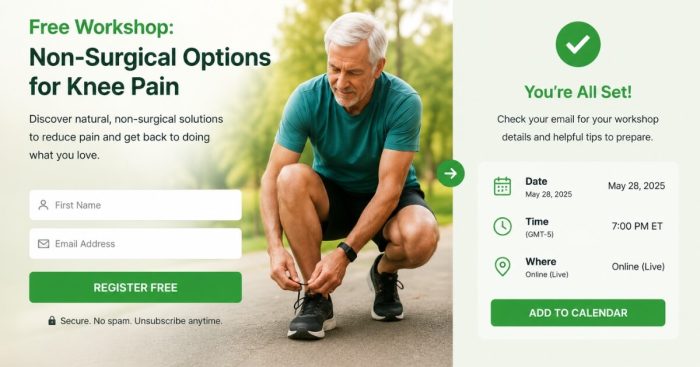
“a free workshop on the latest non-surgical options for knee pain”
Pulls far better than:
“regenerative medicine seminar”
Because prospects identify with their problem.
Use the channels that fit the audience:
- Your patient list
- Your email list
- Local radio
- Local TV
Facebook and Instagram are workhorses for joint-pain and neuropathy seminars because the targeting and the older demographic line up.
Your own patient and email list is the cheapest and warmest source.
For the highest-ticket programs, even local radio or TV can drive registrations.
This is the kind of patient acquisition that fills a room with in-market buyers.
Register people to a simple landing page, then fight no-shows with a confirmation sequence:
- Reminder emails
- Reminder texts
- A confirmation call for in-person events
- A reserved seat commitment device
The two failure points are:
- Promoting the treatment instead of the problem.
- Under-confirming registrations so half the room never shows.
Specific condition, matched channel, and relentless confirmation are what put qualified people in seats.
How do you convert seminar or webinar attendees into booked, paying patients?
You convert attendees by making the consult the natural next step, booking it before they leave, and following up fast and persistently with everyone who doesn’t book on the spot.
The single biggest lever is booking the one-on-one evaluation during the event itself.
Have:
- A clear call to action
- A team ready to schedule attendees right there
- Ideally an incentive to book now rather than think about it
For a webinar, drive attendees to a scheduling page with a real commitment step at the close.
Then run a disciplined follow-up sequence for everyone who attended but didn’t book:
- Reach out within a day
- Reference the specific condition and content from the event
- Continue with calls, texts, and emails until they book or clearly opt out
Speed matters enormously.
The consult is where the high-ticket program is actually presented and the case is evaluated, so the seminar’s only job is to produce booked, warm evaluations.
Practices that nail this treat the event and the follow-up as one system — and that disciplined conversion process is the same thing that helped a regenerative clinic convert leads at a 79.4% rate and a pain practice add over $2 million in 10 months.
FAQ’s About Seminar and Webinar Funnels for Regenerative Clinics
How do regenerative clinics use educational seminars and webinars to sell high-ticket programs?
As the trust-building middle step between an ad and a high-ticket consult: a targeted ad or email drives registrations for a free educational event on a specific condition, the seminar teaches the audience and establishes the provider’s authority, and a clear call to action moves interested attendees into a one-on-one evaluation where the program is presented.
It works for $10K–$25K+ offers because a single ad can’t carry that much trust — the seminar compresses weeks of research into one high-trust session and pre-qualifies the room.
Why do seminars and webinars work so well for high-ticket regenerative offers?
Because these offers are sold on trust and education, and a seminar delivers both at scale to a pre-interested audience.
A $15,000 program isn’t an impulse buy, so the 45–60 minutes you get to explain the condition, establish authority, show outcomes, and pre-handle objections does what a 30-second ad never could.
It also concentrates your sales effort and filters for intent — anyone who registers and attends is self-identifying as a motivated, in-market buyer.
How do you fill a regenerative seminar with the right prospects?
Promote a specific condition (not the treatment) to a matched audience, then confirm registrations aggressively.
“A free workshop on non-surgical options for knee pain” beats “regenerative medicine seminar.”
Facebook and Instagram fit joint-pain and neuropathy demographics, your own patient list is the warmest source, and radio or TV can work for the highest-ticket programs.
Then fight no-shows with reminder emails, texts, confirmation calls, and a reserved-seat commitment device.
How do you convert seminar attendees into booked, paying patients?
Make the consult the natural next step, book it during the event, and follow up fast with everyone who doesn’t book on the spot.
Have a team ready to schedule attendees right there, drive webinar attendees to a scheduling page with a real commitment step, and run a disciplined within-a-day follow-up sequence referencing the event content.
The seminar’s only job is to produce booked, warm evaluations; the consult is where the program is presented.
What’s the next step?
An educational seminar or webinar is the most reliable way to sell a high-ticket regenerative or neuropathy program, because it builds the trust those offers require at a scale a single ad never can.
Promote a specific condition, educate honestly, prove it with real patient stories, set realistic expectations, and make the one-on-one evaluation the obvious next step — then treat the event and the follow-up as one disciplined system.
Real ADvice helps regenerative and pain practices build these seminar and conversion systems end to end, the kind that produced a 79.4% lead-to-appointment conversion rate for an orthobiologics clinic and over $2 million in 10 months for a cash-pay pain practice.