
How Should a Regenerative or Stem Cell Clinic Handle the “Does This Actually Work?” Objection on a Sales Call?
In regenerative medicine, “how much does it cost?” is almost never the real objection. The real objection — the one underneath everything — is “does this actually work, and will it work for me?” Your prospect has often tried other treatments. They’re being asked to spend thousands in cash. They’re quietly terrified of being disappointed again. How your team answers that question on the consult is the single biggest lever on whether a great lead becomes a booked, high-ticket patient. Here’s how to handle the skepticism objection with empathy, proof, and full compliance.
How should a regenerative or stem cell clinic handle the “does this actually work?” objection on a sales call?
Acknowledge the skepticism as reasonable. Ask what they’ve already tried and how it affected their life. Then answer with relevant patient stories and an honest, non-guaranteeing explanation of how the treatment works for cases like theirs.
The worst response is to get defensive or to oversell with hype. Both confirm the patient’s fear that you’re a salesperson, not a clinician.
The right move is to validate the doubt (“that’s a fair question, and honestly you should be skeptical given what you’ve been through”). Then get them talking about their specific situation so you can connect the treatment to their case.
From there, the most persuasive proof is another patient just like them who got their life back. Support that with a clear, truthful explanation of the mechanism and realistic expectations.
You’re not arguing them out of skepticism. You’re replacing it with evidence and a believable path.
This trust-first approach to patient acquisition is exactly how an orthobiologics practice booked leads at a 79.4% conversion rate.
In a high-ticket cash category, the clinic that handles “does this work” with empathy and proof wins the patient.
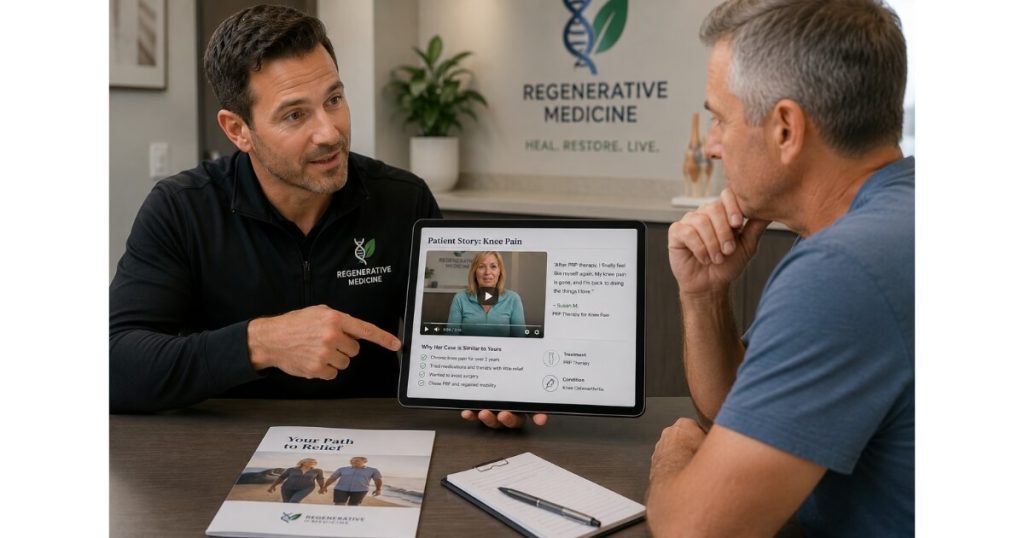
Why do regenerative patients raise the “is this proven” objection in the first place?
Because they’re skeptical by experience, not by accident.
Most regenerative patients have already tried things that didn’t work. They’re also being asked to spend thousands of dollars in cash on something insurance won’t cover.
Put yourself in their position. They’ve seen other doctors. Maybe they’ve had injections or physical therapy. Maybe they’ve been told to just live with it.
Now someone is presenting a treatment they may have only half-heard about.
The “is this proven” question isn’t hostility. It’s self-protection.
They’re really asking three things at once:
- Will this work for my specific problem?
- Can I trust this clinic?
- Am I about to waste money I can’t get back?
When you understand that the objection is fear wearing the costume of a logical question, you stop trying to win a debate about studies.
You start addressing the real concern, which is trust and relevance to their case.
Patients who feel understood drop the skepticism.
Patients who feel sold to dig in.
The objection is an invitation to build trust, not an attack to defend against.
What’s the best way to respond when a patient says “I’ve tried everything and nothing worked”?
Meet it with empathy first. Then reframe why this approach is different for their specific case.
Never dismiss what they’ve tried.
When a patient says nothing has worked, the instinct to immediately pitch is exactly wrong. It tells them you weren’t listening.
Start by validating:
“I hear that a lot, and I understand why you’d be frustrated — you’ve put in the effort and you’re still in pain.”
Then get specific about what they actually tried.
Because “everything” usually means a few things that address symptoms rather than the underlying problem.
That distinction is your opening.
You can honestly explain how a regenerative approach targets something different from what they’ve done before. You can explain why patients in similar situations have responded.
Support it with a story of a patient who also “tried everything” and found relief here.
You’re not promising a miracle.
You’re giving a frustrated person a credible reason to hope.
That hope should be grounded in how the treatment actually works and who it tends to help.
Empathy plus a believable point of difference turns “nothing works” from a wall into a doorway.
Should you use clinical studies or patient stories to overcome skepticism?
Use patient stories as the primary tool and clinical evidence as the supporting layer.
Stories move people. Data reassures them.
A skeptical, in-pain patient is persuaded far more by someone exactly like them describing how they got their life back than by a citation.
The story answers the real question (“will this work for someone like me?”) in a way statistics can’t.
Lead with relevant, specific patient experiences that match the prospect’s condition, age, and situation.
Then use honest clinical context as the rational backstop for the patient who needs to feel the decision is evidence-based.
Explain the mechanism truthfully. Describe realistic outcomes. Never overstate what the research shows.
The combination works because it satisfies both the emotional and the logical parts of the decision.
The story gives them permission to hope. The honest framing gives them permission to trust.
Lead with the human. Back it with the truthful clinical picture. Avoid hype that would undermine the very credibility you’re building.
This is the core of effective pain management marketing— proof that’s both persuasive and honest.
How do you handle the skepticism objection without overpromising or making non-compliant claims?
Set honest expectations. Speak in terms of how patients have responded rather than guaranteed results. Let proof do the persuading instead of hype.
The temptation under a skeptical patient is to overpromise to close the deal.
But in regenerative medicine that’s both a compliance risk and a trust killer.
Savvy patients can smell a guarantee that’s too good to be true.
Stay compliant and credible by avoiding any language that implies certain, typical, or guaranteed outcomes.
Be candid that results vary and not everyone is a candidate.
Ground the conversation in real patient stories with proper consent and honest framing.
Paradoxically, honesty converts better here than hype.
Telling a skeptic “this doesn’t work for everyone, but here’s who it tends to help and here’s a patient who was right where you are” builds the trust that overselling destroys.
In a category under real regulatory scrutiny, the compliant answer and the persuasive answer are the same answer.
Truthful, specific, proof-backed, and free of guarantees.
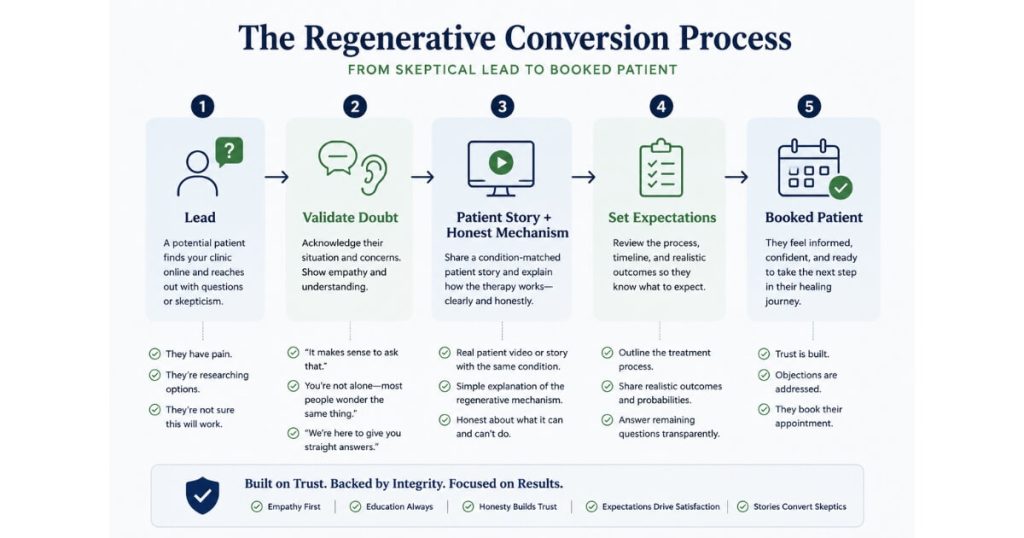
How does a strong conversion process turn skeptics into booked high-ticket patients?
A strong conversion process surfaces the real objection early. It handles it with empathy and proof. It guides the patient to a confident decision instead of leaving them to talk themselves out of it.
Most regenerative practices leak more revenue in a weak conversion process than in their ad spend.
Great leads call in, hit unhandled skepticism, and never book.
The fix is a repeatable consultative process.
A front desk and consult team should be trained to ask about the patient’s history and impact before pitching.
They should validate the “does this work” fear instead of arguing with it.
Also, they should deploy condition-matched patient stories at the right moment.
They should set honest expectations that build trust.
Tracking the right metric matters too.
Measure booked patients and cost per booked patient, not just lead volume.
When the conversion process is built to handle skepticism rather than ignore it, the same lead flow produces dramatically more booked cases.
That’s how a regenerative clinic reached a 79.4% conversion rate and a pain practice added over $2 million in 10 months.
The objection isn’t the obstacle.
An unprepared conversion process is.
FAQ’s About Handling the “Does This Work?” Objection in Regenerative Sales
How should a regenerative or stem cell clinic handle the “does this actually work?” objection on a sales call?
Acknowledge the skepticism as reasonable. Ask what they’ve already tried and how it affected their life. Then answer with relevant patient stories and an honest, non-guaranteeing explanation of how the treatment works for cases like theirs.
Don’t get defensive or oversell. Both confirm the fear that you’re a salesperson.
Validate the doubt, get them talking about their case, and replace skepticism with a believable path.
This trust-first approach is how an orthobiologics practice booked leads at a 79.4% conversion rate.
Why do regenerative patients raise the “is this proven” objection?
Because they’re skeptical by experience.
Most have already tried things that didn’t work and are being asked to spend thousands in cash on something insurance won’t cover.
The question is self-protection, not hostility.
They’re really asking whether it will work for their problem, whether they can trust you, and whether they’re about to waste money.
Treat it as an invitation to build trust, not an attack to defend against.
Should you use clinical studies or patient stories to overcome skepticism?
Use patient stories as the primary tool and clinical evidence as the supporting layer.
Stories move people. Data reassures them.
A condition-matched patient describing how they got their life back answers “will this work for me?” better than any citation.
Back it with an honest explanation of the mechanism and realistic outcomes.
Never overstate the research.
The story gives permission to hope. The honest framing gives permission to trust.
How do you handle skepticism without overpromising or making non-compliant claims?
Set honest expectations. Speak in terms of how patients have responded rather than guaranteed results. Let proof persuade instead of hype.
Avoid language implying certain or typical outcomes.
Be candid that results vary and not everyone is a candidate.
Ground the conversation in consented patient stories.
In a category under regulatory scrutiny, the compliant answer and the persuasive answer are the same.
Truthful, specific, proof-backed, and guarantee-free.
What’s the next step?
The “does this actually work?” objection is the moment your marketing budget either converts into a booked patient or evaporates.
Train your team to treat skepticism as fear in disguise. Validate it before answering. Lead with condition-matched patient stories. Set honest, compliant expectations.
The clinics that win in regenerative medicine aren’t the ones with the slickest pitch.
They’re the ones whose conversion process is built to earn a skeptic’s trust.
Real ADvice builds exactly these trust-first conversion systems for regenerative and pain practices.
The kind that produced a 79.4% lead-to-appointment conversion rate for an orthobiologics clinic and over $2 million in 10 months for a cash-pay pain practice.
If your leads are calling but not booking, that’s the conversation to have.