
How Does a Stem Cell or Regenerative Medicine Clinic Show Up in Local Search and Google Maps?
Most regenerative and stem cell patients begin in exactly one place: a search bar. They type a symptom, a treatment, and “near me.” If your clinic isn’t in the local pack and on Google Maps for those searches, you’re invisible at the precise moment a high-ticket cash patient is looking for you. The good news is that local search is one of the most controllable and highest-ROI channels in this category. Unlike paid ads, the results compound. Here’s exactly how a regenerative medicine clinic earns its place in local search and why it’s the foundation every other channel builds on.
How does a stem cell or regenerative medicine clinic show up in local search and Google Maps?
A regenerative clinic shows up in Google Maps and the local pack by combining a fully optimized Google Business Profile, a steady flow of recent reviews that name your treatments, and treatment-specific pages on your website that match what patients actually search.
Google ranks local results using three factors: relevance, distance, and prominence.
Relevance measures whether your profile and website match the search.
Distance measures how close you are to the searcher.
Prominence measures reviews, citations, and your overall authority online.
You can’t control distance. However, you can directly control relevance and prominence.
Choose service categories that accurately match your treatments.
Write a profile description using the same language patients search for. Examples include “PRP injections,” “stem cell therapy for knee pain,” and “regenerative medicine.”
Keep your name, address, and phone number identical everywhere online.
Build dedicated pages for every treatment and condition you treat.
Pain and regenerative care is a search-first behavior.
Patients search symptoms, treatments, and “near me” before they ever call.
The clinic that aligns its profile and website with those searches is the clinic that appears.
This is the foundation of effective stem cell clinic marketing.
It’s also how we generated $309,590 in cash-pay revenue in 10 months for a regenerative clinic from SEO alone, with zero ad spend.
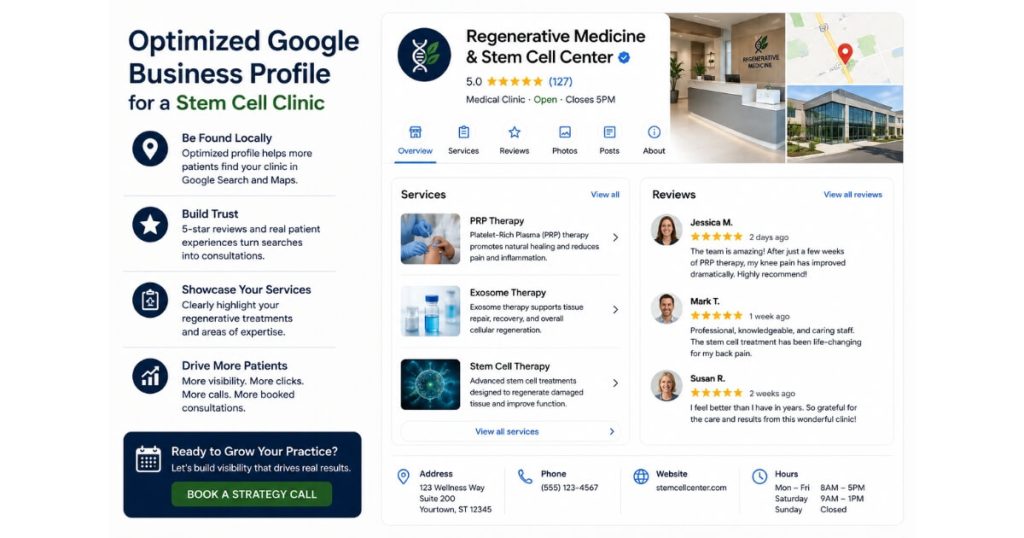
What matters most in a regenerative clinic’s Google Business Profile?
The highest-impact elements are accurate service categories, a keyword-rich description, individually listed services, frequent reviews, and regular posts tied to your treatments.
Choose the primary category that best matches your practice.
Then add every relevant secondary category. Examples include pain management clinic, medical clinic, and sports medicine clinic.
List each treatment as its own service.
That includes PRP, bone marrow concentrate, exosomes, stem cell therapy, and neuropathy treatment.
Give each service a short description using the phrases patients actually search.
Fill out your hours.
Upload photos of the clinic, providers, and staff.
Write a description that sounds like a patient’s search query, not a polished brochure.
Then keep the profile active.
Google rewards profiles that receive fresh reviews and regular posts.
Those posts should focus on the same treatments and conditions you want to rank for.
A neglected profile with three reviews and the wrong primary category will lose to a competitor who treats the profile as a living asset.
Your Google Business Profile is your front door in local search.
Most regenerative clinics complete only part of it and then wonder why they don’t appear on the map.
How do reviews affect whether a regenerative or stem cell clinic ranks locally?
Reviews are one of the strongest local ranking signals.
They’re also one of the biggest conversion drivers in a trust-first category like regenerative medicine.
Google looks at review count, review recency, and review velocity.
A steady stream of recent reviews signals an active and trusted practice.
The content of the review matters too.
A review that says “Dr. Smith’s PRP treatment fixed my knee pain” provides far more local relevance than a generic five-star review.
That type of review can help you rank for phrases like “PRP knee pain.”
Build a simple review-request process.
Ask every satisfied patient for a review within a day or two of a positive visit.
Encourage happy patients to mention the specific treatment they received and the condition it addressed.
Patients often spend weeks researching before committing thousands of dollars in cash.
That means a wall of recent, treatment-specific reviews can become the deciding factor between you and the clinic across town.
Reviews help drive rankings.
Then they help convert patients once they find you.
That’s why review velocity sits at the center of any serious pain management marketing strategy.
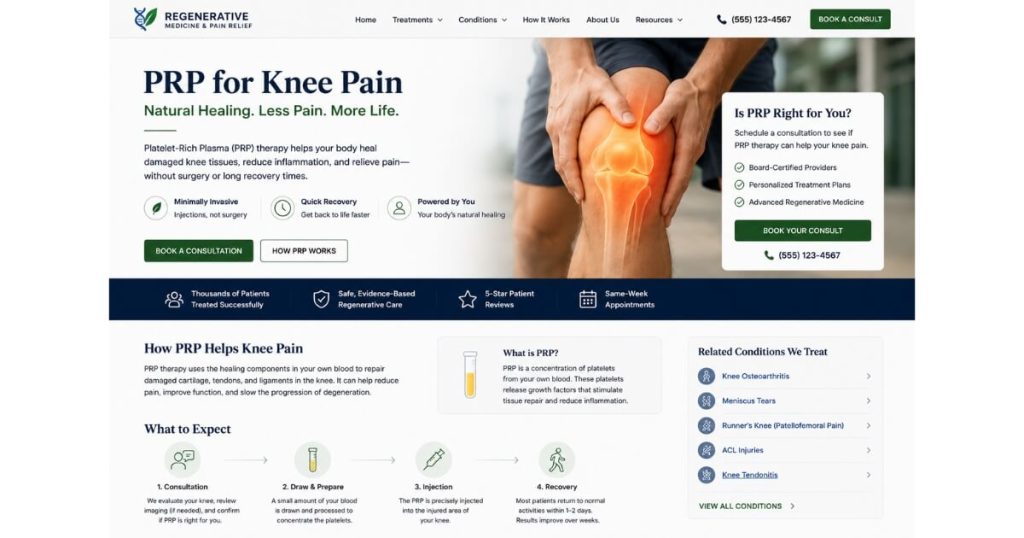
How do you rank a regenerative clinic for treatment-specific searches like “PRP for knee pain near me”?
Build a dedicated page for every treatment-and-condition pair and match it to the exact language patients use when searching.
A regenerative patient rarely searches for “regenerative medicine clinic.”
Instead, they search for phrases like:
- PRP for knee pain
- Stem cell therapy for shoulder pain
- Neuropathy treatment near me
- Non-surgical knee pain treatment
One catch-all services page can’t rank for all of those searches.
Create a page for each treatment and a page for each condition.
Include the target search phrase in the title, headers, and body content.
Provide real depth about the treatment, who it helps, and what patients can realistically expect.
Then add internal links between related treatments and conditions.
Next, align your Google Business Profile with those same services.
Pair that with reviews that mention those treatments by name.
Now you’ve matched relevance across every surface Google evaluates.
This is how an orthobiologics practice converted leads at a 79.4% rate from search traffic alone.
Patients who found those pages had already self-qualified by searching for the exact treatment.
As a result, they arrived ready to book.
In this category, depth and specificity beat a thin, generic website every time.
How long does local SEO take to work for a regenerative medicine clinic?
Local SEO typically begins producing leads within a few months.
The biggest gains usually happen between months six and twelve.
Google Business Profile optimization and a surge of fresh reviews can improve local-pack visibility within weeks.
Ranking treatment pages for competitive “near me” searches takes longer.
That process usually requires content depth, internal linking, and review velocity working together.
The important shift in thinking is this:
Local SEO is an asset, not an advertising expense.
Once a treatment page ranks and your profile gains authority, it can continue producing leads month after month.
There is no per-click cost.
We generated $309,590 in cash-pay revenue in 10 months for a regenerative clinic through SEO alone.
We also generated 26 organic website leads per month for a cash-pay pain practice.
Those were compounding results, not one-time spikes.
The clinics that win treat the first few months as a build phase.
They evaluate the channel based on long-term lead flow, not week-two results.
Should a regenerative clinic invest in local SEO or paid ads first?
For most established regenerative and pain practices, local SEO and Google Business Profile should be the foundation.
Paid ads should be layered on top later.
Pain and regenerative care is search-first.
Patients are already looking for symptom relief and treatment options.
That makes organic search and local-pack visibility some of the highest-intent lead sources available.
Paid ads can add speed and volume.
However, stem cell and PRP campaigns face platform restrictions and frequent disapprovals.
The moment you stop paying, the leads stop.
SEO keeps producing.
The strongest strategy is to build the local-search foundation first.
Own a compounding lead source.
Then layer paid ads on top once your offer and conversion process are proven.
A regenerative clinic that leads with SEO builds an asset.
A clinic that leads with ads rents its results.
FAQs About Local Search for Regenerative and Stem Cell Clinics
How does a stem cell or regenerative medicine clinic show up in local search and Google Maps?
By combining a fully optimized Google Business Profile, a steady flow of recent reviews, and treatment-specific pages that match what patients search.
Google ranks local results based on relevance, distance, and prominence.
You control relevance and prominence by matching your categories, descriptions, services, and website content to the exact phrases patients use.
Pain and regenerative care is search-first.
The clinic that aligns itself with those searches is the clinic that appears.
What matters most in a regenerative clinic’s Google Business Profile?
Accurate service categories, a keyword-rich description, individual treatment listings, frequent reviews, and regular posts.
Choose the best primary category.
Add relevant secondary categories.
List each treatment individually.
Keep the profile updated with fresh reviews and treatment-focused posts.
The clinics that treat their profile as a living asset consistently outperform those that don’t.
How do reviews affect whether a regenerative clinic ranks locally?
Reviews are one of the strongest local ranking signals and one of the biggest trust builders.
Google evaluates review count, recency, and velocity.
Reviews that mention treatments and conditions by name create additional relevance.
Ask happy patients for reviews shortly after positive visits and encourage them to mention their treatment experience.
Should a regenerative clinic invest in local SEO or paid ads first?
For most established regenerative and pain practices, local SEO should come first.
Google Business Profile and organic search create a durable lead source.
Paid ads can accelerate growth later.
However, ads stop producing when spending stops.
SEO continues generating leads long after the work is completed.
What’s the next step?
If your regenerative or stem cell clinic isn’t showing up when local patients search for symptoms and treatments, the solution usually isn’t more ad spend.
It’s owning the local-search surfaces patients use first.
Fully optimize your Google Business Profile.
Build a review engine that consistently generates treatment-specific reviews.
Create dedicated pages for every treatment-and-condition pair you want to rank for.
That foundation compounds into a lead source you don’t have to keep paying for.
Real ADvice has built exactly this system for practices like yours.
That includes $309,590 in cash-pay revenue in 10 months from SEO alone for an orthobiologics clinic and more than $2 million in 10 months for a cash-pay pain practice.
If you want to see where the gaps are in your local search presence and what it would take to own it, that’s the conversation to book.