
Should a Stem Cell or Regenerative Clinic Lower Prices to Get More Patients? (Why Discounting Backfires)
When bookings slow down, the first instinct is to cut the price. It feels like the obvious lever — make it cheaper, get more patients. But for an established stem cell or regenerative clinic, discounting usually attacks the wrong problem and quietly damages the premium position you spent years building. The real bottleneck is almost never that you’re too expensive. Here’s why discounting backfires in regenerative medicine, and the higher-leverage moves that actually fill the schedule.
Should a stem cell or regenerative clinic lower its prices to get more patients?
Usually not — for an established regenerative clinic, lowering prices is the wrong lever and tends to backfire.
When bookings slow, the instinct is to cut price.
But in regenerative medicine the real bottleneck is almost never that you’re too expensive.
It’s that:
- Not enough of the right patients trust you yet
- Your conversion process isn’t turning the leads you already have into booked cases
A discount doesn’t fix either problem.
It does three damaging things instead:
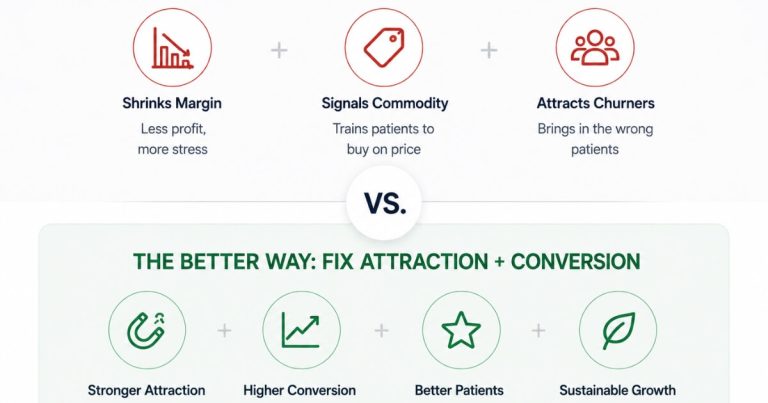
- It shrinks the margin you need to fund marketing and follow-up.
- It signals that your work is a commodity.
- It attracts price-shoppers who churn and refer more price-shoppers.
Before touching price, look at whether you’re attracting the right patient and converting your existing leads.
Orthobiologics booked 79.4% of its leads at full cash-pay pricing — the gain came from conversion and trust, not from a lower price.
That’s the heart of durable stem cell clinic marketing.
Why does discounting backfire for an established regenerative practice?
Because it attacks the wrong problem and damages your positioning at the same time.
Regenerative patients are skeptical and choose on trust, so a sudden discount can actually reduce confidence:
“if it really works, why is it on sale?”
It also trains your market:
- To wait for the next discount
- To see your high-value work as a commodity
Which is the opposite of how an established practice should be positioned.
Financially, regenerative programs depend on margin to fund the ad spend, follow-up, and fast cash flow the category requires — thin that margin and the whole engine sputters.
And the patients a discount brings in are the least loyal and most likely to churn.
You end up:
- Working harder
- For less
- With worse patients
While eroding the premium reputation that lets established practices stay less price-sensitive in the first place.
What should you do instead of lowering prices when bookings slow?
Fix the two things that actually drive bookings: attracting the right patient and converting the leads you already have.
On the front end, invest in trust assets:
- SEO and Google My Business so you rank for the conditions patients search
- Education content and provider authority that build credibility
- Reviews and proof that make you the obvious choice
These compound over time and lower your cost per patient, the opposite of a discount that resets every campaign.
On the back end, tighten the conversion process:
- Answer leads fast
- Run a strong consult that anchors on value
- Train the front desk to book on the call
Most regenerative practices leave more money in a weak conversion process than they’d ever recover from a discount — the same engine behind a cash-pay pain practice that added over $2 million in 10 months.
If you do want a front-door offer, make it a no-brainer first step that lowers the barrier to the first visit without cheapening the core program.
Is there ever a right way to use an offer in regenerative medicine?
Yes — when it’s a strategic front-door offer, not a discount on your core program.
A well-designed offer lowers the barrier to the first appointment for a high-intent patient without telling the market your work is cheap.
Examples include:
- A free or low-cost consult
- A discounted diagnostic
- A single-joint trial
These can get the right patient through the door, where your consult process and provider expertise convert them into the full program at full value.
The distinction is intent.
A front-door offer is a controlled entry point for a patient you’ll convert on value.
A blanket discount is a surrender of positioning that trains everyone to pay less.
Use the first deliberately — and reserve it for getting the right patient into a process built to close on trust rather than price.
FAQ’s About Discounting at a Regenerative Clinic
Should a stem cell or regenerative clinic lower its prices to get more patients?
Usually not — for an established regenerative clinic, lowering prices is the wrong lever and tends to backfire.
The real bottleneck is rarely price; it’s that not enough of the right patients trust you yet, or your conversion process isn’t booking the leads you have.
A discount shrinks margin, signals commodity, and attracts churners.
Orthobiologics booked 79.4% of its leads at full cash-pay pricing — the gain was conversion and trust, not a lower price.
Why does discounting backfire for an established regenerative practice?
Because it attacks the wrong problem and damages positioning.
Skeptical patients can read a discount as “if it works, why is it on sale?”, and it trains the market to wait for deals and see your work as a commodity.
It also thins the margin that funds ad spend and follow-up, and brings in the least loyal patients.
You work harder for less with worse patients while eroding your premium reputation.
What should you do instead of lowering prices when bookings slow?
Fix attraction and conversion.
On the front end, invest in trust assets:
- SEO
- GMB
- Education
- Provider authority
- Reviews
On the back end:
- Answer leads fast
- Run a value-anchored consult
- Train the front desk to book on the call
Most practices lose more to a weak conversion process than they’d recover from a discount.
If you want a front-door offer, make it a no-brainer first step that doesn’t cheapen the core program.
Is there ever a right way to use an offer in regenerative medicine?
Yes — as a strategic front-door offer, not a discount on the core program.
A free or low-cost consult, a discounted diagnostic, or a single-joint trial gets a high-intent patient through the door, where your consult process converts them at full value.
The distinction is intent:
- A front-door offer is a controlled entry point you’ll convert on value.
- A blanket discount surrenders positioning and trains everyone to pay less.
What’s the next step?
If bookings have slowed and you’re tempted to cut prices, pause first.
For an established regenerative clinic, the answer is almost always in attraction and conversion — not in a smaller number.
Build the trust assets that bring the right patient, tighten the process that books them, and protect the premium position that makes your practice less price-sensitive in the first place.
That’s the system behind results like $309,590 in 10 months at a 79.4% conversion rate, with zero ad spend and no discounting.
If you want help finding where your real bottleneck is, that’s the conversation to book.