
How Do You Market a High-Ticket Stem Cell Therapy Program Without Competing on Price?
Every regenerative practice owner eventually hits the same wall: a competitor down the road drops their stem cell price, and the temptation is to match it. Don’t. High-ticket regenerative programs aren’t won on the lowest number — they’re won on trust. The patient weighing a $5,000 to $20,000 program isn’t really comparing prices; they’re trying to decide whether it will work and whether you’re the right person to do it. Solve that, and price stops being the battleground. Here is the trust-first system that books high-ticket stem cell and regenerative cases without racing anyone to the bottom.
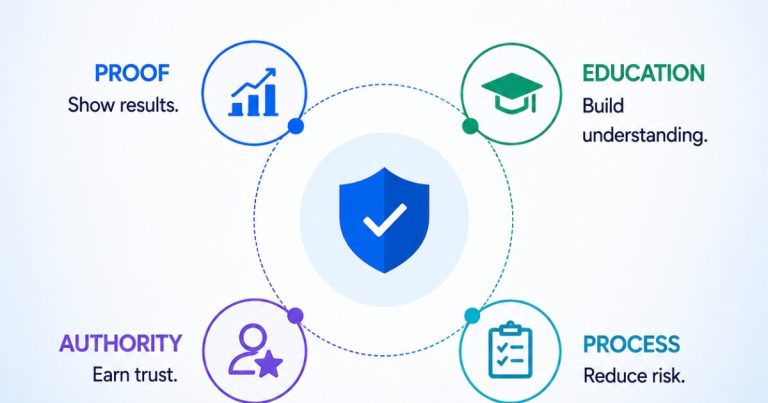
How do you market a high-ticket stem cell therapy program without competing on price?
You make trust and authority the product, so price becomes a detail rather than the decision.
High-ticket regenerative patients are skeptical and research for weeks.
They’ve read the message boards, watched the videos, and seen the overhyped claims that give the field a bad name.
So they choose the clinic that feels the most credible and honest — visible provider expertise, real education, a transparent process, and proof that it works.
When you build those assets, you’re selling the outcome and the expert, not a number on a quote.
That means:
- Leading with the specific condition and the result the patient wants
- Demonstrating your provider’s authority through video and content
- Publishing education that answers what a researcher is already asking
- Running a consult that anchors on value
The clinics that win high-ticket cases don’t have the lowest price — they have the most trust.
That’s what trust-led marketing produces.
Why doesn’t lowering the price help sell a high-ticket regenerative program?
Because price was rarely the real objection — certainty was.
A patient considering an expensive regenerative program isn’t hesitating because the number is big.
They’re hesitating because they aren’t yet sure it will work, and aren’t sure you’re the right person to do it.
Cutting the price doesn’t address either fear.
Worse, it can actively hurt:
- A discount signals that the work is a commodity, or that you don’t fully believe in your own value.
- It attracts exactly the wrong patient — the price-shopper who churns, haggles, and refers other price-shoppers.
The lever that actually moves high-ticket regenerative cases is certainty.
Proof, education, provider authority, and a process that earns trust.
This is the core of effective stem cell clinic marketing: in a field where trust is the whole game, you win by being the most credible option, not the cheapest one.
What marketing assets actually sell high-ticket stem cell and regenerative cases?
The ones that build certainty in a skeptical, well-researched buyer.
Start with:
- Visible provider authority — video, thought leadership, a recognizable expert patients can see and believe in
- Honest education content that answers the questions patients are already typing into Google, YouTube, and AI search
- SEO and Google My Business so those researchers actually find you
- Reviews and outcomes that are easy to see
- A consult process designed to convert a well-researched prospect rather than a cold one
The most powerful of these is provider authority.
We helped Dr. Joy Kong become the #1 stem cell expert on YouTube — and that authority is what let her hire four more doctors and scale herself out of the business.
In regenerative medicine, a visible, credible expert is the single most powerful sales asset there is.
Unlike a discount that resets to zero every campaign, these assets compound and steadily lower your cost per booked case.
How should the consult or sales process work for a high-ticket regenerative program?
It should qualify and educate, then anchor on value before any number is discussed.
By the time a researched patient reaches a consult, your marketing should have already established credibility — so the call confirms fit rather than starting the persuasion from scratch.
Diagnose the problem thoroughly.
Connect it to the outcome the patient actually wants.
Present the program as the path to that outcome.
Then quote the price with confidence, as the investment in the result, not as something to apologize for.
This is where most high-ticket regenerative practices leak revenue.
A coordinator who answers fast, books on the call, and presents price without flinching is worth more than another discount.
The gap between a 20% and a 50% booking rate is almost always the conversation, not the campaign — which is why the consult process deserves as much attention as the ads.
FAQ’s About Marketing a High-Ticket Stem Cell Program
How do you market a high-ticket stem cell therapy program without competing on price?
You make trust and authority the product, so price becomes a detail rather than the decision.
High-ticket regenerative patients research for weeks and choose the clinic that feels the most credible — visible provider expertise, honest education, a transparent process, and real proof.
Build those assets and you sell the outcome and the expert, not a number.
Orthobiologics booked 79.4% of its SEO leads and generated $309,590 in 10 months with zero ad spend, which is what trust-led marketing produces.
Why doesn’t lowering the price help sell a high-ticket regenerative program?
Because price was rarely the real objection — certainty was.
A patient weighing an expensive program is hesitating over whether it will work and whether you’re the right person, not over the size of the number.
Discounting doesn’t fix that, signals that the work is a commodity, and attracts price-shoppers who churn.
The lever that moves high-ticket cases is certainty: proof, education, provider authority, and a trust-building process.
What marketing assets actually sell high-ticket stem cell cases?
The ones that build certainty:
- Visible provider authority through video and thought leadership
- Honest education content
- SEO and Google My Business so researchers find you
- Reviews and outcomes
- A consult process built to convert a researched prospect
Dr. Joy Kong became the number-one stem cell expert on YouTube, and that authority let her scale her practice — because a visible, credible expert is the most powerful sales asset in regenerative medicine.
How should the consult process work for a high-ticket regenerative program?
It should qualify and educate, then anchor on value before any number is discussed.
By the time a researched patient reaches a consult, your marketing should have established credibility, so the call confirms fit.
Diagnose thoroughly, connect to the desired outcome, present the program as the path, and quote price with confidence as the investment in the result.
A coordinator who books on the call and presents price without flinching is worth more than another discount.
What’s the next step?
If your regenerative practice keeps getting pulled into price fights, the fix isn’t a better discount — it’s a marketing system that makes you the obvious, credible choice before price ever comes up.
Build:
- The provider authority
- The honest education
- The search visibility
- The value-anchored consult
And high-ticket cases start booking because patients trust you, not because you were cheapest.
That’s the same trust-first approach behind helping Dr. Joy Kong become the #1 stem cell expert on YouTube and scale her practice.
If you want to map what that system looks like for your offers and your market, that’s the conversation to book.