
Why Are Established Regenerative Medicine Practices Less Price-Sensitive Than New Ones? (And What It Means for How You Market)
If you run an established stem cell, PRP, or regenerative pain practice, you’ve probably noticed something newer clinics haven’t earned yet: your patients don’t shop you on price the way they did when you opened. They find you, they research you, and they book because they trust you — not because you’re the cheapest option in town. That isn’t luck. It’s the predictable result of having built the one asset that overrides price in this field. Understanding why it happens changes where you should put every marketing dollar. After helping regenerative and pain practices across the country grow on trust rather than discounts, here is the honest breakdown of why mature clinics command a premium — and how to market like one.
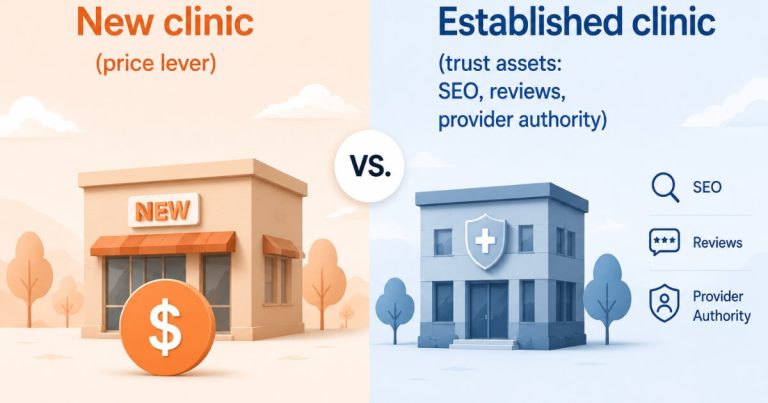
Why are established regenerative medicine practices less price-sensitive than newer clinics?
Because they’ve accumulated the one asset that overrides price in regenerative medicine: trust.
Stem cell, PRP, and regenerative pain patients are different from any other cash-pay buyer.
They’re skeptical, they research for weeks, and they’ve seen the overhyped claims that give the field a bad name.
So they gravitate to the clinic that feels the most credible and honest — visible provider expertise, real education, strong reviews, and a track record.
An established practice has all of that.
Its patients are choosing it for reasons that have nothing to do with being the lowest number on a quote.
A new clinic has none of that yet, so price is the only lever it can pull.
The exact same treatment can command a premium at a trusted practice and barely move at a discount at an unknown one.
This is why mature regenerative clinics convert high-ticket cases at rates new clinics can’t touch — Orthobiologics Associates booked at a 79.4% conversion rate from SEO leads alone.
When trust does the selling, price stops being the deciding factor.
Does this mean an established regenerative practice should stop running discount offers?
Largely, yes — discounting is usually the wrong lever for a practice that has already earned trust.
Once patients are choosing you for credibility, a deep discount does two damaging things:
- It signals that your work is a commodity that competes on price, undercutting the exact premium positioning you spent years building.
- It attracts price-shoppers — patients who churn, haggle, and refer other price-shoppers.
You end up working harder for worse patients.
There’s still a smart, narrow role for offers.
A no-brainer first step — a single-joint trial, a discounted diagnostic, a free consult — can lower the barrier to the first appointment without cheapening the core program.
But that’s a front-door tactic, not a strategy.
The strategy for an established regenerative practice is the durable, trust-first stem cell clinic marketing that makes patients want you at full price.
A new clinic discounts because it has no other lever.
An established clinic that keeps discounting is leaving margin and positioning on the table.
What should an established regenerative or stem cell practice spend its marketing budget on instead of discounts?
On the assets that make patients choose you regardless of price — the ones that compound for years.
That means:
- SEO and Google My Business so you rank for the conditions and treatments your patients actually search.
- Education-led content that answers their questions honestly and demonstrates real expertise.
- Visible provider authority through video and thought leadership.
- Reviews and proof that are easy to find.
- A conversion system that turns a researching, skeptical prospect into a booked case.
This is durable spend.
It compounds, it lowers your cost per patient over time, and — unlike paid ads for stem cell or PRP — it can’t be disapproved off a platform overnight.
The proof is in what trust assets produce.
Orthobiologics generated $309,590 in cash-pay revenue in 10 months from SEO alone, with zero ad spend.
On the authority side, we helped Dr. Joy Kong become the #1 stem cell expert on YouTube, hire four more doctors, and scale herself out of the business — because visible expertise is the ultimate trust-builder in this category.
Neither result came from a discount.
How do you market a regenerative practice when patients aren’t choosing on price?
You market on outcome, credibility, and confidence — never on the lowest number.
Lead with the specific condition and the result the patient actually wants:
- Lasting relief without drugs or surgery.
- Getting back to the life they had before the pain.
Demonstrate provider expertise visibly — patients want to see the doctor who will treat them and believe that person is a genuine authority.
Publish honest education that answers the questions a skeptical researcher is already typing into Google, ChatGPT, and YouTube.
And make the proof — reviews, outcomes, credentials — impossible to miss.
Then build a consult process that anchors on value and books the case with confidence instead of apologizing for the price.
When your marketing has already established that you are the credible expert, the price conversation stops being an objection and becomes a qualification step.
The patient isn’t asking “why are you more expensive?” — they’re asking “how do I get started?”
What’s the biggest marketing mistake established regenerative practices make?
Marketing like they’re still new — leading with discounts and aggressive offers long after they’ve earned the right to lead with authority.
It’s an easy trap.
Discounting worked in year one, so it becomes a reflex.
But the practice has changed even if the marketing hasn’t.
A clinic with a real reputation, a wall of reviews, and a recognized provider that keeps running “$500 off” as its primary message is actively training the market to see it as a commodity.
Worse, it’s spending budget on a lever that erodes the premium instead of on the trust assets that protect it.
The fix is to let your marketing grow up with your practice.
Audit what your top-of-funnel message actually leads with.
If it’s price, you’re competing in the new-clinic arena you’ve already outgrown.
Shift the spend toward SEO, education, provider authority, and conversion — and let the established practices that are less price-sensitive stay that way on purpose.
FAQ’s About Marketing an Established Regenerative Medicine Practice
Why are established regenerative medicine practices less price-sensitive than newer clinics?
Because they have accumulated the one asset that overrides price in regenerative medicine: trust.
Stem cell, PRP, and regenerative pain patients are skeptical and research for weeks, so they gravitate to the clinic that feels the most credible — visible provider expertise, real education, strong reviews, and a track record.
An established practice has all of that, so its patients are choosing it for reasons unrelated to being the cheapest.
A new clinic has none of it yet, so price is the only lever it can pull.
That is why mature regenerative clinics convert high-ticket cases at high rates — Orthobiologics Associates booked at a 79.4% conversion rate from SEO leads alone — while new clinics feel forced to discount.
Does this mean an established regenerative practice should stop running discount offers?
Largely, yes — discounting is usually the wrong lever for a practice that has earned trust.
A deep discount signals that your work is a commodity and attracts price-shoppers who churn and refer other price-shoppers.
The better move is to invest in the assets that compound your premium position — SEO, education content, reviews, provider visibility, and a value-based conversion process.
There are smart, narrow roles for a no-brainer first step, but the strategy should be trust, not price.
What should an established regenerative or stem cell practice spend its marketing budget on instead of discounts?
On the assets that make patients choose you regardless of price:
- SEO and Google My Business
- Education-led content that demonstrates expertise
- Visible provider authority through video and thought leadership
- Reviews and proof
- A conversion system that books researching prospects
This is durable spend that compounds for years and can’t be disapproved like paid ads.
Orthobiologics generated $309,590 in 10 months from SEO alone with zero ad spend, and Dr. Joy Kong became the number-one stem cell expert on YouTube and used that authority to scale her practice.
How do you know your regenerative practice has earned the right to charge premium prices?
You’ve earned it when patients find and choose you before any price is discussed — when leads arrive already educated, already convinced of your expertise, and asking how to get started rather than how your price compares.
Concretely, that shows up as:
- Inbound organic leads
- A high consult-to-booking conversion rate
- Reviews that mention your expertise by name
- Patients who travel to see you
If you’re still winning mainly because you were cheapest, the trust assets aren’t built yet.
What’s the next step?
If you run an established stem cell, regenerative, or pain practice and your marketing still leads with discounts, you’re competing in an arena you’ve already outgrown.
The patients you want aren’t choosing on price — they’re choosing on trust.
The job is to point every marketing dollar at the assets that compound that trust:
- Ranking for the right queries
- Publishing honest education
- Making your provider authority visible
- Converting researchers with confidence
That’s exactly the system behind results like $309,590 in cash-pay revenue in 10 months from SEO alone, at a 79.4% conversion rate.
If you want someone to map where the leverage is in your practice — what to stop discounting and what to invest in instead — that’s the conversation to book.