
Is My Clinic’s Lead Problem a Marketing Problem or a People Problem? (The Daily Follow-Up System That Converts the Leads You Already Have)
When a clinic isn’t growing, the owner’s first instinct is usually “I need more leads” or “I need a better marketing agency.” But if leads are coming in and few of them convert, more marketing won’t fix anything. It will only pile more uncontacted prospects on top of the ones already going cold. The constraint isn’t the top of the funnel. It’s that nobody owns the daily follow-up. Here’s how to tell which problem you actually have, and the system that fixes it.
Is my lead conversion problem a marketing problem or a people problem?
More often than owners expect, it’s a people problem. If you already have a CRM and a defined follow-up cadence, but leads still aren’t being worked, the constraint isn’t your marketing. It’s that no one is reliably executing the follow-up every day.
The diagnostic is straightforward. Are leads actually coming in? If yes, you don’t have a top-of-funnel problem. Are they sitting uncontacted in your pipeline a few days later? If yes, you have a follow-up ownership problem.
The most common version is easy to spot. The owner is doing half of an admin’s job plus all of her own. She’s drawing up meds, giving shots, answering phones, and checking patients out. Lead follow-up gets whatever scraps of time are left. That is never enough. The leads pile up, not because the system is wrong, but because no single person owns running it.
That reframe matters because the fixes are completely different. A marketing problem is solved with more or better lead generation. A people problem is solved by assigning one accountable owner. Pouring more leads onto a people problem just wastes money. This is the part of a predictable patient acquisition system that clinics most often skip.
Why aren’t my leads converting even though we get plenty of them?
Because they’re piling up unworked in the later stages of your pipeline. They are contacted once, then abandoned, while the one person responsible juggles clinical and front-desk duties at the same time.
Picture the typical breakdown. Leads land in a “Day 1” stage. The owner works a few between patients. However, the “Day 2” and “Day 3” stages fill faster than anyone can clear them. The leads that need a second or third touch never get it. That is where most conversions actually happen.
It looks like a conversion problem on the dashboard. Underneath, it’s a capacity-and-ownership problem. High lead volume on top of no dedicated owner only produces a bigger backlog of cold prospects.
The leads you already paid to generate are the cheapest patients available to you. Letting them die in stage two is the most expensive thing a growing clinic quietly does.
What’s the right daily follow-up cadence for new patient leads?
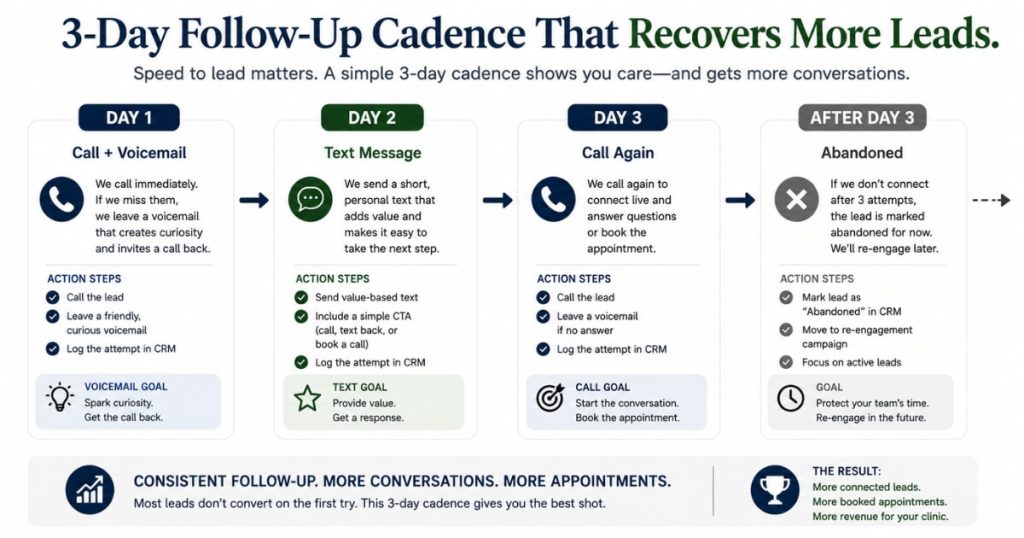
Use a simple, fixed three-touch sequence. On Day 1, call and leave a voicemail. Then on Day 2, send a follow-up text. Finally, on Day 3, call again. If there’s no response after three days of real effort, move the lead to an “abandoned” stage. It can re-enter later if they come back.
This is the same playbook the best franchise front desks run. It works because it’s simple and relentless. The non-negotiable part is that it happens every single day, in order. It cannot happen only when someone finally has time. That approach is usually days late and defeats the entire purpose.
Continuity is the whole game. A lead worked on the right day converts. The same lead worked a week later is gone. A dead lead in the abandoned stage costs nothing. A live lead you didn’t touch on Day 2 costs you a patient.
Keep the cadence boring and consistent. The magic isn’t a clever script. It’s that someone runs the same three touches, on schedule, for every lead, every day.
Should I hire someone just to handle lead follow-up, or can my existing staff do it?
For most growing cash-pay clinics, lead follow-up should be a dedicated role. It should not be a side task bolted onto clinical or front-desk staff who will always deprioritize it.
There’s a human reason existing staff don’t do it. Most people avoid sales calls because they’re afraid of sounding unsure. As a result, leads quietly go cold. The owner often ends up as the only one calling. That doesn’t scale.
A dedicated person removes the bottleneck. This can be an affordable hire whose entire job is calling, texting, and converting leads daily. The work is self-contained. The person makes the outreach, moves the lead to the next stage, and repeats. It doesn’t require constant back-and-forth with anyone else. That is exactly why one owner can be the constraint and one focused hire can unblock the whole funnel.
The framing that helps owners commit is simple. The challenge isn’t building a role for a person you already have. It’s finding the right person for the role. Define the job explicitly. Ask whether the candidate can do it. If not, find someone who will.
Should my virtual admin or my in-person staff handle lead follow-up?
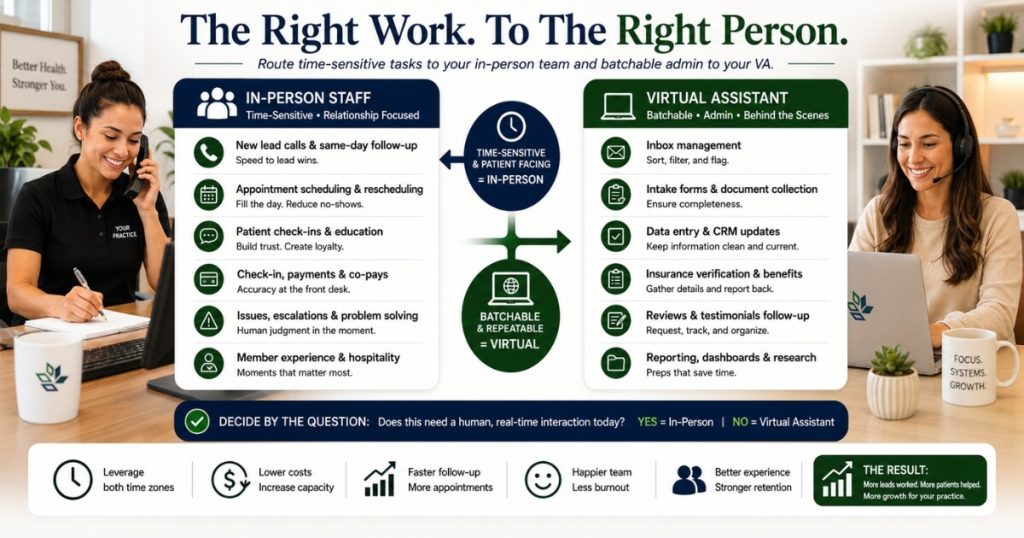
Daily lead follow-up needs someone present and consistent every day. That makes it a poor fit for a part-time, fully remote admin who travels. Route time-sensitive work to in-person staff. Reserve the virtual person for batchable back-office tasks.
The principle is to sort work by how time-sensitive it is. Same-day, real-time tasks belong to in-person staff. This includes lead calls, lab orders, and pharmacy calls. They can act on them the same hour.
Batchable work that survives a missed day is perfect for a virtual assistant. This includes payroll, reconciliations, weekly reports, and tracking that memberships and payments are going through.
When a remote person dips into time-sensitive lead work a few days late, it confuses the in-house team. The leads still go cold. Matching the task to the right kind of worker is half the fix.
Stop stretching one person across everything. Split the work by urgency. Give the daily follow-up to someone who’s there daily. Let the virtual admin own the things that can wait.
How do I stop leads from falling through the cracks in my CRM?
The CRM isn’t the problem. The missing piece is a person committed to working the pipeline stages every day, in order. Don’t swap tools. Assign an owner.
Set clear stages: Day 1, Day 2, Day 3, Contacted, and Abandoned. Have one owner move leads through them on a daily cadence. This includes re-contacting everyone sitting in “Contacted” who hasn’t been touched.
Software organizes the work and reminds you it exists. However, only consistent daily human follow-up actually converts it. Clinics burn months evaluating new CRMs. In many cases, their current one is perfectly capable. The real gap is that nobody is running it every day.
If your leads live in a system but go cold anyway, resist the urge to buy different software. Assign the owner. Install the daily cadence. Then watch the conversion rate move on the leads you already have. It’s the same discipline behind clinics like Orthobiologics Associates, which converted 79.4% of its leads to booked appointments.
FAQs About Lead Follow-Up and Conversion
Is my lead conversion problem a marketing problem or a people problem?
Usually a people problem if leads are coming in but sitting uncontacted in your pipeline. A marketing problem means too few leads. A people problem means leads aren’t being worked. Pouring more leads onto a people problem just grows the backlog. Assign a dedicated daily owner instead.
What’s the best follow-up cadence for new patient leads?
A fixed three-touch sequence: Day 1 call plus voicemail, Day 2 follow-up text, Day 3 call, then move to abandoned if there’s no response. The key is running it every single day in order. Catching up days late allows leads to go cold.
Should I hire a dedicated person for lead follow-up?
For most growing clinics, yes. Existing clinical and front-desk staff avoid sales calls and deprioritize follow-up, so leads die. A dedicated person whose only job is calling, texting, and converting leads daily removes the bottleneck. The work is self-contained and requires little coordination.
Should a virtual assistant or in-person staff handle lead follow-up?
In-person staff, because daily follow-up needs someone present and consistent every day. Reserve a remote, part-time admin for batchable back-office work like payroll, reconciliations, and reporting that survives a missed day. Match the task to how time-sensitive it is.
Do I need a new CRM to stop losing leads?
Almost never. If leads go cold in a CRM you already have, the gap is an owner working the stages daily, not the software. Set clear pipeline stages. Assign one person to advance leads every day. Re-contact anyone stuck in “Contacted.”
What’s the next step?
If your clinic gets leads but few of them convert, run the diagnostic before you spend another dollar on marketing. Are leads coming in but going cold in the pipeline? That’s a people problem. More ads will only make the backlog bigger.
The fix is a dedicated daily owner, a fixed three-touch cadence, and a clean split between time-sensitive and batchable work.
If you want help diagnosing your funnel and installing the follow-up system, that’s the conversation to book. We’ll help with the cadence, the role, and the pipeline discipline. It’s the same conversion work behind clinics like Orthobiologics Associates, which booked 79.4% of its leads with zero ad spend. We’ll find where your leads are leaking on the call. It’s the heart of a working patient acquisition system.